Preston Tower: A Fortified Hamilton Residence in Scotland


Site at a Glance
- Rating
- 4.5
- Popularity
- Low
- Country
- United Kingdom
- Primary era
- Medieval
- External website
- Open
- Eras represented
- Medieval, Early Modern
- Civilizations
- Kingdom of Scotland
- Site type
- Military
- Remains
- Castle
On this page12 sections
History
Preston Tower is a ruined fortified residence in Prestonpans, Scotland, United Kingdom, generally dated to the fifteenth century and built as a tower house, a tall stone residence designed for both domestic occupation and defence. It stood as the seat of the Preston branch of the Hamilton family, whose estate occupied an important place in the history of the surrounding community.
Before and during Hamilton ownership
Preston had earlier associations with the Seton and Liddle families, while local tradition also connects the estate with the Home family. Through marriage, the property passed to the Hamiltons at the end of the fourteenth century. The precise date of the tower’s construction remains uncertain, although parts of its original fabric may belong to the fourteenth century and the building is generally assigned to the following century.
The tower was drawn into the Anglo-Scottish conflicts known as the Rough Wooing, a series of sixteenth-century wars arising from Henry VIII’s attempt to force a marriage between his son Edward and Mary, Queen of Scots. On 16 May 1544, Edward Seymour, Earl of Hertford, burned Preston Tower after his forces had burned Edinburgh. David Hamilton of Preston had accompanied James V to France in 1536, later served as Master Usher to Regent Arran, and acted as a deputy warden of the Middle March on the English border.
The Preston estate also included a coal mine. John Hamilton transported coal by boat to Dunbar Castle, while Preston supplied building lime and other materials for the forts at Eyemouth and Inchkeith. In 1555 and 1558, during the regency of Mary of Guise, Hamilton and the inhabitants of Prestonpans and Tranent were asked to accommodate and feed French troops preparing for an anticipated English invasion.
Political and social changes
A Hamilton of Preston fought for Mary, Queen of Scots, at the Battle of Langside. Mary ruled Scotland from 1542 to 1567 and was defeated at Langside in 1568. The Hamilton’s son, described as the younger laird of Preston, was captured and imprisoned after the battle.
In 1617, James VI and I granted Preston and Prestonpans the status of a free barony for John Hamilton, the grandson of George Hamilton, and John’s wife, Jean Otterburn. A free barony was a Scottish feudal status that could include local jurisdiction and defined legal or market privileges. The grant allowed the holding of St Jerome’s Fair for three days each October and included permission to rebuild the harbour.
John Hamilton and the Earl of Lothian presided over the trial of John Hunter, a blacksmith accused of stealing iron ploughshares and fittings from neighbouring farms for scrap metal. John Hamilton later married Katherine Howison, and the initials of the couple were carved on the tower.
Seventeenth-century destruction and abandonment
The Hamiltons began constructing nearby Hamilton House in 1628. Four years earlier, in 1626, the tower had received a substantial upward addition. Preston Tower was later burned by Oliver Cromwell’s troops in 1650 during the Wars of the Three Kingdoms, conflicts that involved struggles over the political and religious government of Britain. The fire apparently destroyed the family records.
After the tower was restored, an accidental fire damaged it again in 1663. The family then abandoned the building in favour of the nearby Preston House. The Hamilton family was raised to the baronetage of Nova Scotia in 1673, a hereditary British title distinct from a peerage, but the family was forfeited in 1684. Its properties were recovered in the nineteenth century.
Robert Hamilton, a prominent Covenanter and commander at Drumclog and Bothwell Brig, was the last member of the Preston branch. Covenanters were Scottish Protestants who opposed royal interference in Presbyterian church government. Robert Hamilton died in 1701.
Conservation and later recognition
Preston Tower was consolidated in 1936, purchased by the National Trust for Scotland in 1969, and restored in 2004–05. It remains under the guardianship of East Lothian Council. The tower and its associated dovecot are protected as a scheduled monument. The building was also protected as a listed building from 1936 and received Scotland’s highest listing category, Category A, in 1971; that listing was removed in 2015.
In 2026, Preston Tower, the dovecot, and the gardens received one of the annual awards of the Royal Incorporation of Architects in Scotland. The citation praised the site’s careful heritage stewardship and its continuing social importance to the local community. A separate tradition says that a Green Lady, a folkloric female apparition, haunts the tower.
Remains
Preston Tower survives as an L-plan tower house or keep built from red-sandstone rubble masonry. Its two wings meet at right angles, and the walls reach up to 2 metres in thickness. The original building rose through four storeys. In 1626, approximately 6.4 metres of additional building was placed above the parapet, creating a six-storey structure approximately 20.4 metres high. This upper work was designed in the Renaissance style.
The tower house
Renaissance upper addition
The upper addition contains Renaissance windows carrying the initials “SIDKH,” representing Sir John and Dame Katherine Hamilton. Its parapet projects outward and is openworked at the corners. Crenellations and a continuous wall-walk complete the defensive treatment. A parapet is a low protective wall along the edge of a roof or platform, while a wall-walk is a passage running behind or along such a wall.
Entrance and internal spaces
The entrance is positioned on the first floor within a semicircular projecting turret at the inner angle of the L-shaped plan. An external wooden stair once provided access. The entrance was protected by a lean-to hoarding, a projecting wooden defensive structure from which defenders could drop boulders, hot sand, or boiling oil onto attackers.
Inside, the ground floor has a barrel-vaulted ceiling, and the higher hall has a half-vault. A vaulted basement near the entrance contains a pit prison with an iron gate. A pit prison was a confinement chamber, often below ground. The Preston Merkat Cross was later used as the local prison.
Enclosing features and gardens
Dovecot and enclosing wall
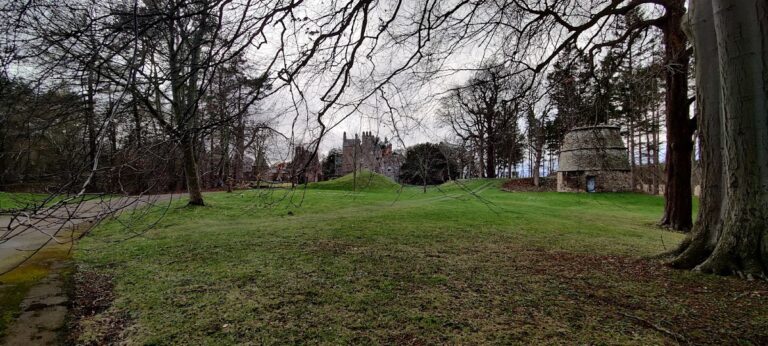
The surviving enclosing wall preserves part of the setting around the tower. The associated dovecot is a lectern-style structure dating from the middle of the seventeenth century, after Cromwell’s troops had sacked the tower. Dovecots were buildings designed to house domestic pigeons, and this one remains part of the surviving group of structures connected with the estate.
Grounds
The grounds include a laburnum arch and a herb garden. Together with the tower, enclosing wall, and dovecot, these features form the preserved physical setting of the former Hamilton residence.