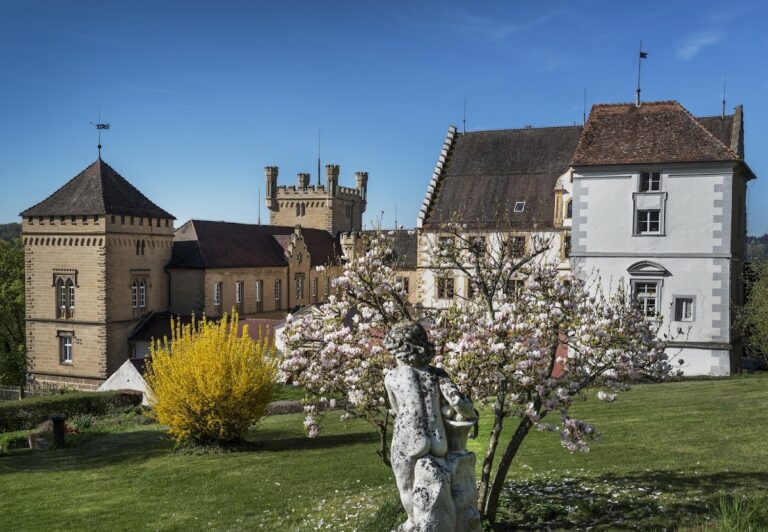
Wehrstein Castle: A Medieval Hilltop Castle Ruin in Germany


Site at a Glance
- Rating
- 4.4
- Popularity
- Low
- Country
- Germany
- Primary era
- Medieval
- External website
- Open
- Eras represented
- Medieval
- Civilizations
- Holy Roman Empire
- Site type
- Military
- Remains
- Castle
On this page6 sections
History
Wehrstein Castle is a hilltop castle ruin above Fischingen near Sulz am Neckar in Germany. Its traditional history reaches back to 752, when Charlemagne, the Frankish ruler who became emperor in 800, is said to have met his Swabian wife Hildegard there. The nearby settlements of Fischingen and Empfingen were first mentioned in 772.
The Lords of Wehrstein
The noble family of Wehrstein entered the historical record around 1100, when Marquard of Wehrstein and his wife, Gepa, donated property to Hirsau Abbey, an influential Benedictine monastery in southwestern Germany. From about the same period, the family used a golden anchor as its coat of arms. A later tradition linked the emblem to the rescue of a Wehrstein nobleman who had supposedly joined a crusade with Frederick Barbarossa, the twelfth-century Holy Roman Emperor, and survived a storm at sea.
The Lords of Wehrstein are known from 1101 until about 1395. Their lordship covered the castle and its estate, together with Fischingen, Betra, and Empfingen. The territory was initially held as a fief from the Counts Palatine of Tübingen, meaning that it was granted in return for allegiance and recognized obligations. It later became a fief of the Counts of Hohenberg and, from 1381, an Austrian fief.
Hiltibold of Wehrstein became abbot of St. Gall in 1318. Although the family probably ended with the death of Benz of Wehrstein in 1409, the Counts of Hohenberg had already been recorded as owners of the castle in 1331. They therefore assumed control of the lordship and its associated settlements.
Hohenberg and Austrian overlordship
In 1373 the Counts of Hohenberg pledged the lordship to the Lords of Weitingen, who enlarged the castle after receiving control of it. Duke Leopold of Austria purchased the Hohenberg possessions in 1381, making Wehrstein an Austrian fief. Austria retained the superior feudal claim until the early nineteenth century, while other lords held or administered the territory.
In 1400 the lordship was pledged to Burkard of Mansperg, whose ancestral castle stood at Mansberg near Kirchheim unter Teck. The pledge soon became a fief, and the Lords of Weitingen reacquired the lordship in that capacity in 1419. Wehrstein survived the German Peasants’ War of 1525 without damage.
Hohenzollern rule and wartime destruction
Count Christoph of Nellenburg-Tengen acquired the lordship in 1528 and died in 1539. In 1552 Jos Niklas II of Zollern purchased it for his cousin, Count Karl I of Hohenzollern. A Hohenzollern inheritance agreement in 1575 assigned Wehrstein to the Hohenzollern-Haigerloch branch. Until 1585, a bailiff, an official governing a territory for its superior lord, administered the lordship from the castle.
When the Hohenzollern-Wehrstein and Haigerloch line died out in 1634, Wehrstein passed to Hohenzollern-Sigmaringen rather than Hohenzollern-Hechingen. During the Thirty Years’ War, the major European conflict of 1618 to 1648, Bavarian forces almost completely destroyed the castle in 1643. The complex was later rebuilt.
Demolition and preservation
The Peace of Pressburg, the 1805 treaty that ended the War of the Third Coalition and reshaped political control in Central Europe, brought Austrian feudal overlordship to an end. Wehrstein became the full possession of Hohenzollern-Sigmaringen. Fischingen and Betra were initially placed in the Oberamt Glatt administrative district, which was incorporated into Oberamt Haigerloch in 1854.
Structural deterioration led to the demolition of the castle around 1830. Larger repairs were carried out at the ruins in 1842, and Prince Karl Anton of Hohenzollern-Sigmaringen took measures to protect them from further decay. The Friends of Wehrstein Castle Ruins was founded in 2003 to help prevent additional deterioration. In June 2006, the ruins were purchased by Alois Gfrörer, who owned a gravel works in Empfingen. The Baden-Württemberg Monument Foundation named Wehrstein its Monument of the Month in February 2011.
Remains
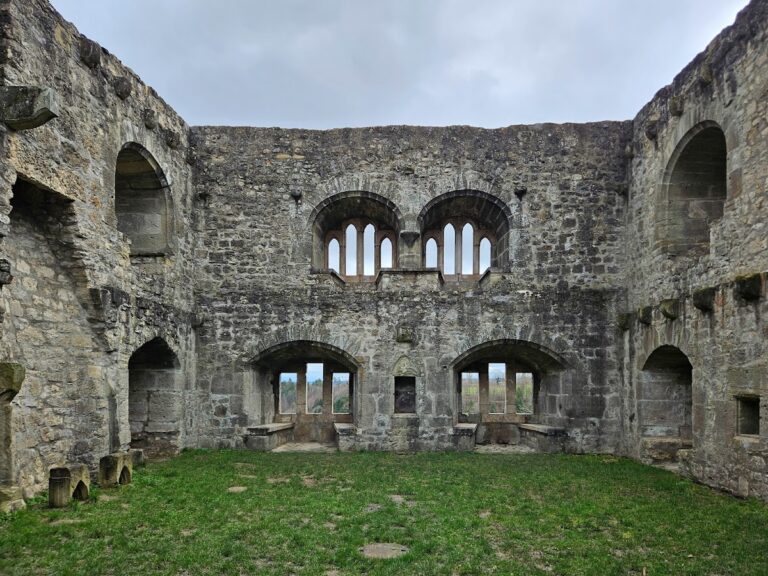
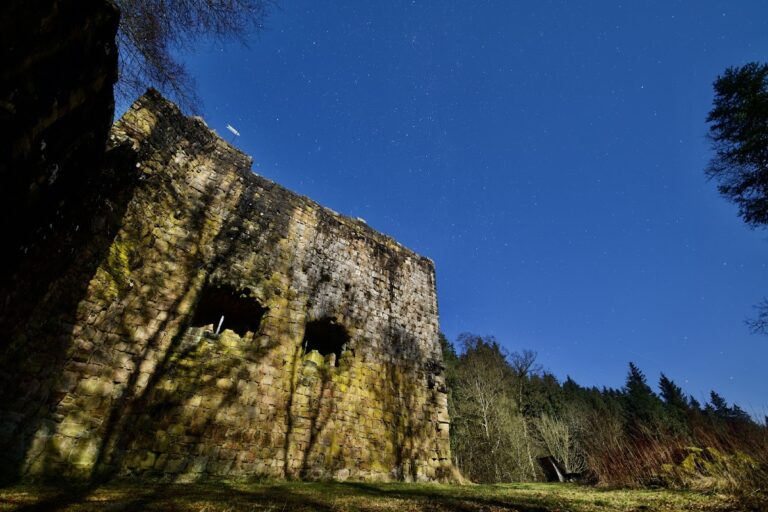
Wehrstein survives as the remains of a former free-noble hilltop castle above Fischingen. Free nobles were medieval nobles who held their status and lands without being subordinate vassals of another noble lord. The complex comprised the castle and the associated Wehrstein estate, and its form was enlarged under the Lords of Weitingen after 1373. The surviving fabric reflects the site’s destruction in 1643, later rebuilding, deterioration, and the repairs undertaken in 1842. No detailed plan, dimensions, building materials, individual rooms, gates, towers, or other specific architectural components are available.