Okopy Castle: A Baroque Frontier Fortress in Ukraine


Site at a Glance
- Rating
- 4.7
- Popularity
- Low
- Country
- Ukraine
- Primary era
- Early Modern
- External website
- Open
- Eras represented
- Classical, Medieval, Early Modern
- Civilizations
- Polish–Lithuanian Commonwealth
- Site type
- Military
- Remains
- Fort
On this page13 sections
History
Okopy Castle is a Baroque fortress in Ukraine, built under the Polish-Lithuanian Commonwealth in 1692 as a frontier defense against the Ottoman Empire. It occupies a steep promontory where the Zbruch River meets the Dniester, a position that enabled its garrison to control a nearby river crossing and roads toward Kamianets-Podilskyi. The fortress formed part of the Commonwealth’s southeastern defensive line and was intended to obstruct Ottoman communications and supply movements.
Earlier Fortifications
The promontory had a long history of fortified occupation. Archaeological investigations identified wooden defenses associated with the Antes, an early medieval people linked with the lands north of the lower Danube and the Black Sea, dating from the third to the fifth centuries. Later remains relate to the Tivertsi, an early medieval East Slavic tribal group, in the sixth to ninth centuries, and to medieval Rus’, the East Slavic political and cultural world centered on Kyivan Rus’ and its successor principalities, from the tenth to the thirteenth centuries.
In 1664, General Marcin Kazimierz Kątski built an earlier fortification on his estate. It followed a design by Guillaume Le Vasseur de Beauplan, a French architect known for work on fortifications in the Polish-Lithuanian Commonwealth. This earlier work preceded the fortress that survives in the historical record as Okopy Castle.
Foundation and Ottoman War
Construction of the present fortress began on 25 March 1692 and continued from March through October. Crown Grand Hetman Stanisław Jan Jabłonowski, a Polish military commander and senior Commonwealth officer, financed the project himself. He also brought the site to the attention of King John III Sobieski, who ruled Poland and Lithuania from 1674 to 1696. The Dutch-born architect Tylman van Gameren designed the fortress, while General of Crown Artillery Marcin Kątski directed its construction.
Okopy was established during the Commonwealth’s war with the Ottoman Empire to interrupt the connection between the Ottoman garrison at Kamianets-Podilskyi and Moldavia. Its position, about 20 kilometres from Kamianets-Podilskyi and about 6.5 kilometres from Khotyn, placed it near important military routes. Together with the Virgin Mary’s Redoubt, approximately 43 kilometres to the west, it was intended to contain Ottoman forces operating from Khotyn and Kamianets-Podilskyi.
The fortress served as a support point for the Polish blockade of the Ottoman forces at Kamianets. Its troops controlled the nearby Dniester ford and roads leading toward Kamianets-Podilskyi, intercepted food and ammunition moving to the besieged garrison, and attacked Ottoman detachments operating from Kamianets and Khotyn.
Garrison and Frontier Service
Jabłonowski organized the garrison in 1692 and appointed its commanders. Michał Brandt led the foreign-enlisted troops, which included 11 companies of arquebusiers, 1,500 infantrymen, and 100 dragoons. Jakub Kalinowski commanded the national-style cavalry, arranged in 18 banners, or mounted units: 13 armored and 5 Wallachian. The planned garrison contained about 4,000 soldiers and 18 cannons.
Kalinowski was temporarily replaced by Chomentowski in September 1693 and by Konstanty Zahorowski from October of that year. The cavalry force was reduced in late August 1693, when three armored banners and one Wallachian banner moved to the newly built Virgin Mary’s Redoubt near Wasilów. Difficult service conditions meant that seconded cavalrymen were generally expected to serve for about a year before replacement. A double hibernium, an allowance supplementing their pay, was used to encourage continued service.
Settlement and Later Conflicts
The blockade of Kamianets continued from 1692 until 1699. The Treaty of Karlowitz, concluded in 1699, ended the Ottoman-Polish conflict and returned Kamianets-Podilskyi and Podolia to the Polish-Lithuanian Commonwealth. Okopy consequently lost much of its military importance. On 18 September 1699, a thanksgiving Mass was held at the fortress for exiles from Podolia and Kamianets who were returning to their lands after 27 years.
In 1700, King August II granted town rights and fair privileges to the settlement near the fortress, including permission to hold two fairs. In 1711, an Ottoman army and a Swedish army led by Charles XII threatened Poland from the direction of Wallachia. Okopy and Kamianets were then hastily prepared for defense, and their walls were strengthened.
The fortress again became a battlefield during the Bar Confederation, an armed Polish movement formed in 1768 to oppose Russian influence and defend the political and religious privileges of the Commonwealth’s nobility. On 8 March 1769, Casimir Pulaski, a Polish nobleman and military commander, defended Okopy for three hours against Russian attacks. About 200 defenders were killed. Pulaski withdrew across the Dniester with some of his soldiers, while other defenders died in the ruins of the burned church or were taken prisoner. The fighting severely damaged the walls.
Decline and Commemoration
After the territory came under Habsburg rule, part of the ramparts was dismantled in 1772. Restoration took place in 1870–1874 and again in 1905, when the Polish Society of Antiquities Enthusiasts carried out the work. The fortress was destroyed in 1915. During the interwar Polish period, the Border Protection Corps, a military formation responsible for guarding the eastern and southeastern frontiers, maintained a watch post called “Holy Trinity Trenches” at Okopy.
A Roman Catholic church within the castle complex, built in 1700, was burned by a unit of the Ukrainian Insurgent Army in 1943. It remained ruined until 2012, when a Holy Trinity parish was re-established and reconstruction began. The church was reconsecrated on 14 June 2014. The name “Holy Trinity Trenches” also appears in Zygmunt Krasiński’s The Undivine Comedy, where it identifies the last stronghold of the aristocracy. Okopy Castle is designated an architectural monument of national importance in Ukraine.
Remains
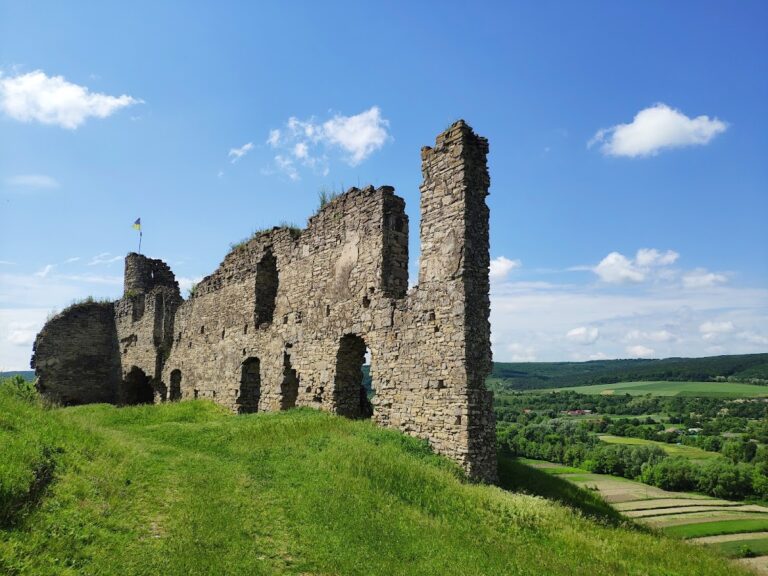
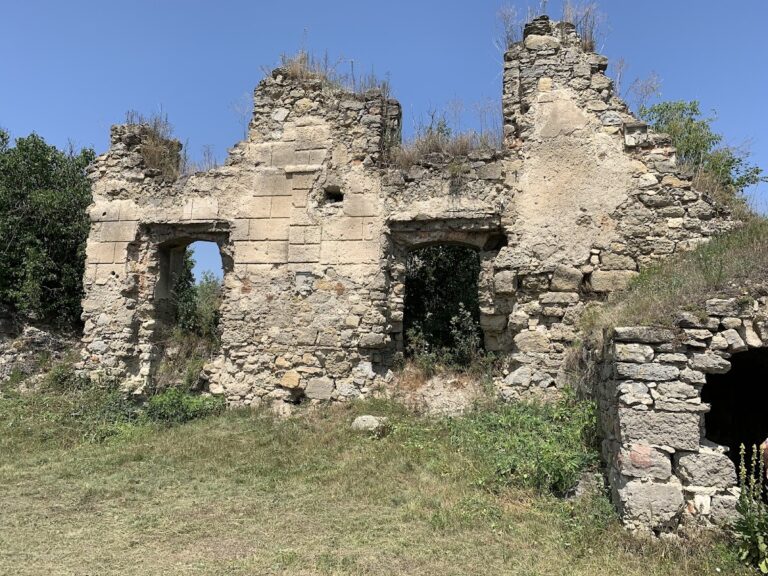
Okopy Castle occupies a narrow, steep promontory above the meeting of the Zbruch and Dniester rivers. The fortress was built as a Baroque bastion fortification, using stone, including limestone. Its defenses followed the shape of the ground and incorporated projecting works designed to provide flanking fire along the walls. Surviving elements are in a ruined condition, with the principal entrance structures, earthen defenses, a watchtower, and the restored church conveying the organization of the former stronghold.
Defensive Lines and Entrances
Kamianets Gate
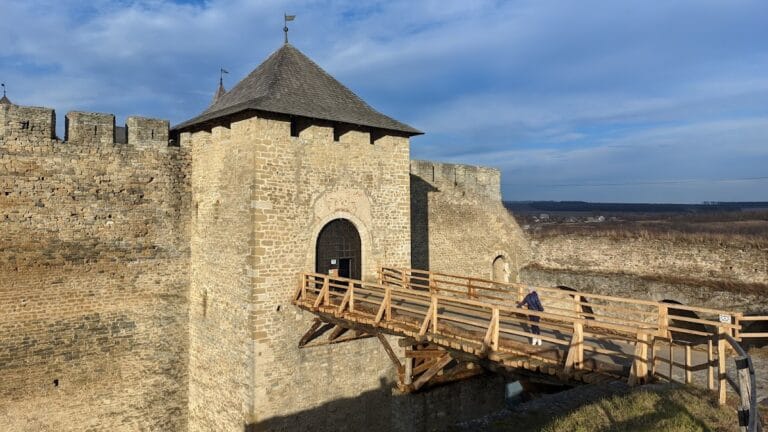
The eastern defensive line included one bastion and two half-bastions, each a projecting work with one full flanking side. The Kamianets Gate formed part of this line and was protected by a ravelin, an outer defensive work placed in front of a gate or wall. The surviving gate is a rectangular, two-tiered stone tower with cannon loopholes on its upper level. It measures approximately 12.3 metres in length and 8.0 metres in width, and rises to about 7.5 metres.
Lviv Gate
The western defensive line consisted of two half-bastions with the Lviv Gate between them. A ravelin provided additional protection in front of the entrance. Like the Kamianets Gate, the Lviv Gate survives as a rectangular, two-tiered tower with cannon loopholes on the upper level. It is approximately 10.4 metres long and 8.5 metres wide, with a height of about 7.5 metres. The two gates stand approximately 480 metres apart.
Outer Defenses and Church
Watchtower and Earthen Bastions
A partly ruined watchtower survives above the Zbruch. Near the gates, a system of earthen bastions preserves part of the fortress’s outer defensive arrangement. These works belonged to a system that guarded the promontory, the nearby ford across the Dniester, and the roads leading toward Kamianets-Podilskyi.
Holy Trinity Church
The castle complex included a Catholic church built in 1700. The restored building has wall polychromy, with a painted interior that forms part of the surviving architectural character of the complex. Its reconstruction followed the re-establishment of the Holy Trinity parish in 2012, and the church was reconsecrated in 2014.