Burgruine Rosenau: A Hilltop Castle Ruin in Germany


Site at a Glance
- Rating
- 4.3
- Popularity
- Low
- Country
- Germany
- Primary era
- Medieval
- Eras represented
- Medieval
- Civilizations
- Holy Roman Empire
- Site type
- Military
- Remains
- Castle
On this page6 sections
History
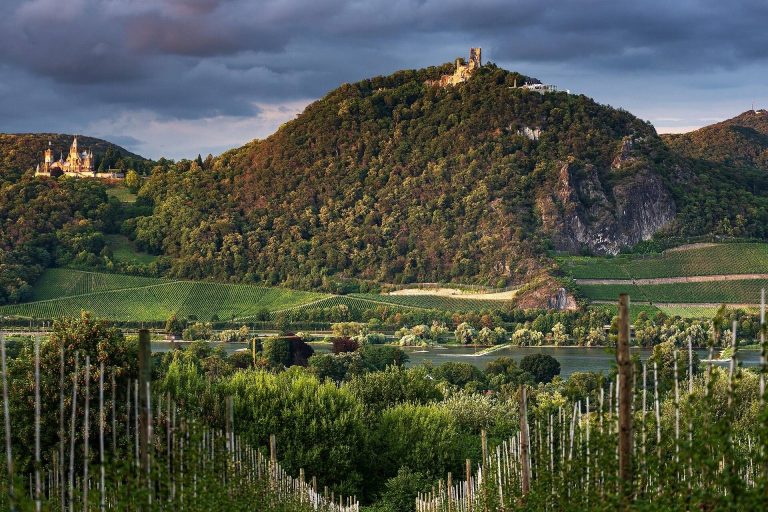
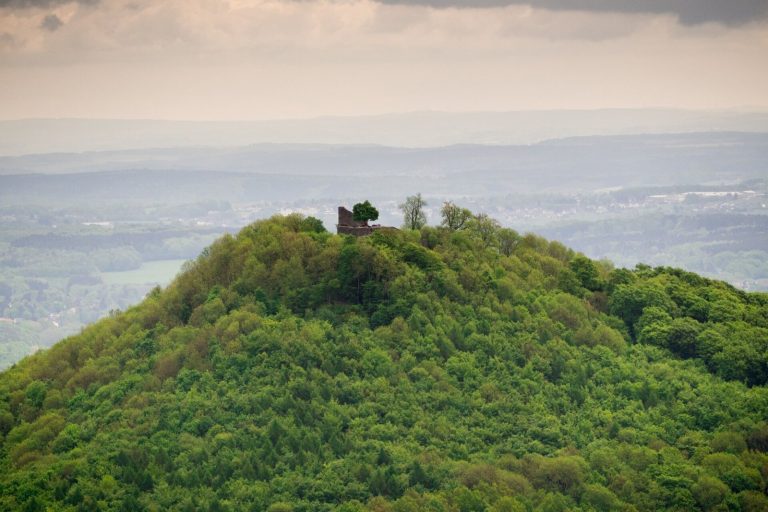
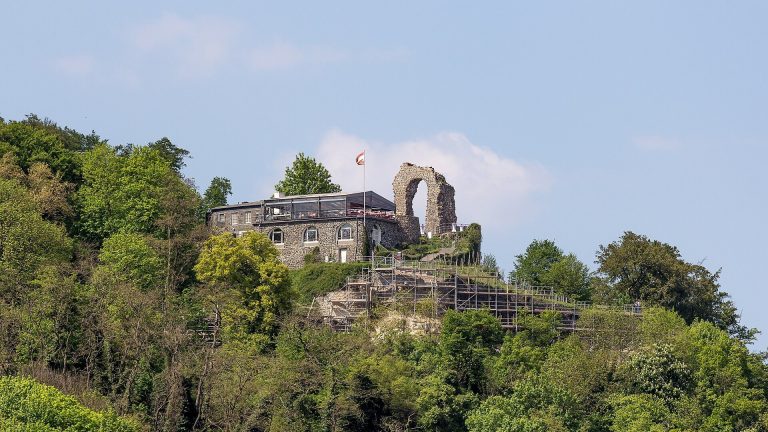
Burgruine Rosenau is a medieval hilltop castle ruin in Germany, situated in Königswinter on Rosenau Mountain in the Siebengebirge Nature Park. Its construction date is unknown, but the castle probably belonged to the Archdiocese of Cologne, an ecclesiastical territory governed by an archbishop. It formed part of a line of fortifications that protected the southern flank of the archbishopric, together with Rolandseck, Godesburg, Drachenfels, and Wolkenburg.
The Medieval Castle
A document dated 27 February 1222 names the castle and its owner, Dietrich von Dorndorf, a member of the lower nobility. After becoming lord of the castle, Dietrich also adopted the name Dietrich von Rosenau. Following his death, his widow Agnes sold Rosenau to Heisterbach Monastery in November 1243. The agreement gave the monastery the express right to destroy the castle, an unusual condition in a medieval property transfer.
A daughter-in-law of Agnes von Rosenau challenged the first sale, and a second contract was concluded in 1249. Heisterbach Monastery destroyed the castle around 1250. Its stones were probably reused as building material in the monastery buildings, ending Rosenau’s role as a fortified residence.
The Hotel and Wartime Destruction
By 1885, the nearby settlement of Rosenau had 20 inhabitants in three buildings. Between 1896 and 1898, the site owner Anselm Bachem commissioned a hotel on the former castle grounds. A short branch railway connected the construction site with the Heisterbach Valley Railway in May 1896, allowing building materials to reach Rosenau. The hotel shell was finished by the end of November that year, but its opening was delayed until 4 May 1898 after the west facade collapsed inward during construction.
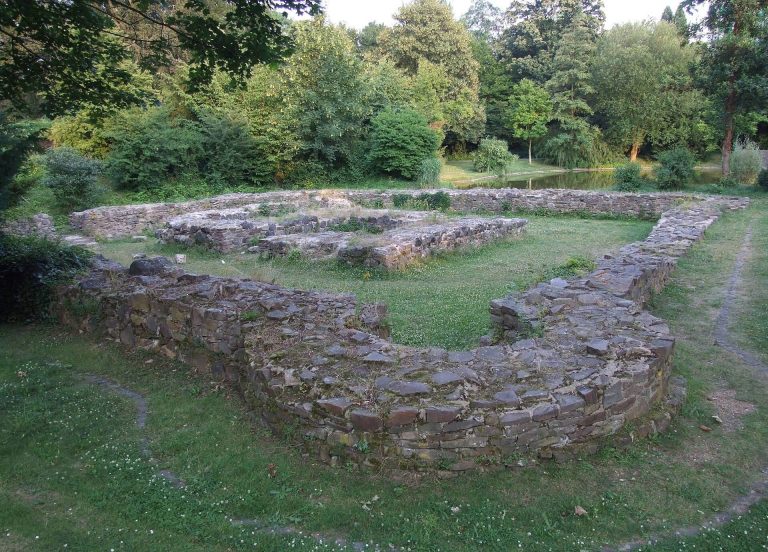
The former Stenzelberg cart track was converted into a road to improve the hotel’s connection with the surrounding area, opening on 1 April 1899. In 1902, work on paths and a pavilion exposed castle walls. Edmund Renard, the Rhenish provincial conservator responsible for historic monument preservation in the Rhine Province, described the remains as an elongated rectangle about 18 metres wide and 30 metres long.
After the Nazi seizure of power in 1933, a road from Heisterbacherrott to Rosenau was built as an employment-creation measure. Explosive bombs severely damaged the hotel on 4 February 1944 during the Second World War. IG Bergbau und Energie, then the hotel’s owner, had the building demolished in 1953.
Conservation
The surviving castle remains were secured in 1990 and 1991 through conservation work assisted by IG Bergbau und Energie, the state of North Rhine-Westphalia, and the city of Königswinter.
Remains
Castle Enclosure
Burgruine Rosenau occupies elevated ground on Rosenau Mountain, also called Große Rosenau, which rises to 322.1 metres above sea level between Nonnenstromberg and Großer Ölberg. The castle stood on an artificially created plateau, a relatively level surface formed above the surrounding terrain. Its surviving masonry consists of sections of a ring wall, an enclosing defensive wall around the fortified area, built from trachyte, a hard volcanic stone. The southern sections rise as high as 6 metres. The walls exposed in 1902 formed an elongated rectangle approximately 18 metres wide and 30 metres long, providing the clearest surviving outline of the former hilltop castle.