Wolfsburg Castle: A Medieval Hill Fortress in Germany



Site at a Glance
- Rating
- 4.6
- Popularity
- Low
- Country
- Germany
- Primary era
- Medieval
- External website
- Open
- Eras represented
- Medieval
- Civilizations
- Electoral Palatinate, Holy Roman Empire
- Site type
- Military
- Remains
- Castle
On this page11 sections
History
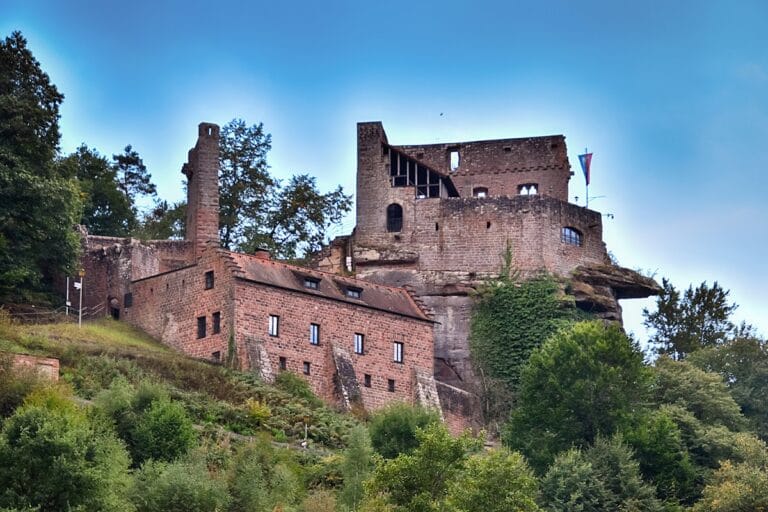
Wolfsburg Castle is a medieval hill castle in Neustadt an der Weinstraße, Germany, probably built by Count Palatine Ludwig the Kelheimer no later than the beginning of the thirteenth century. Its listed construction period is 1120–1300. Built on the southern spur of Wolfsberg, it protected the route from Neustadt to Kaiserslautern and its imperial palace.
Origins and Palatine Rule
The castle first appears in writing in 1255 as Castrum Volfperg, in a record that also names the town of Nova Civitas, now Neustadt. Albrecht von Lichtenstein later held Wolfsburg as a fief from Elector Ludwig the Strict. The terms of his tenure required him to live at the castle and prohibited him from leaving without the elector’s permission, with the threat of losing the fief if he disobeyed.
At the beginning of the fourteenth century, Emperor Ludwig the Bavarian temporarily pledged the castle. The Treaty of Pavia then divided the Wittelsbach territories between their Palatine and Bavarian branches. The Electoral Palatinate and the Upper Palatinate passed to the descendants of Count Palatine Rudolf I, Rudolf II, and Ruprecht I.
Governors, War, and Destruction
Until 1423, Wolfsburg was a residence for governors of the Palatinate electors. Along with Frankenstein Castle and Hardenburg, each about 15 kilometres away, it formed part of the defence of the former palatine territories. The governors were initially expected to remain at Wolfsburg. In return, they received money, wine, grain, hunting rights in the electoral forest, and permission to cut timber there for repairs.
During the German Peasants’ War in 1525, insurgents captured and plundered the castle twice within a short time. It was rebuilt after the uprising was suppressed. In the early years of the Thirty Years’ War, a major European conflict fought mainly between 1618 and 1648, Wolfsburg sheltered inhabitants from nearby settlements. Imperial troops burned and demolished it in 1635, and it remained a ruin thereafter.
Democratic Memory and Preservation
Wolfsburg also became associated with the democratic movement of the nineteenth century. During the March Revolution of 1848, a wave of liberal and democratic uprisings across the German states, citizens of Neustadt who supported democracy held a national festival at the castle and raised the black-red-gold flag, linked at the time with German unity and constitutional government.
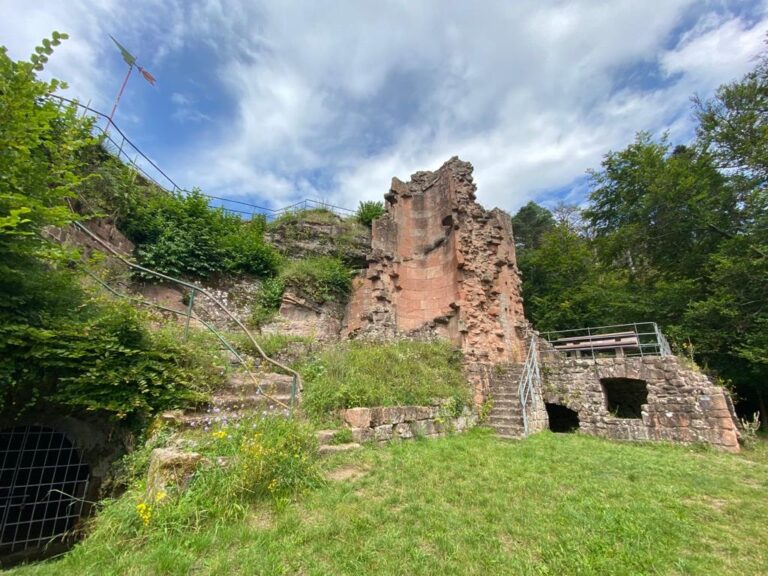
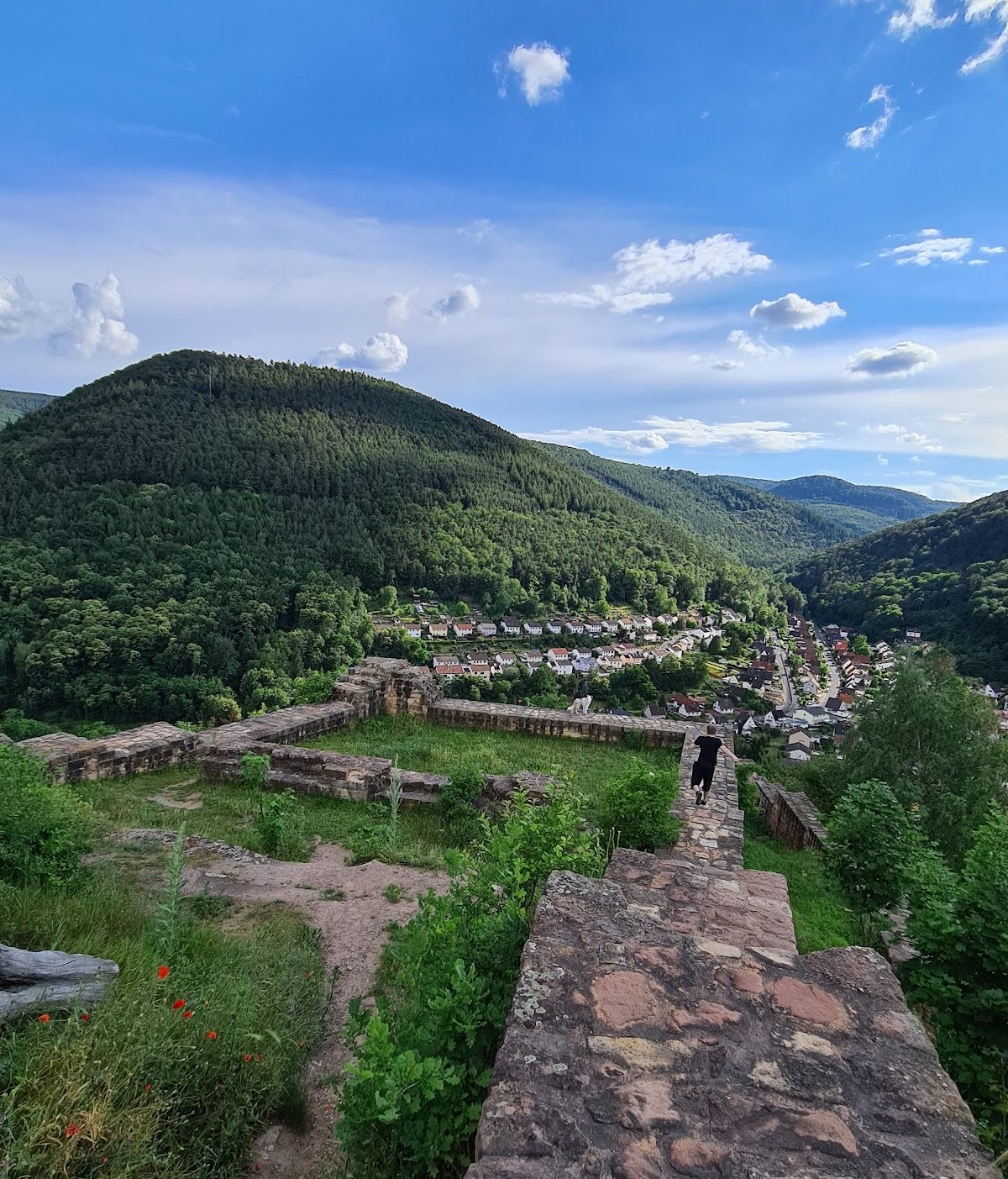
The castle grounds now form part of the Am Wolfsberg nature reserve, whose legal regulation protects the ruin as an architectural monument. Excavation and maintenance in the courtyard and around the castle during the second half of the twentieth century exposed structural remains and small finds. Since the 1970s, the Schöntal citizens’ association, now the Wolfsburgverein Neustadt, has led stabilization and restoration with help from the city and heritage authorities in Mainz and Speyer. The work included clearing the courtyard, securing and largely rebuilding the shield wall, restoring the slope below the castle, and removing excessive vegetation that had concealed the ruin from the valley entrance.
Remains
Site Layout and Defenses
Mountain Spur and Neck Ditch
The ruin occupies a rocky spur of Wolfsberg at about 270 to 273 metres above sea level, roughly 130 metres above the northern bank of the Speyerbach and the Schöntal district. Wolfsberg is the southern spur of the Weinbiet in the Haardt mountain range. The castle follows the elongated shape of the ridge, extending about 140 metres from northeast to southwest while measuring only around 30 metres across. Its slopes fall steeply on three sides.
Shield Wall and Outer Enclosure
On the uphill northern side, a deep neck ditch cut into the rock separates the castle from the rising hillside. Behind it stood the shield wall, a particularly strong defensive wall protecting the most vulnerable approach. The rock platform behind the wall was faced with bossed ashlar masonry, as were the wall’s corners. A square keep once stood on this platform, but it has been completely destroyed.
A projecting outer defensive enclosure, or zwinger, surrounded the main castle and the lower outer bailey. A gate building on the northeastern side provided access to this enclosure, while the gate building and the castle’s actual entrance have not survived. The main castle and outer bailey shared an inner ring wall, whose surviving sections are partly restored.
Residential Buildings and Archaeological Evidence
Palas and Castle Interior
Inside the main castle, the remains of the former palas, the principal residential hall of a medieval castle, stand beside the shield wall. The building crossed the site’s long axis. Rooms beneath it provided accommodation for lower-status guests and guard personnel, linking the residential building with the practical needs of the garrison and household.
Excavated Structures and Finds
Excavations in the courtyard uncovered cellar vaults, foundations, and gate pillars with anchoring holes for hinges and locks. Coins, tools, and weapon points were also recovered. Together, these remains and objects help identify the former appearance of the castle and the positions of individual areas within it.
Because no historical depictions of Wolfsburg survive, its precise original form cannot be reconstructed. Reconstruction studies therefore use comparisons with other castle ruins together with the draughtsman’s practical experience. The slope beneath the castle has been cleared of excessive vegetation and returned to its historical condition, while the ruin itself remains within the protected Am Wolfsberg nature reserve.
Nearby sites