Weilerburg: A Medieval Hilltop Castle Ruin in Germany


Site at a Glance
- Rating
- 4.6
- Popularity
- Low
- Country
- Germany
- Primary era
- Medieval
- External website
- Open
- Eras represented
- Medieval
- Civilizations
- Holy Roman Empire
- Site type
- Military
- Remains
- Castle
On this page8 sections
History
Weilerburg is a medieval hilltop castle ruin above Weiler near Rottenburg in Germany. The castle probably originated in the eleventh century, although its first documentary mention dates to 1225. Known historically as Rotenburg, it also appears in records as Alt-Rotenburg, Rotinburc, and Rotinburch.
Origins and early lords
The free lords of Rotenburg are regarded as the likely builders of Weilerburg. A mid-twelfth-century Adelbertus of Rotenburg and his son Konrad made donations to Hirsau Abbey at Gültstein. Their proposed descent from the Zollern-Hohenberg family remains disputed, and they may instead have belonged to a collateral branch of the Counts of Dillingen.
A document from 1225 names Albertus, lord of Rotinburc, as an arbitrator in a dispute between Kreuzlingen Abbey and the heir to a farm in the Neckargau. Albertus was a son of Count Burkhard of Zollern and sealed the document with the seal of his deceased brother, Count Burkhard of Hohenberg.
The Hohenberg period
By the thirteenth century at the latest, the castle belonged to the Counts of Hohenberg, a medieval comital dynasty whose possessions included the Rottenburg area. Gertrud of Hohenberg, later Queen Anna of Habsburg, is traditionally said to have spent her childhood and youth at the castle. Through her, the family became connected with the Habsburgs, a European ruling dynasty that acquired extensive territories in central Europe.
Gertrud’s brother, Count Albrecht II of Hohenberg, was an imperial bailiff and a minnesinger, a medieval German-speaking court poet and singer who performed secular songs, often about courtly love. He was also sometimes called Count of Rotenburg and is traditionally said to have lived at Weilerburg for a period.
After the Hohenbergs established a court castle in the newly built city of Rottenburg around 1280, or expanded a castle that may already have stood there, the older Rotenburg lost its former function. It was probably then used mainly as a residence. In 1381 the Hohenbergs sold Rotenburg to the Habsburgs.
Destruction, decline, and reconstruction
A tradition recorded by Nicodemus Frischlin, a sixteenth-century German humanist, poet, and historian, attributes the castle’s destruction to Count Friedrich XII of Zollern, known as Oettinger and the Grey Count. According to this tradition, he destroyed it during a raid in 1407. The castle was subsequently only partly rebuilt.
During the fifteenth and sixteenth centuries, the surviving castle was used at times as an inn and as a destination during hunting excursions, while it increasingly fell into decay. In 1624 it was dismantled down to its foundations on the orders of the Austrian bailiff. Its stone was reused to build the Capuchin monastery at Ehingen in Rottenburg.
In 1873 and 1874, the Sülchgau Antiquarian Association, a local historical and antiquarian society, initiated the reconstruction of the castle gate and the 24-metre tower as a Victory and Minnesinger Monument. The City of Rottenburg am Neckar has owned the ruin since 1974.
Remains
Weilerburg occupies the 555-metre-high Rotenberg, also called Burgberg, above the former castle hamlet and present-day district of Weiler. The hill is an isolated witness hill on a northeastern spur of the Rammert. The surviving complex is a ruin whose original fabric was reduced to its foundations in 1624, while the castle gate and a 24-metre-high tower were reconstructed in the nineteenth century.
Gate and tower
Reconstructed castle gate
The castle gate belongs to the features reconstructed in 1873 and 1874. It forms part of the surviving ruin and was rebuilt together with the tower as a Victory and Minnesinger Monument.
Tower and lookout
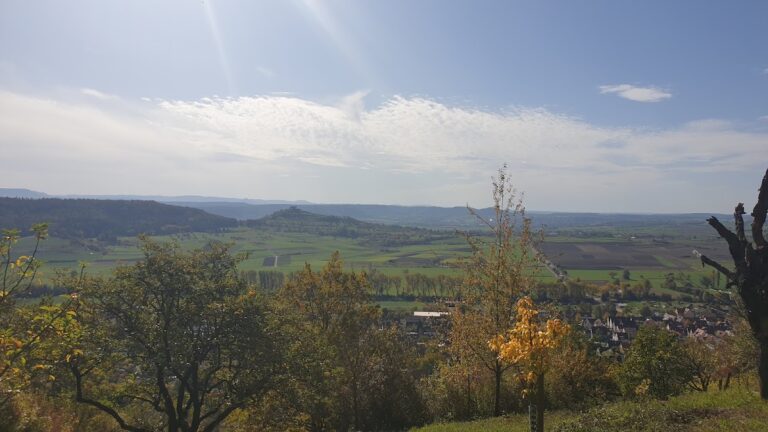
The reconstructed tower serves both as an observation tower and as a Bergfried, the main tower of a medieval German castle, generally intended as a strong defensive refuge rather than ordinary residential quarters. It rises 24 metres, is visible from a considerable distance, and provides a wide view over Rottenburg, the southwestern German cuesta landscape, and the Albtrauf, the steep escarpment of the Swabian Jura.
Nearby sites