Wieladingen Castle Ruins: A Medieval Noble Castle in Germany


Site at a Glance
- Rating
- 4.7
- Popularity
- Low
- Country
- Germany
- Primary era
- Medieval
- Eras represented
- Medieval
- Civilizations
- Holy Roman Empire
- Site type
- Military
- Remains
- Castle
On this page7 sections
History
Wieladingen Castle Ruins, also known as Harpolinger Schloss, are the remains of a medieval noble castle in Germany above Rickenbach. Built in the twelfth century, the castle belonged to Säckingen Abbey, a medieval religious institution that held estates and exercised lordship in the region. It is first documented around 1260 as the property of the Lords of Wieladingen.
The Lords of Wieladingen
The castle’s connection with the local nobility appears in a document issued on 19 March 1285 by Anna, abbess of Säckingen. The document concerned the hereditary fief of Rheinsulz, an estate held under inheritable terms, and named the knight Ulrich of Wieladingen. This reference places the castle within the network of noble and ecclesiastical possessions associated with Säckingen Abbey.
Decline and conservation
During the fifteenth century, the castle fell into disrepair. Farmsteads in the surrounding area later used the ruin as a source of building stone, further reducing the surviving fabric. The collapse of an attached gate down the steep slope in 1982 made the need for conservation clear. Between 1984 and 1996, volunteers from the Förderkreis Burgruine Wieladingen secured the remaining structures and made the tower accessible. The association continues to care for the site, while conservation work has also protected archaeological ground finds recovered from the ruin.
Remains
Setting and construction
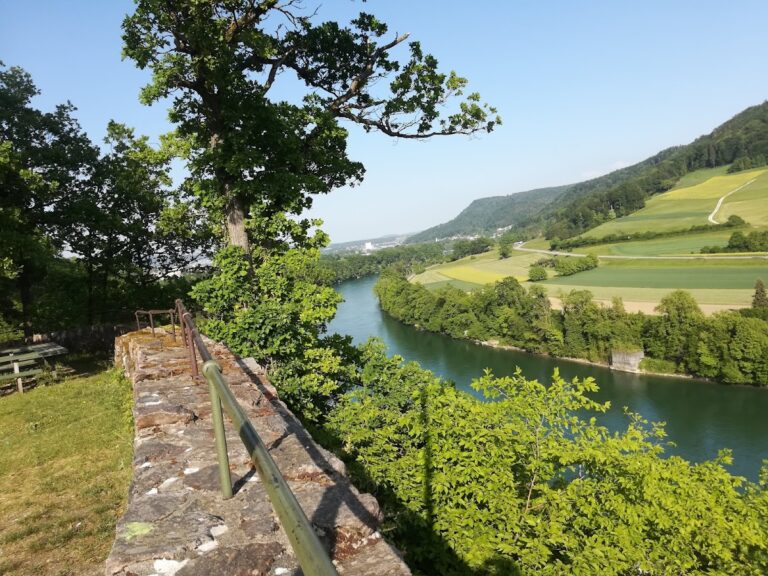
The ruin occupies a mountain spur at 540 metres above sea level beside the Lehnbach, above the Murg Valley near Wieladingen in the municipality of Rickenbach, Baden-Württemberg. A castle on such a projecting spur could use the steep slopes as part of its defenses. The complex was built from bossed sandstone blocks, whose outer faces project from the wall surface in a rugged finish. The stone came from Upper Buntsandstein, a regional formation of red sandstone.
Surviving buildings
The surviving complex includes parts of a double gate and a palas, the main residential and representative building of a medieval castle. Its principal tower, the 28-metre-high bergfried, also remains. This fortified tower served mainly for defense and refuge rather than as a permanent residence. Before conservation, shrubs overgrew the tower and threatened the masonry. Among them was a pine estimated to be about 400 years old, with a trunk approximately 35 centimetres in diameter.
Archaeological finds
Objects recovered from the ruin include pottery sherds, numerous stove tiles, crossbow bolts, parts of door locks, and nails. Other finds include a jaw harp and an unusual small candlestick made from bronze sheet metal. The candlestick is approximately 13 centimetres high. Together with the surviving masonry, these objects preserve evidence of activities and material use within the castle.
Nearby sites