Ouvrage de Froideterre: An Intermediate Fortification of Verdun


Site at a Glance
- Rating
- 4.6
- Popularity
- Low
- Country
- France
- Primary era
- Modern
- External website
- Open
- Eras represented
- Modern
- Civilizations
- French
- Site type
- Military
- Remains
- Fort
On this page14 sections
History
Ouvrage de Froideterre is an intermediate fortification in France, forming part of the fortified place of Verdun near the boundary between Fleury-devant-Douaumont and Bras-sur-Meuse. Built by France in 1887–1888, it belonged to the Séré de Rivières system, the late-nineteenth-century network of forts, batteries, and smaller defensive works created to protect the eastern frontier. The ouvrage was constructed at the southwestern end of the Côte de Froideterre, where it strengthened the interval between Fort de Charny on the left bank of the Meuse and Fort de Douaumont.
Construction and modernization
Ouvrage de Froideterre was built together with Ouvrage de Thiaumont as part of the defenses created around Verdun between 1885 and 1889. These works responded to the development of powerful explosive shells, sometimes called “torpedo shells,” which could breach traditional masonry fortifications. Around Verdun, the response included 42 batteries and 15 intermediate works, distributing defensive fire across a wider system rather than relying only on large forts.
Under the 1900 modernization program for eastern French fortresses, Froideterre was extensively altered between 1902 and 1905. Its structures were reinforced with concrete, and its armament was upgraded to a level comparable to that of a major fort. The work transformed the original position from a simple infantry defense into a heavily armed and more durable element of the Verdun fortress.
Froideterre during the First World War
In August 1914, the ouvrage and its surrounding defenses were placed on a wartime footing. The garrison was brought to full strength, trenches were dug between the different components, and 122 men occupied the position, whose barracks had been designed for 142. The surrounding system included three concrete batteries, four infantry shelters, and an underground shelter.
From late 1915, the position was partly disarmed. The guns of the Casemate de Bourges were removed, and the machine-gun turrets had very little ammunition. The situation changed in March 1916, after German forces captured Fort de Douaumont on 25 February and their offensive approached the Verdun defenses. A machine-gun company reinforced the garrison with eight additional guns, while the Casemate de Bourges guns were returned to service.
During the Battle of Verdun, the major First World War campaign fought by French and German forces around Verdun in 1916, Froideterre became a resistance strongpoint and a barrier covering the approach to the city. German troops had captured Ouvrage de Thiaumont and occupied the Thiaumont ridge, increasing the defensive pressure on Froideterre. The position also supported operations around Côte 304 and Mort-Homme, serving as an observation post and directing flanking fire with assistance from artillery on the left bank of the Meuse.
German artillery began concentrating on the ouvrage on 14 May 1916, with the heaviest bombardment taking place on 23 June. By 24 June, 2,270 shells had been counted, including 305 mm and 380 mm projectiles that struck on 21 June. Gas and tear-gas shells were fired during the night of 22–23 June. Bombardment continued mainly until September and intermittently until 1917, with approximately 30,000–40,000 shells falling on the position during 1916 and 1917.
The assault of 23 June 1916
On 23 June, after the German artillery preparation ended, German infantry reached the glacis, the sloping ground before the fortification. Captain Dartigues, the commander of Froideterre and a territorial artillery officer who had lost one hand, ordered the right machine-gun turret into action. Debris had blocked its rotation, however, and German troops reached the barracks and threw grenades into the position.
The artillery turret responded by firing all 116 boxes of its available canister ammunition, while a machine gun at the entrance fired directly ahead. A French counterattack around midday cleared the ouvrage and captured several prisoners. German troops came close to taking the position but withdrew after mistaking the ignition of French illuminating ammunition, set off by grenades thrown into the fortification, for the beginning of a demolition. The French garrison therefore retained control, and Froideterre remained in French hands throughout the bombardment.
On 24 June, a shell struck the observation cupola occupied by Captain Dartigues, rupturing his eardrums and forcing his evacuation. Captain Motte of the 131st Infantry Regiment replaced him. The continued shelling temporarily jammed the left machine-gun turret, disabled the right turret for a week, and badly damaged the right turret when another shell struck it on 26 July.
Later military history and preservation
Because surface trenches and connections between the fortification’s components were repeatedly destroyed, a deep communication gallery was excavated from 1916 onward. The system eventually reached about 480 metres and included shelters, a water cistern, electric-generator groups for lighting and ventilation, and an unfinished emergency exit toward the southwest. The barracks passage vault, the Casemate de Bourges, and the turrets were repaired in October and November 1917.
During the Second World War, an armored turret briefly resisted advancing German forces before anti-tank guns put it out of action. Its crew then surrendered. The French military decommissioned and abandoned the ouvrage after the war, allowing vegetation to overgrow the position. Tourist development began in the 1970s under the National Forestry Office. The underground galleries are now protected as an artificial cavern environment because bats hibernate there, while the upper works have been partly cleared and opened for access.
Remains
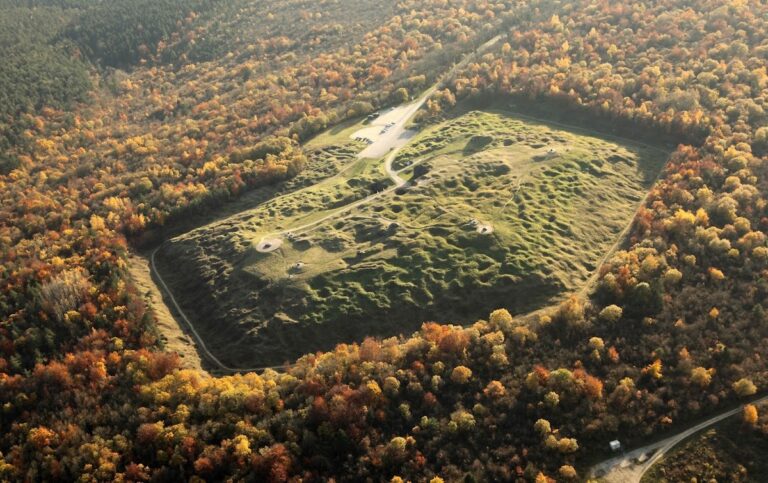
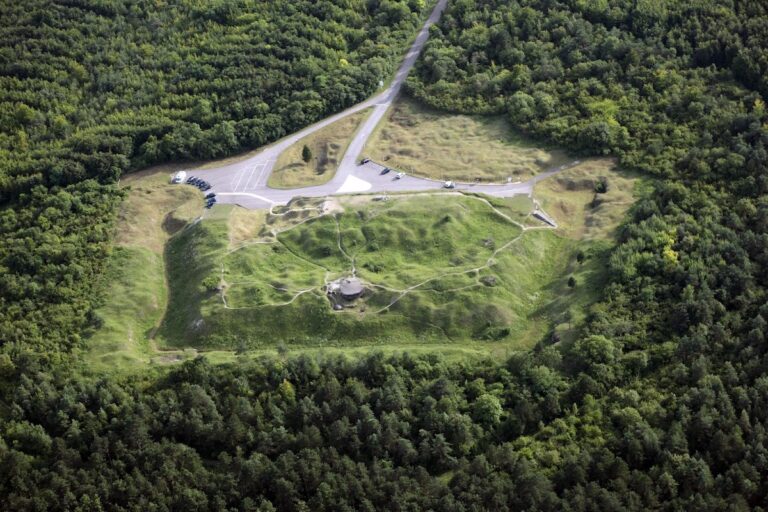
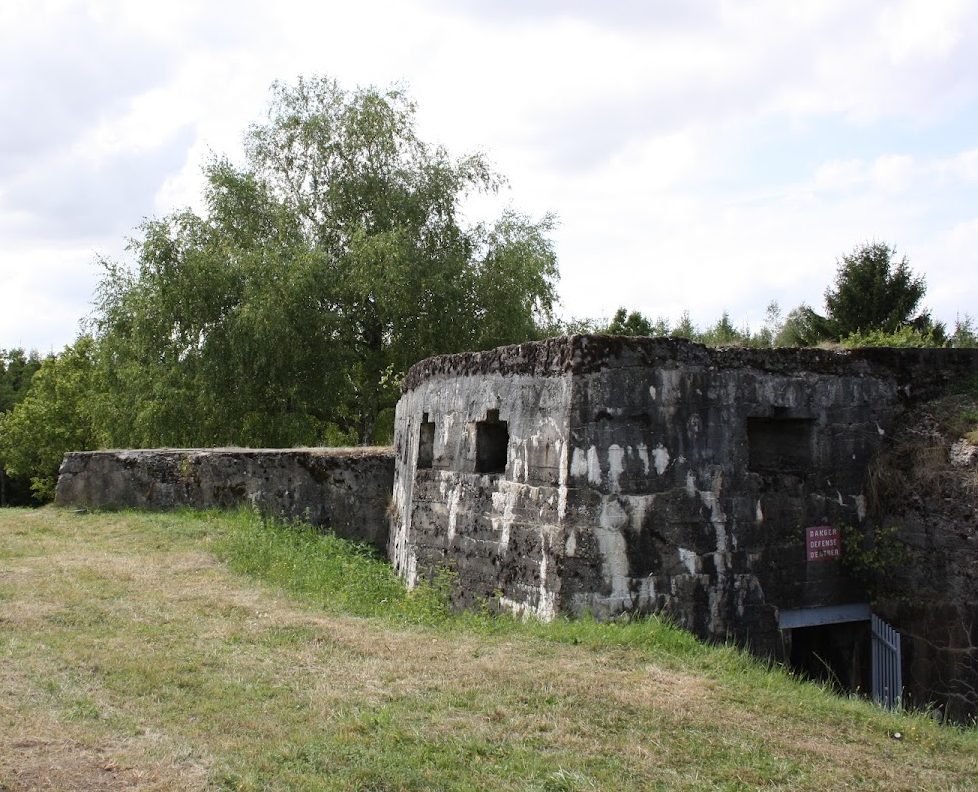
Froideterre covers approximately 280 by 200 metres. The modernized position forms a continuous reinforced-concrete fortification surrounded by a ditch about 10 metres wide and 5 metres deep. A 2.5-metre-high grille and a belt of barbed wire about 20 metres wide once strengthened the perimeter. Bombardment disrupted the ditch and destroyed these outer defenses, leaving shell holes across the grass-covered ground.
Surface defenses and barracks
Perimeter defenses
The original ouvrage was an intermediate work with a simple infantry parapet and no major flanking armament, armored installation, or special concrete reinforcement. The modernization of 1902–1905 replaced this simpler arrangement with a reinforced-concrete structure. The surviving surface area retains the relationship between the perimeter defenses and the central combat installations, although wartime shelling heavily altered the ground and damaged the protective works.
Barracks
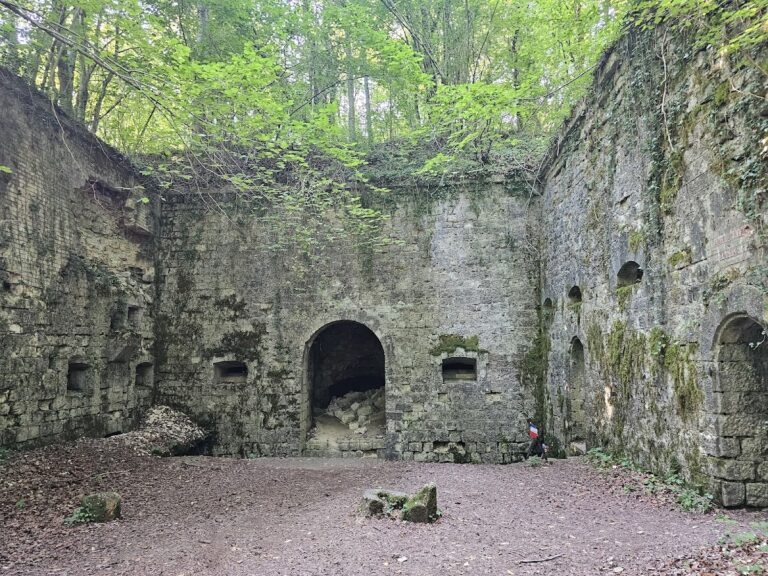
Along the eastern side stands a barracks about 60 metres long and 16 metres wide. Its masonry walls were covered with reinforced concrete and earth, and the concrete vault was 1.80 metres thick beneath approximately 1.40 metres of earth. The building contained a kitchen, storage rooms, latrines, and water cisterns. A heavy shell collapsed the vault over the barracks passage on 21 June 1916, killing five men and injuring four. The damaged vault was repaired in October and November 1917.
Armament and observation works
Artillery turret and Casemate de Bourges
The main artillery consisted of a Galopin 75R05 revolving and retractable turret carrying two 75 mm guns. It covered the ridge toward Douaumont to the northeast. On the western flank, the Casemate de Bourges, a protected gun chamber for flanking fire, held two guns of the same caliber and covered the Meuse valley and the ground to the west. Both the casemate and the artillery turret were repaired after the First World War bombardments.
Machine-gun turrets
Two revolving and retractable machine-gun turrets stood on the front of the position and near the barracks. One was a Hotchkiss turret, while the other was a model 1899 turret. The right-hand turret was heavily damaged by the shell of 26 July 1916. The artillery turret remains in place with its gun tubes and can still be retracted. Paint partly conceals corrosion, while numerous projectile impacts remain visible on the armored surfaces.
Observation cupolas
Two armored observation cupolas remain at the ouvrage. They provided protected observation over the surrounding defenses, including the areas where Froideterre directed fire during the Battle of Verdun. The cupola occupied by Captain Dartigues was struck during the shelling of 24 June 1916.
Underground galleries
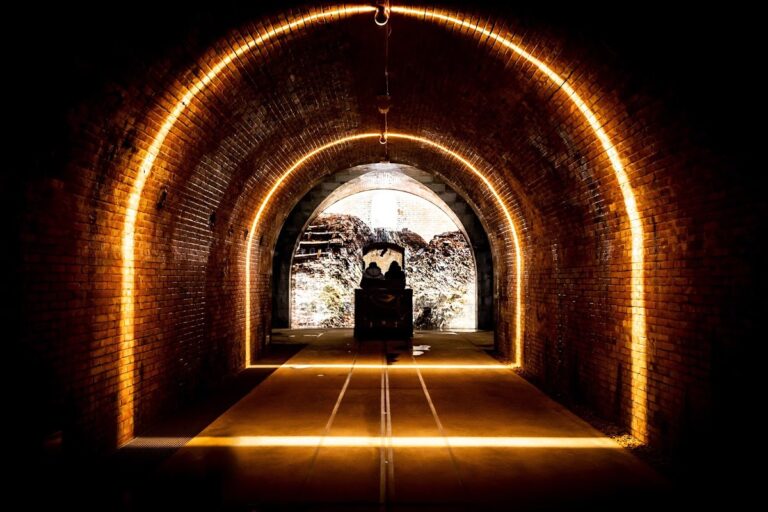
The principal combat rooms were not initially connected. A gallery later excavated roughly parallel to the rampart linked them at a depth of about 10–12 metres. The deeper gallery system created from 1916 onward extended to approximately 480 metres and connected the surface components by shafts. It contained shelters for the garrison and a cistern, while small electric-generator groups supplied lighting and ventilation. The emergency exit toward the southwest remained unfinished.
The underground galleries were reinforced with concrete in 1931–1933 to prevent collapse. Since the 1990s, steel profiles have also been installed to protect the bat colony that hibernates in the tunnels. The interiors are in poor condition and unsafe, so the underground sections are closed. The upper works remain accessible, and woodland has been partly cleared from the approaches. A road and a small parking area occupy part of the courtyard.
Nearby sites