Forte de São Sebastião: Angra do Heroísmo’s Maritime Fortress


Site at a Glance
- Rating
- 4.5
- Popularity
- Low
- Country
- Portugal
- Primary era
- Early Modern
- External website
- Open
- Eras represented
- Early Modern, Modern
- Civilizations
- Portuguese
- Site type
- Military
- Remains
- Fort
On this page14 sections
History
Forte de São Sebastião is a Portuguese maritime fortress at Porto de Pipas in Angra do Heroísmo, on Terceira Island. Also known as Castelo de São Sebastião or Castelinho, it was built in the sixteenth century as the first major fortification guarding Angra’s port and bay. Its construction formed part of Portugal’s response to the growing danger posed by pirates and privateers to ships carrying wealth from Africa, India, and Brazil.
Planning and construction
Angra’s strategic value was emphasized to King John III by Bartolomeu Ferraz in 1543. In 1537, the king had ordered Pedro Anes do Canto to build a fortress at the site, but a letter dated 14 May 1561 stated that this earlier fortification no longer existed. Luis Gonçalves was appointed master of the fortification works on 22 April 1562, although construction began about a decade later.
The Italian military architect Tommaso Benedetto visited the Azores in 1567 to advise on their defenses. He supported concentrating coastal protection around the ports, which would be garrisoned by local populations under municipal responsibility. In 1572, King Sebastian I ordered forts at Porto de Pipas and Fanais instead of the previously proposed strongpoint at the tip of Monte Brasil. Diego Alvares Cardoso was sent to plan the works, and land overlooking the bay was purchased from Pedro de Castro e Canto.
The Porto de Pipas fort was usable by 1576, when Manuel Corte-Real became its captain general. Construction was completed in 1580, although the fort remained incomplete because much of the wall facing the bay had not yet been built. It was placed under the invocation of Saint Sebastian in honor of the reigning king and was then the only fortification on Terceira’s coast.
Sixteenth- and seventeenth-century defenses
Armed with substantial artillery, the fort helped disperse Pedro de Valdez’s fleet in 1581, an action connected with the subsequent landing and Battle of Salga. In 1583, its crossfire with the Fortress of Saint John the Baptist on Monte Brasil blocked access to Angra from the sea. After Álvaro de Bazán entered the city through the Gate of São Bento, the Marquis of Santa Cruz received the formal surrender of the French troops stationed on the island at Forte de São Sebastião.
The fort continued to serve its defensive purpose during attempted attacks by Sir Francis Drake in 1589 and by the fleet of Robert Devereux, 2nd Earl of Essex, in 1597. Essex’s force included approximately 140 vessels, but its attempted landing on Terceira failed. The fort’s walls are associated with the period of the Philippine Dynasty, the years from 1580 to 1640 when Portugal was ruled by the Spanish Habsburg monarchs and fortification activity increased.
During the Restoration of Portuguese Independence, the revolt that ended the Spanish union and restored Portuguese rule under King John IV, Álvaro de Viveiros proposed demolishing the fort in 1641. The Senate of Angra rejected the proposal. On 27 March, the Ribeirinha company under Captain Manuel Jaques de Oliveira captured the fort from the Castilian garrison commanded by Captain Respenho. Portuguese artillery was then turned against Forte de São Filipe. Control of São Sebastião helped secure Terceira’s port and hindered assistance to the Spanish forces besieged there.
A royal charter dated 7 October 1649 appointed Manuel de Barcelos da Câmara Vasconcelos chief governor of the forts. In 1698, King Peter II ordered the rebuilding of Forte de São Sebastião. During the War of the Spanish Succession, the fort and the artillery on Monte Brasil repelled the forces of the French privateer René Duguay-Trouin in 1708. At that time, it was described as the castle of São Sebastião above the port of Angra.
Repairs and changing military use
An inspection in 1767 found that the low battery needed a missing section of wall, repairs to defective and cracked older masonry, more gun embrasures, and renewed platforms. Powder barrels were to be moved away from exposed positions. The sea had also cut a large concavity beneath one angle of the battery, leading to a recommendation that the angle be set farther inward. A plan of the fort was sent to the War Secretariat in Lisbon in 1772.
Forte de São Sebastião still had a strategic role in the defense of Angra Bay in 1822. During the Portuguese Civil War, Engineer Serra directed the addition of the low battery later called the Battery of Heroism. After the conflict, the island’s defensive system received less attention, although an inspection in 1862 found the fort in good condition. An engineering report from 1868 still listed it as garrisoned together with the Fortress of Saint John the Baptist, on which it depended. The fort’s artillery was later transferred to that fortress.
Public, military, and modern uses
In 1885, Public Works authorities erected a temporary wooden building for a leprosy isolation hospital and provisionally transferred it to Angra do Heroísmo’s civil government. During the First World War, artillery batteries were installed within the fort. In the early twentieth century, part of the site served as a port disinfection station, while temporary sheds, storage buildings, and a prefabricated house were added.
The Portuguese Army regained the fort in 1935. It subsequently housed the Prisoners’ Depot of the Police for the Surveillance and Defense of the State. British troops occupied the installations from 1943 during the Second World War. After the war, Santos Costa, first Minister of War and later Minister of Defense, promoted a general review of the old walls after becoming concerned about the fort’s neglected condition. The site later accommodated administrative services of the Port Captaincy of Angra do Heroísmo and, more recently, the Maritime Police.
Forte de São Sebastião was proposed as a Property of Public Interest in 1964 and received that classification by decree on 24 January 1967. Its walls form part of the Historic Center of Angra do Heroísmo, designated a UNESCO World Heritage Site in 1983. The Portuguese Navy lowered the national flag at the fort for the last time on 2 May 2003, after which maintenance and recovery work began. The property was adapted for the Pousadas de Portugal network and reopened in 2006 as a Pousada Histórica Design, combining historic buildings with light-colored modern structures. It is now used as a hotel.
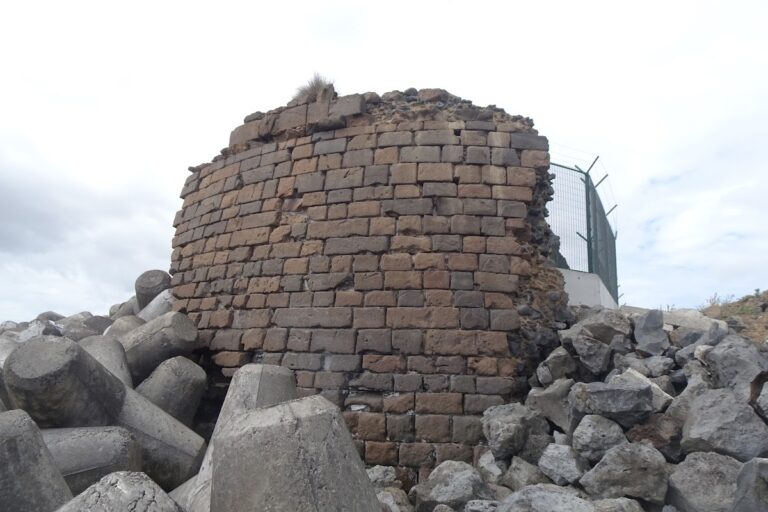
Part of the eastern wall collapsed into the sea on 9 November 2008. The collapse was attributed to long-standing water infiltration together with inadequate periodic inspection and maintenance.
Remains
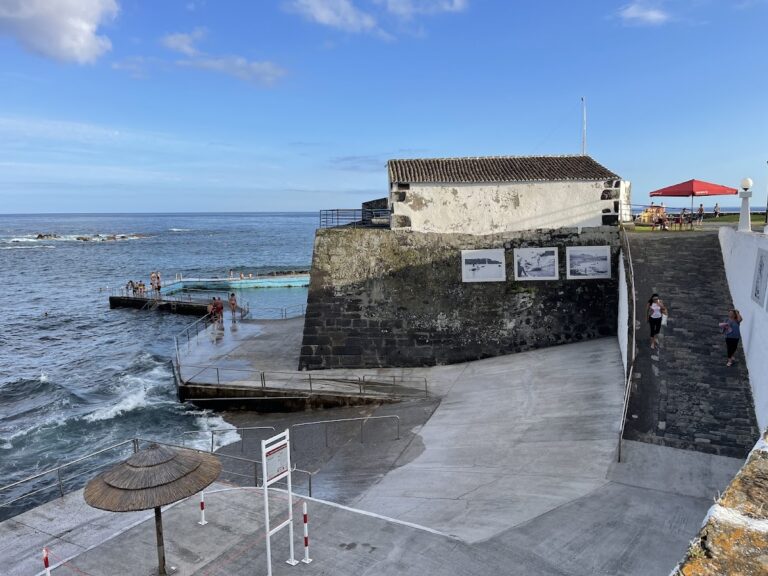
Forte de São Sebastião occupies a small hill at the extreme southeastern end of Angra Bay, beside Porto de Pipas and within the city’s historic center. Its irregular pentagonal plan is adapted to the ground. The bastioned fortification has three batteries facing the sea and two bastioned fronts toward the land. Its thick mortar-built walls are topped with crenellations.
Fortification and batteries
The upper sea battery stands above the bastions, while a second battery lies beside the central parade area, the open space used for assembling and moving troops. A third, later battery occupies the lowest level, almost flush with the surrounding ground. This low battery, later known as the Battery of Heroism, is 13.40 meters above sea level. The parade area lies at 26.60 meters, and the two high bastions reach 32.70 meters. The fortress covers approximately 10,504 square meters.
Entrance and outer defenses
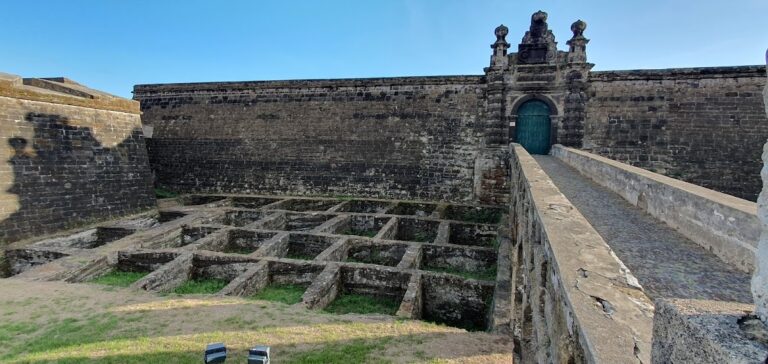
At the north wall, a two-arched stone bridge crosses the ditch and leads to the Gate of Arms. The bridge was completed before the wooden drawbridge planned for the entrance could be installed. The northern and western walls were originally preceded by a ravelin, a detached triangular defense placed in front of a wall. A ditch protected the northern side and is now partly filled. Additional ditches outside the northern walls have a pronounced slope and extend westward to the limits of the fortress.
Low battery
The low battery occupies the seaward lower level and was the subject of repeated repairs and alterations. Its platforms, gun embrasures, and masonry were examined during the eighteenth-century inspection, while the later Battery of Heroism was added during the Portuguese Civil War. A straight ramp and tunnel originally connected it with the fort, although the present route is partly curved.
Buildings within the fort
Governor’s House
The Governor’s House stands beside the entrance. It contains storerooms and an upper floor for the adjutant. The regular building is made of mortar masonry and has nine divisions on its main floor, wood-lined walls, and wooden ceilings. Its ground floor contains five divisions, including storerooms, some with vaulted ceilings.
Barracks and adjutant’s quarters
A separate thick-walled mortar-masonry building was designed for troop barracks and the adjutant’s quarters. Its upper floor contains five panelled divisions and a vaulted corridor. The lower floor forms the barracks beneath them.
Guardhouse and casemate
The vaulted Guardhouse lies beneath the curtain wall, the wall joining two bastions. A postern, or small secondary passage, connects it to a casemate, a vaulted protected chamber, containing two small vaulted arsenals within the bastion earthworks. These spaces were very damp and were considered useful mainly in emergencies.
Routes, water, and surrounding grounds
The original access system included the Camino a la Cima, which has disappeared, and a ramp from Porto de Pipas that is now blocked. The western side also included land formerly cultivated or leased under the Ministry of War. This ground could provide food for the garrison during a siege. In front of Porto de Pipas beach, the area once called the public garden now consists of grass. Part of it was transferred in 1857 for an extension requested by the minister responsible for Public Works and War.
The fort contains a cistern holding 33,000 liters of drinking water. An underground water-transport tunnel runs from the western side toward the rocky coast on the east. The municipality opened it in 1850 to drain rainwater flowing from higher parts of Angra during heavy floods. The passage is between 1.5 and 2 meters high. Its total length remains unknown, and the structure has been placed under recovery for possible public access.
The modern adaptation preserves the historic buildings while adding light-colored structures with contemporary lines. Their appearance contrasts visibly with the older walls and reflects the fort’s transition from a coastal defense installation to a property used for lodging.
Nearby sites