Ancient City of Telmessos: A Lycian Harbor City in Türkiye


Site at a Glance
- Rating
- 4.5
- Popularity
- Low
- Country
- Turkey
- Primary era
- Classical
- Eras represented
- Bronze Age, Classical
- Civilizations
- Hittite, Lycian
- Site type
- City
On this page15 sections
History
Ancient City of Telmessos is the remains of a major Lycian city in Türkiye, beneath and around modern Fethiye. Inhabited from the Bronze Age, it occupied a strategic position near the border of Lycia and Caria and developed into a commercial center whose history continued through the Byzantine period.
Bronze Age Telmessos
The settlement’s earliest date is uncertain, with proposed beginnings ranging from the third to the second millennium BCE. The Hittites knew it as Kuwalapašša, while the Lycians called it Telebehi. In the thirteenth century BCE, the annals of Hattusili III, a Hittite king, placed Telmessos within Lukka, the Hittite name for the region later known as Lycia, and described its conquest by the Hittites.
Another Hittite document records that Kuwalapašša and Dalawa sent assistance to the Hittites during their war with Iyalanda. These references place Telmessos within the political and military networks of Bronze Age western Anatolia. Greek traditions later gave the city a mythical foundation, attributing its establishment either to Sarpedon, a Cretan prince exiled by his brother Minos, or to Telmissos, a son of Apollo.
A Lycian commercial center
Telmessos prospered through its protected harbor, maritime and overland connections, broad hinterland, and fertile coastal plain. It remained an important commercial and settlement center through antiquity and the Hellenistic period. The city also had an oracle dedicated to Apollo, the Greek god associated with prophecy, and was known for its school of diviners.
During the fifth century BCE, the city used the Lycian name Telebehi on its coinage. In 446 BCE, Cimon, an Athenian statesman and military commander, secured Telmessos’s membership in the Delian League, an alliance led by Athens, together with city-states in Caria and Lycia.
Dynastic conflict and Persian rule
After the Delian League dissolved, Telmessos became involved in struggles among Lycian rulers. The Greek historian Theopompus stated that Arbinas, also called Erbbina, of the Xanthos dynasty first captured the city. After 380 BCE, the Lycian prince Pericles besieged Telmessos, and its inhabitants eventually surrendered.
Following this period of conflict, the Achaemenid Empire conquered Telmessos and incorporated it, with Lycia, into a satrapy. The Achaemenid Empire was the Persian imperial state that ruled much of western Anatolia before Alexander’s conquests, while a satrapy was a province governed for the Persian king by a satrap. By the fourth century BCE, Telmessos was increasingly influenced by Lycian culture.
Alexander and the Hellenistic kingdoms
In 334 BCE, after the siege of Halicarnassus, Telmessos surrendered to Alexander the Great without a battle. Alexander intended to place the city under Nearchus, his Cretan companion, but a man named Antipatrides seized it. Nearchus recovered Telmessos soon afterward.
After Alexander’s death, the city successively came under Lysimachus and the Antigonid dynasty, one of the successor ruling houses of the Hellenistic period. Following the Battle of Ipsus in 301 BCE, Telmessos passed to Cassander and later became part of the Ptolemaic kingdom.
From 258 BCE, Telmessos was the center of a Ptolemaic vassal kingdom. Its first ruler was Ptolemy Epigonos, the son of Lysimachus and a former co-king in the Ptolemaic kingdom. His sons, Lysimachus of Telmessos and Epigonos of Telmessos, later governed the kingdom as members of the Lysimachid dynasty.
Roman incorporation and late antiquity
Telmessos passed to the Seleucid Empire in 197 BCE and then to the Kingdom of Pergamon under the Treaty of Apamea in 188 BCE. When Pergamon joined the Roman Republic in 133 BCE, the Roman Senate granted Telmessos independence. The city later joined the Lycian League, a federation of Lycian communities with shared political institutions, before coming definitively under Roman rule around the middle of the first century BCE.
Roman control and changes in Aegean transit routes reduced Telmessos’s commercial importance. Declining trade and population changed the city from a major port into a small harbor settlement. In AD 43, it became part of the newly established province of Lycia, and its name changed to Makri, or Macre.
Byzantine Telmessos
During the Byzantine period, Telmessos became an episcopal center subordinate to the metropolitan see of Myra. Two bishops are recorded: Hilary in AD 370 and Zenodotus, who attended the Council of Chalcedon in AD 451. Episcopal records list Telmessos among Myra’s subordinate bishoprics until the tenth century. In 1316, they mention the see of Macra and Lybysium.
Arab attacks looted the city in the seventh century. It was rebuilt during the reign of the Byzantine emperor Anastasios II and renamed Anastasiopolis, but that name did not endure. By the ninth century, the settlement was again called Makri. The name is first documented in AD 879, although a seventh-century inscription found in Gibraltar bearing the ethnic name Makriotes may indicate that it was used earlier.
Archaeological investigation
Modern excavations, including recent work by a museum, have clarified the ancient settlement and its organization. Much of the Roman-period city lies beneath modern Fethiye, while repeated earthquakes and changing settlement patterns caused many ancient buildings to disappear over time. The surviving ancient remains are preserved and restored, allowing the city’s long development to be studied through its tombs and theater.
Remains
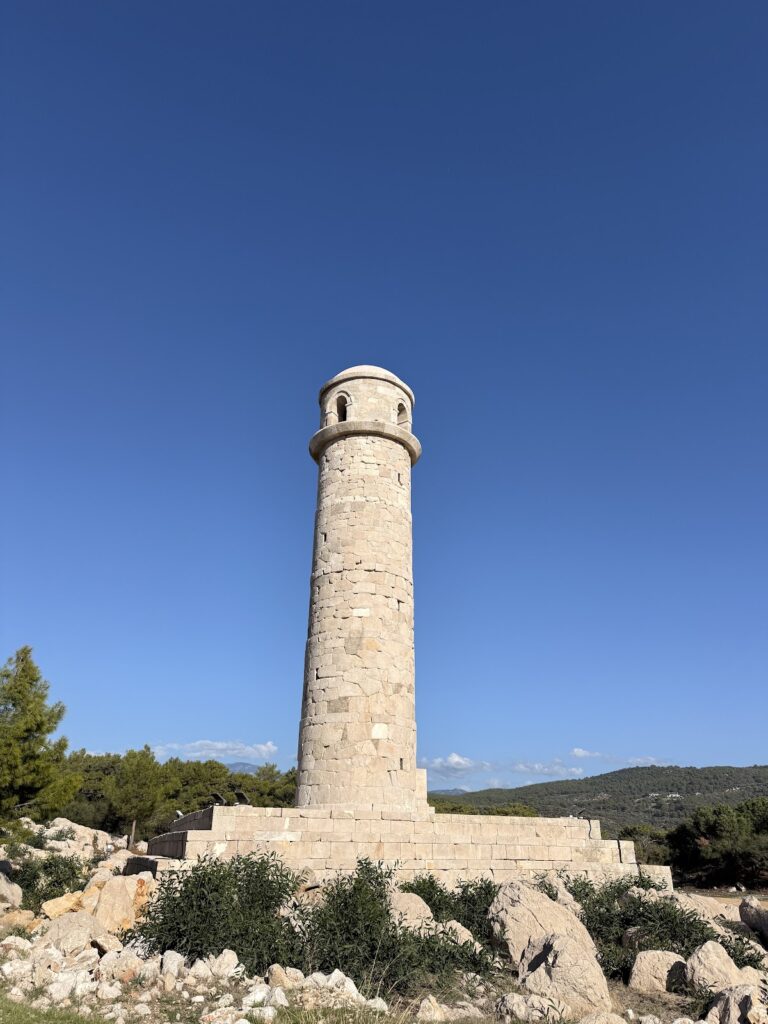
The surviving remains of Telmessos are distributed through the modern town and its rocky southern area. A well-protected harbor, separated from the Gulf of Telmessos by an island, formed part of the city’s maritime and commercial setting. Rock-cut tombs, Lycian sarcophagus tombs, and a theater provide the clearest surviving evidence for the ancient settlement’s burial practices, public architecture, and organization.
Burial monuments
Rock-cut tombs
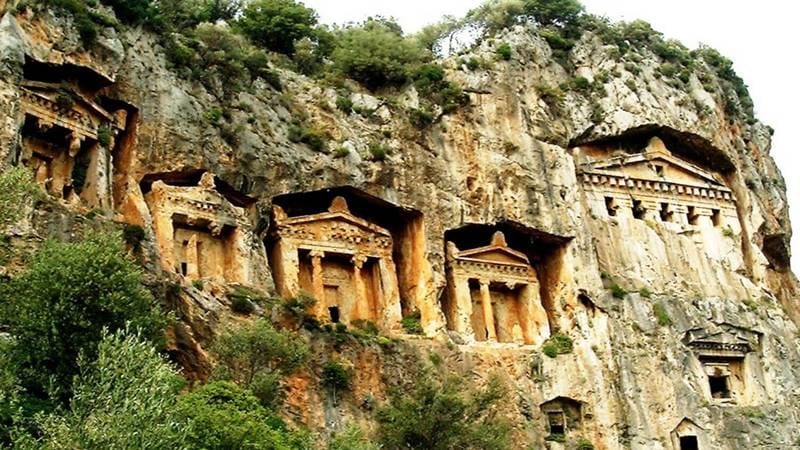
Rock-cut tombs survive in the rocky area south of modern Fethiye. These are burial chambers carved directly into natural stone and are regarded as among the oldest surviving remains of Telmessos. Their position in the rocky landscape preserves a direct connection between the city’s ancient burial practices and the natural stone of the area.
Tomb of Amyntas
The most prominent rock-cut monument is the Tomb of Amyntas. An inscription on the left anta, the projecting wall end framing the front of a classical building, indicates that Amyntas was probably buried there around 330 BCE. The tomb therefore belongs to the period when Telmessos was passing through the political changes that followed Persian rule and preceded the Hellenistic kingdoms.
Lycian sarcophagus tombs
Sarcophagus tombs occur at various locations across the ancient settlement. Together with the rock-cut chambers, they form a dispersed group of Lycian burial monuments that survives within the area of ancient Telmessos. The sarcophagi are among the physical remains that connect the settlement’s wider urban area with its funerary landscape.
Public architecture
Theater
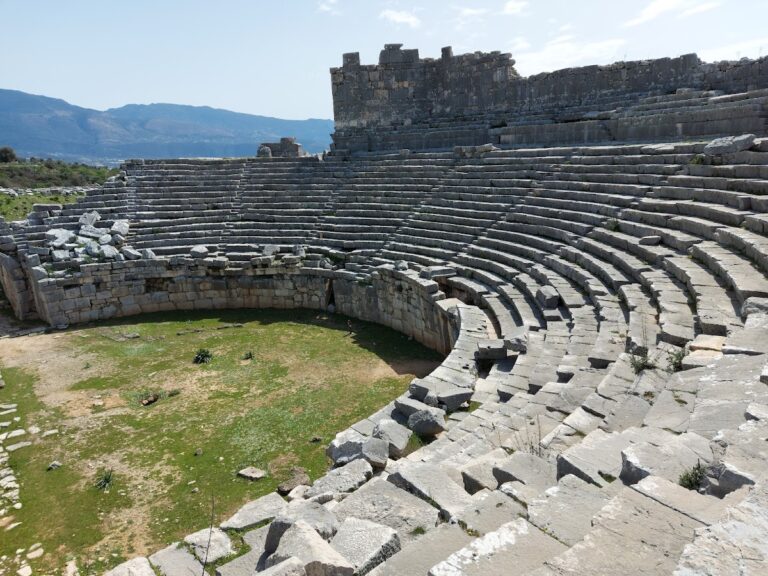
Museum excavations have uncovered remains of a theater. The structure provides evidence for the layout and organization of Telmessos during antiquity and adds a public building to the surviving funerary remains. Its preserved remains contribute to the reconstruction of the ancient city’s arrangement, much of which lies beneath modern Fethiye.