Wasserburg Erffa: A Medieval Water Castle in Germany


Site at a Glance
- Rating
- 4.4
- Popularity
- Very Low
- Country
- Germany
- Primary era
- Unclassified
- Eras represented
- Unclassified
- Civilizations
- Unclassified
- Site type
- Military
- Remains
- Castle
On this page6 sections
History
Wasserburg Erffa is a medieval water castle in Germany, established after 1100 beside the Nesse near present-day Friedrichswerth in Thuringia. Built as the seat of noble lords who initially held free status rather than serving as feudal vassals, it formed part of the fortified landscape of the lower Nesse valley.
Origins and the Lords of Erffa
Friedrichswerth is mentioned much earlier as villa Erphohi in an early ninth-century register of the possessions of Hersfeld Abbey. The abbey was founded by Archbishop Lullus of Mainz, an eighth-century churchman associated with its foundation and development. A direct link between this early place-name and the later Erffa family, however, cannot be demonstrated.
During the High Middle Ages, Fulda Abbey and officials of the Thuringian landgraves controlled the lower Nesse valley. A landgrave was a high-ranking territorial prince whose authority was exercised directly within a larger principality. These authorities established fortifications at Goldbach, Wangenheim, and the site of modern Friedrichswerth.
The Lords of Erffa enter surviving documentary evidence in 1170, when Hartungus de Erfaha was recorded as a knight. The family is therefore regarded as part of the ancient Thuringian nobility. After a succession war ended, the formerly free-status lords became vassals of the Wettins, a German dynasty that ruled extensive territories in central Germany, including Saxony and parts of Thuringia. They then expanded and modernized the castle complex.
Feudal control and replacement
The chronicles do not establish whether Wasserburg Erffa was involved in the severe conflicts between King Adolf of Nassau and the Wettins. In 1390, Landgrave Balthasar purchased the feudal overlordship from Fulda Abbey. The castle and village remained in Erffa family possession until 1677.
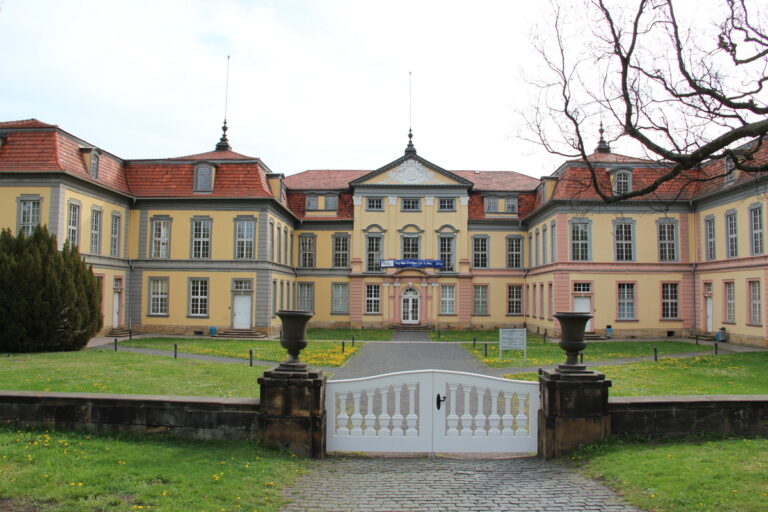
Between 1677 and 1680, every castle building described in the historical record was demolished. Rubble from the structures was used to fill the old moat, and the later construction of Friedrichswerth Palace entirely replaced the castle and its economic buildings. A pen drawing found in 1898 in a report preserved in a tower finial provides the only known depiction of the former complex. The castle now survives as an archaeological site beneath the palace. Friedrichswerth Palace and its park are protected architectural and archaeological monuments.
Remains
Wasserburg Erffa was a lowland water castle, meaning a fortified residence in relatively level terrain defended partly by surrounding waterworks rather than a naturally elevated position. It stood beside the Nesse, separated from the village, and consisted of a core castle, a broad moat, and an outer bailey with economic courtyards to the east. No structure remains above ground, because the former castle and its outlying buildings are buried beneath the later palace grounds in eastern Friedrichswerth.
Core castle and courtyards
The southern part of the core castle contained an inner courtyard enclosed by a wall and three tall defensive towers. A larger outer courtyard lay to the north, where residential and economic buildings were arranged. A low wall enclosed this outer courtyard, while another wall farther outward formed an additional boundary for the inner courtyard and moat.
The outer bailey was reached from the eastern side of the core castle by a wooden footbridge. Its economic buildings formed three spacious courtyard complexes, each divided from the others by walls and fences. These courtyards were completely removed during the construction of Friedrichswerth Palace.
Moat and water channels
The broad moat was connected to the Nesse by channels on its eastern and western sides. These connections allowed water to circulate and helped regulate the moat’s level. The moat was later filled with rubble from the demolished castle buildings, leaving its former arrangement as part of the buried archaeological remains.