Castle of Marutegi: A Medieval Frontier Fortress in Spain
Site at a Glance
- Rating
- 4.3
- Popularity
- Very Low
- Country
- Spain
- Primary era
- Medieval
- External website
- Open
- Eras represented
- Medieval
- Civilizations
- Kingdom of Navarre
- Site type
- Military
- Remains
- Castle
On this page8 sections
History
Castle of Marutegi, also known as Murutegi or Morotegi, is a ruined medieval fortress in Spain, near Araia in Álava. Traditionally identified with the Araxa or Araia castle, it was built to defend the frontier of the Kingdom of Pamplona, the predecessor of the medieval Kingdom of Navarre. Its construction is uncertain and has been placed in the eighth or ninth century. One tradition dates it to around 839, during the reign of Eneko Arista, while another attributes it to García Íñiguez, a later ninth-century ruler of Pamplona.
Origins and frontier role
A fortress of Arab origin is believed to have occupied the site before the present castle and may have contributed to the origin of its name. The castle was positioned on the frontier between Navarre and Castile, giving it a military role within the developing frontier system of Pamplona. It also protected a commercial route between the interior and the coast through the San Adrián tunnel, as well as the old road toward Gipuzkoa.
The fortress is also associated with a reconstruction in the eleventh century. Its elevated position allowed it to oversee the eastern part of the Álava Plain and the entrance into Navarre through the Barranca, or Sakana, valley. The castle was especially active from the thirteenth century until the beginning of the sixteenth century, when its use came to an end.
Later history and protection
After the castle ceased to be used, a hermitage dedicated to Saint Michael was built on the site. In 2021, the Basque Government designated Castle of Marutegi a protected cultural property with special protection as an archaeological area. The ruins are regarded as an important place for understanding the historical development represented by medieval fortifications in the Basque Country, and the site retains considerable potential for archaeological research and public interpretation.
Remains
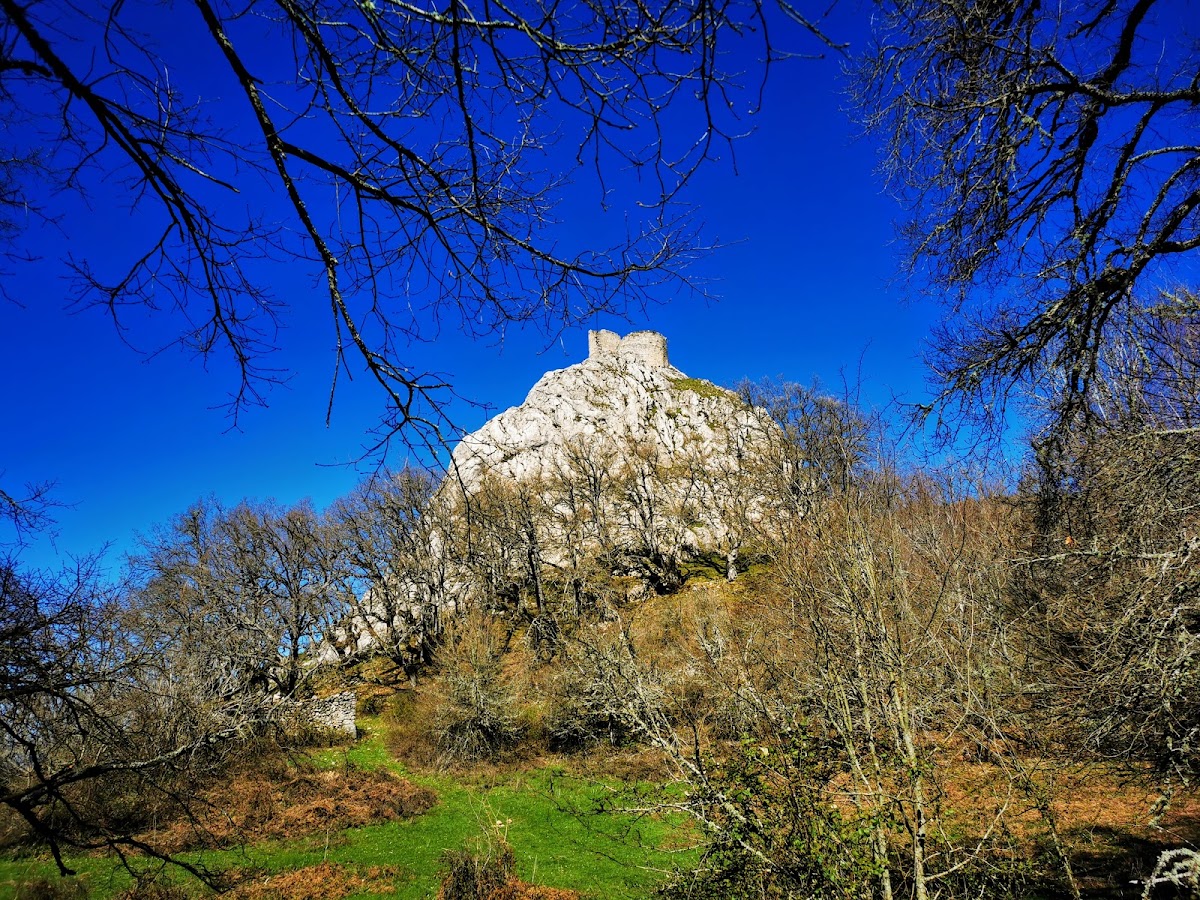
The ruins occupy the summit of the rocky Marutegi, or Marumendi, crag in the Altzaina range, at an altitude of 863 metres and slightly more than two kilometres from Araia. The defensive complex was arranged in an upper enclosure and a lower enclosure. Its position commanded the historic road toward Gipuzkoa through the San Adrián tunnel, while the summit provided the setting for the fortress’s principal defensive position.
Lower and upper enclosures
Lower enclosure
The lower enclosure contains a large building measuring approximately 31 by 12 metres. Its robust walls, made from carefully worked masonry, are about 1.5 metres thick. These walls probably enclosed the building’s space as part of the defensive boundary, linking the structure to the wider organization of the castle.
Upper enclosure
The upper enclosure occupied the highest part of the crag and is understood to have contained the main tower. Despite the restricted summit area, the tower was probably surrounded by a perimeter wall. Rock cuttings in the crag indicate the presence of this enclosure, while medium-sized ashlar blocks, meaning regularly shaped and carefully dressed stone, point to structural unity within the complex. A gate was probably placed in the only readily accessible part of the enclosure.
Main tower
The main tower stood at the tip of the crag, where its form was adapted to the available rock. It had a D-shaped plan measuring approximately 10.5 by 9 metres. The walls were uneven in thickness, reaching about 2.70 metres on the eastern side and 1.40 metres on the western side. The tower served as a lookout and as the fortress’s final defensive position.
Access was probably from the south at ground level, without a raised approach or an additional defensive structure. Inside, two floor levels were created by removing irregular rock outcrops and applying a lime-based coating. Surviving wall remains indicate that the second storey stood about three metres above the lower level. The castle now survives as ruins, with the tower and enclosure remains preserving the defensive arrangement of the summit.
Nearby sites