Mirambell Castle: A Medieval Fortification in Spain


Site at a Glance
- Rating
- 4.2
- Popularity
- Very Low
- Country
- Spain
- Primary era
- Medieval
- External website
- Open
- Eras represented
- Medieval
- Civilizations
- Crown of Aragon
- Site type
- Military
- Remains
- Castle
On this page9 sections
History
Mirambell Castle is a medieval fortification above Mirambell in Catalonia, Spain, whose origins lie in a defensive and observation tower. The site is first mentioned in 1023, when a land sale referred to property within the castle’s territory.
Early medieval ownership
In 1037, Sunifred of Cardona granted his wife, Belesa, half of the castle. Two years later, the viscountess Engúncia, widow of Ramon, Viscount of Osona-Cardona, listed Mirambell among the properties she held through aprisio, the medieval occupation and cultivation of land that could establish a recognized property claim, and feudal tenure. She also left land in the castle’s territory to Sant Pere de Casserres monastery.
In 1086, Viscount Ramon Folc divided the allod of Mirambell, meaning land held as free property rather than dependent feudal tenure. He left one half to Sant Pere de Casserres and the other to his wife, Ermessenda. The Cardona family retained ownership during the twelfth century. In 1102, Bermon of Cardona donated his holdings at Mirambell to Santa Maria de Solsona, Sant Jaume de Calaf, and Sant Pere del Mont. In 1143, his son Bernat gave his allod at the castle to his sister, Ermeniarda.
The Cardona castellans
The Cardona family placed the castle in the care of successive castellans, officials appointed to administer and defend a castle for its lord. Berenguer Sendred held the office during the first half of the twelfth century, followed by his son Arnau. From 1170, the office was associated with a family that took the name Mirambell.
Members of that family later entered Sant Pere de Casserres monastery. Arnau de Mirambell is recorded there as a monk in 1235. Ramon de Mirambell served as chamberlain between 1257 and 1263 and later became prior.
Later status and protection
Mirambell Castle remained among the Cardona family’s properties during the fourteenth century. In 1375, it formed part of the patrimony of the County of Cardona. The castle is now protected as a historical monument, with recognition as a Cultural Asset of National Interest in Catalonia and as a Spanish Asset of Cultural Interest under reference RI-51-0005230. The Spanish designation has been in force since 1988.
Remains
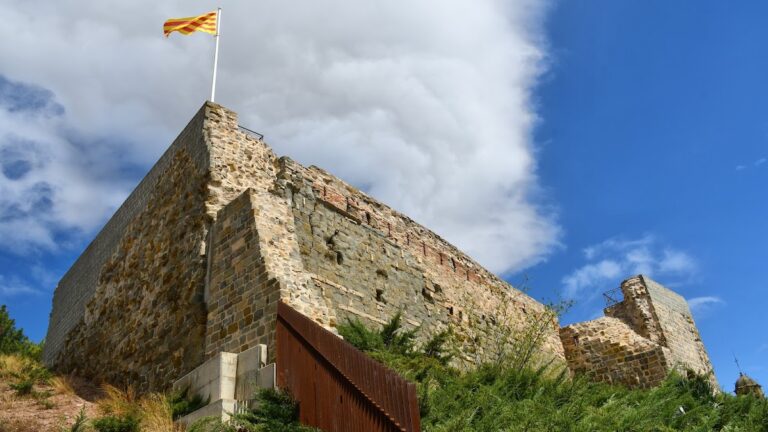
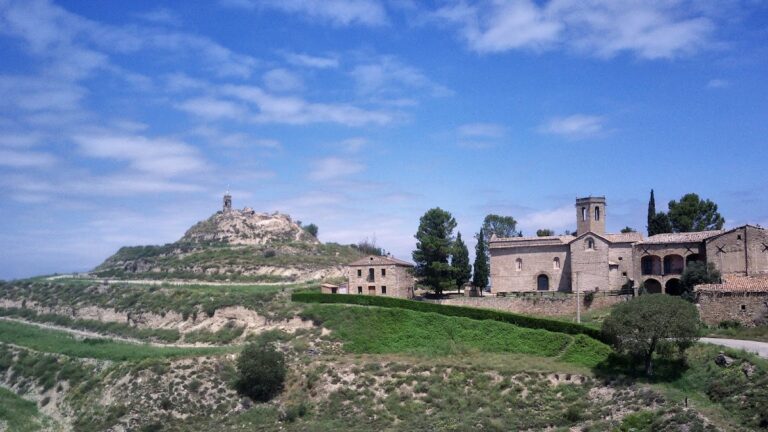
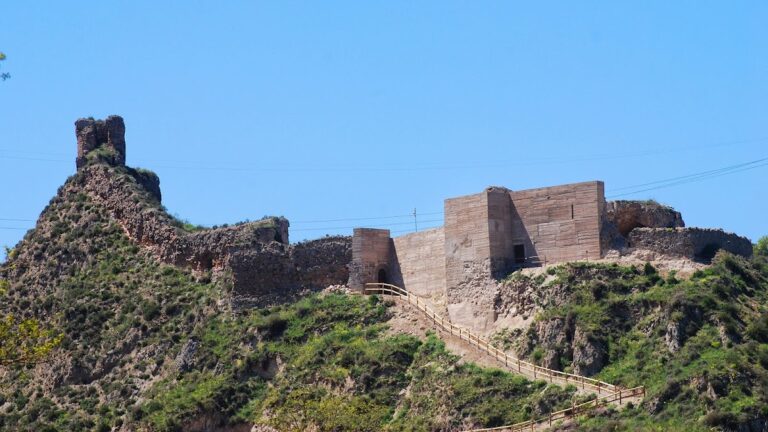
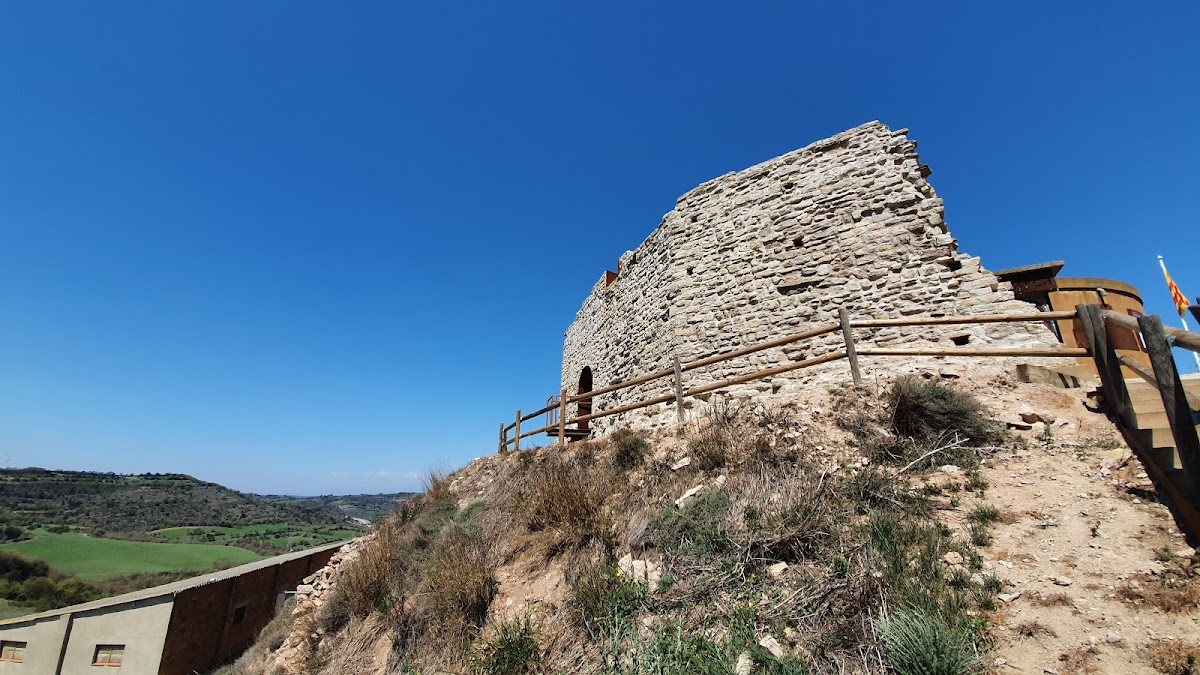
The castle stands at about 707 metres above sea level on a hill overlooking Mirambell, with the village houses clustered around it. It is an isolated and highly ruinous fortification near Church Square, outside the current urban centre, opposite Durfort and above the road from Calaf to Cervera. The surviving masonry reveals a later polygonal building superimposed on an earlier circular tower. The interior now contains the water tank that serves the small village.
Polygonal enclosure
Surviving walls
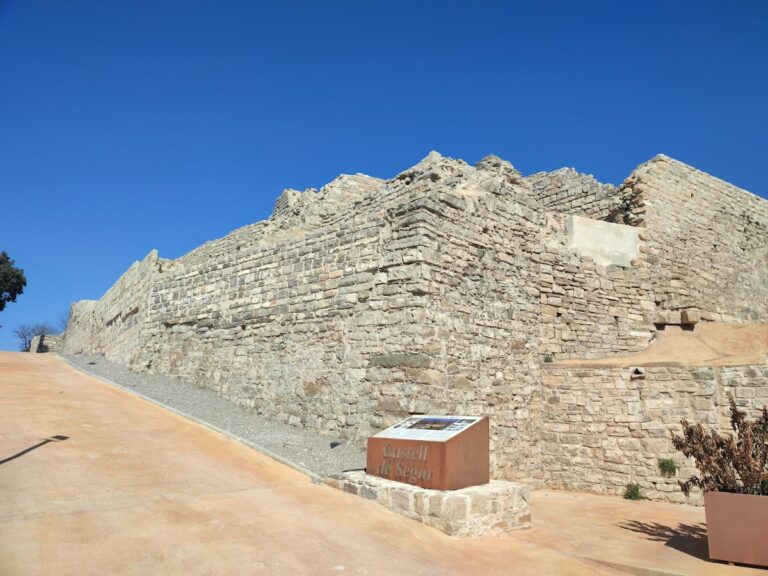
The principal structure had a polygonal plan, probably formed by five or six façades. Parts of three façades survive, measuring approximately 5.5, 8.9, and 11.5 metres in length. Their maximum preserved height is 3.5 metres. The building was probably constructed during the twelfth or thirteenth century.
Its walls are built from medium-sized ashlar blocks laid with lime mortar. The unusually thick wall cores contain many stones and very little mortar. The polygonal form resembles that of other castles in the surrounding region, including Calaf.
Earlier circular tower
Southern tower
A circular tower is inferred at the southern end of the site. It predates the polygonal enclosure and may belong to the eleventh century. About 2.2 metres of the tower survive, while its original diameter was probably about 4.5 metres and its walls were approximately 180 centimetres thick.
The tower’s masonry resembles that of the polygonal castle, although its blocks are somewhat smaller and more roughly dressed. The physical overlap between the earlier circular tower and the later polygonal building is a notable feature of the fortification.