Castle of San Faustino: An Early Medieval Stronghold in Italy


Site at a Glance
- Rating
- 4.6
- Popularity
- Very Low
- Country
- Italy
- Primary era
- Medieval
- External website
- Open
- Eras represented
- Medieval
- Civilizations
- Holy Roman Empire
- Site type
- Military
- Remains
- Castle
On this page8 sections
History
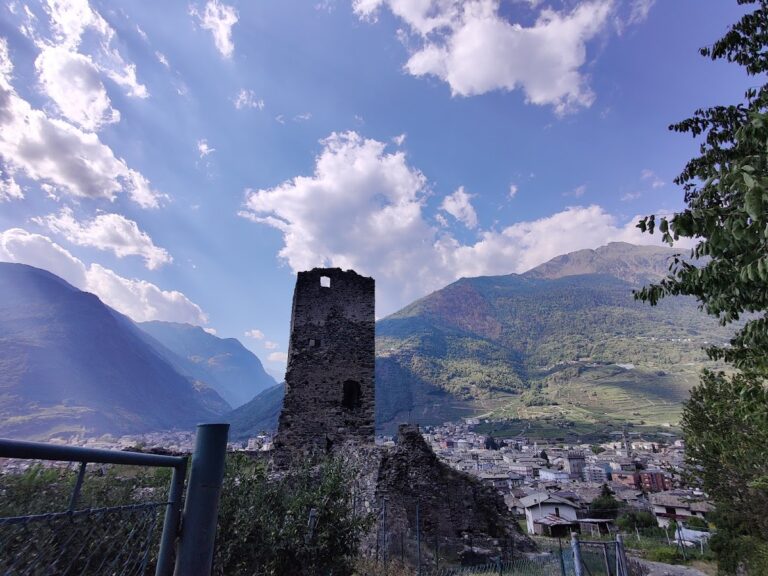
The Castle of San Faustino, also known as the Old Castle, is a ruined early medieval stronghold in Italy, built probably during the tenth or eleventh century at the initiative of the Bishop of Como. It stands at the southern end of Dosso dei Castelli, between Grosotto and Grosio, and held an important position within the Pieve of Mazzo, the medieval ecclesiastical district responsible for surrounding communities and chapels.
Foundation and Strategic Role
The castle’s position allowed control of the valley floor, the Mortirolo Pass, and the entrance to Val Grosina. Steep rocky slopes protected the hill, while the Roasco and Adda waterways lay below it. These natural defenses strengthened the site’s role within the ecclesiastical territory of Mazzo.
The castle appears in written evidence in 1150, when a record of the ecclesiastical administration of Como referred to it as “Castrum Groxii.” The term castrum described a fortified settlement or stronghold, which could include both defensive walls and inhabited areas during the early medieval period.
The Chapel and Later Decline
A church dedicated to Saints Faustino and Giovita probably stood on the site before the castle was established. The two saints were Christian martyrs traditionally associated with Brescia. Their dedication has been linked to economic and cultural connections between Valtellina and Valcamonica. The church was later incorporated into the castle and became its chapel.
The Venosta family probably abandoned the castle around the end of the sixteenth century. Afterward, the small church entered a slow and irreversible decline. Archaeological excavations, including a campaign in 2000, led to new interpretations of the castle’s perimeter and purpose. The surviving masonry suggests that the complex may have served not only as a defensive work but also as a prestigious expression of the feudal lord’s authority over Grosotto and Grosio.
The Castle of San Faustino now forms part of the Grosio Rock Engravings Park and is classified as Italian national heritage.
Remains
Hilltop Layout and Enclosure
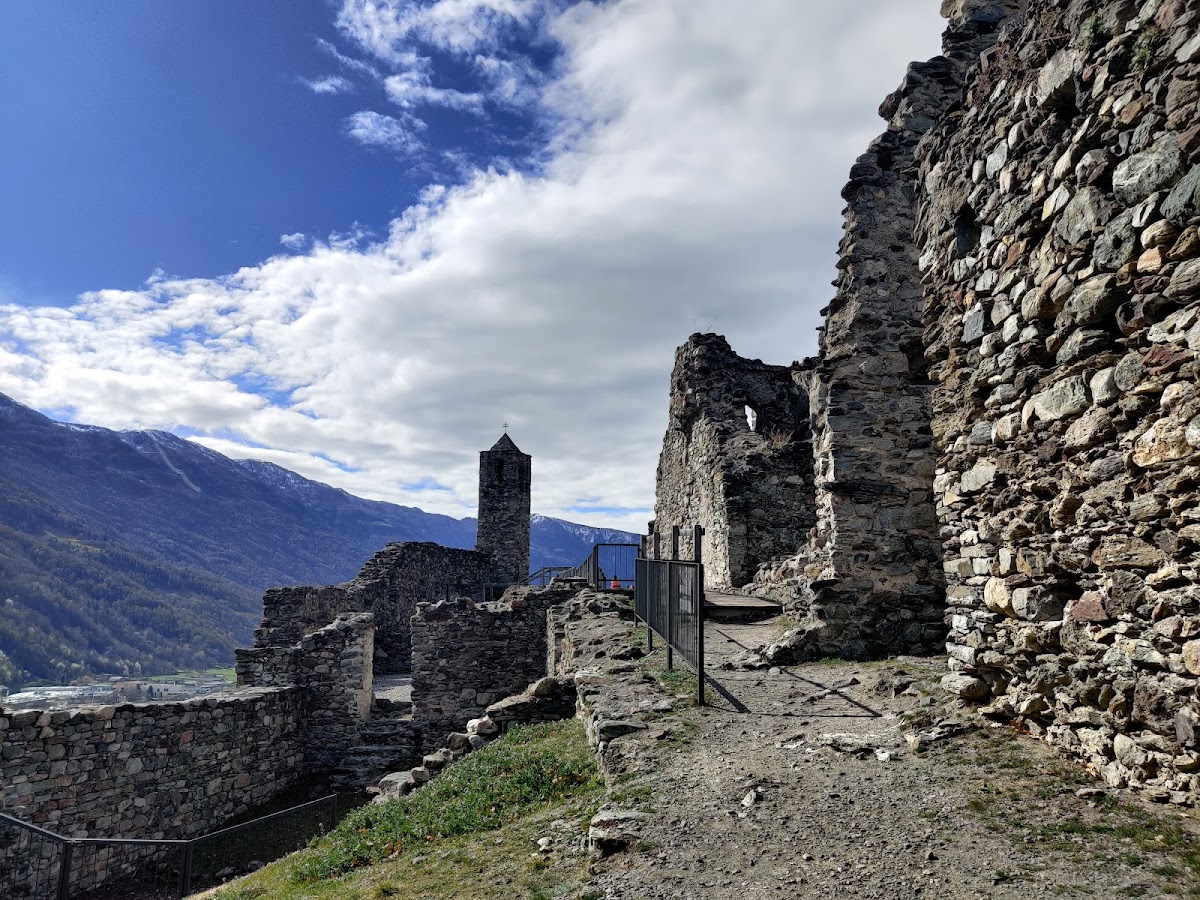
The ruins occupy the southern extremity of Dosso dei Castelli, beyond the Rupe Magna and the New Castle. The Rupe Magna is a major rock surface in the Grosio area covered with prehistoric engravings. Surviving walls define the castle’s perimeter and identify several associated structures, while excavations indicate that the remains may widen toward the north and possibly extend around the entire hilltop.
The buildings were relatively confined and followed the shape of the elevated ground. Archaeological interpretation allows for the possibility that the original complex was considerably larger than the visible ruins. It may have formed a fortified village of the early medieval castrum type, enclosed by a defensive wall around the whole hill.
Religious Structures
Romanesque Bell Tower
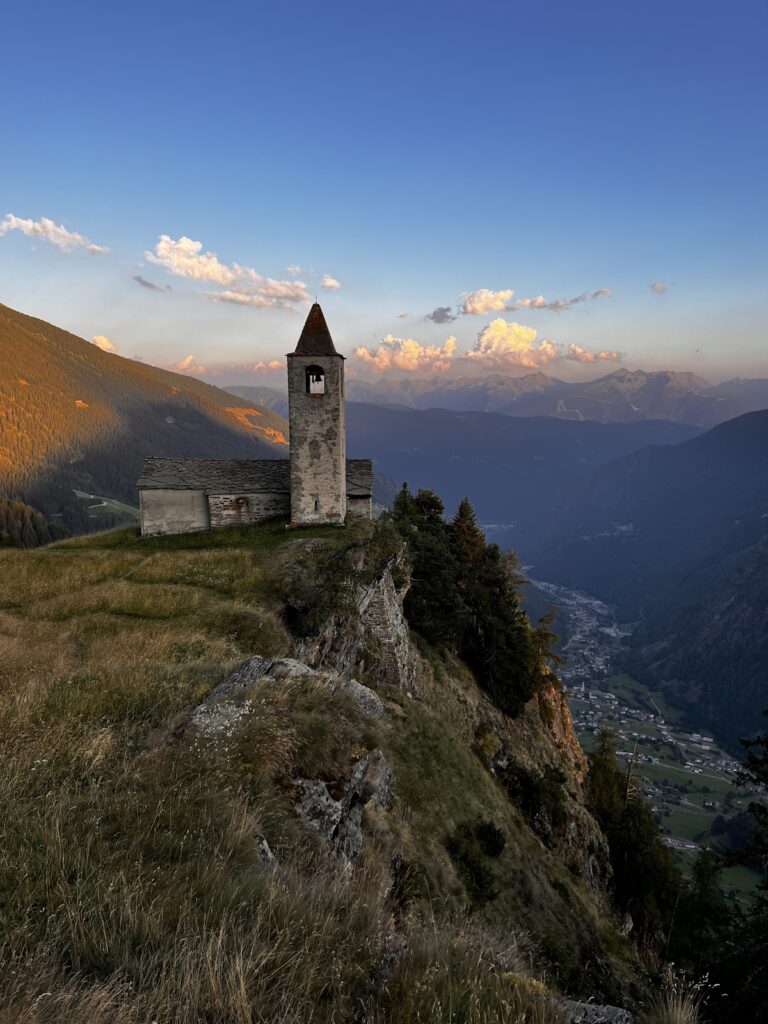
The Romanesque bell tower of the Church of San Faustino and Giovita dominates the surviving ruins. Romanesque architecture is a medieval tradition characterized by robust masonry, rounded arches, and substantial tower-like forms. The church was incorporated into the castle complex and served as its chapel.
Early Funerary Chapel
The oldest structure identified during the 2000 excavations dates to the sixth century AD. It was a primitive funerary chapel containing two tombs cut into the rock. Their privileged position indicates that the chapel was connected with burials of particular status before the later castle complex developed around the site.