Château de Rochetaillée-sur-Saône: A Medieval Castle and Automobile Museum in France


Site at a Glance
- Rating
- 4.5
- Popularity
- Low
- Country
- France
- Primary era
- Medieval
- Eras represented
- Medieval, Early Modern
- Civilizations
- French, Holy Roman Empire
- Site type
- Military
- Remains
- Castle
On this page8 sections
History
Château de Rochetaillée-sur-Saône is a former medieval fortified castle in France, first constructed in the twelfth century and later adapted for ecclesiastical, residential, and museum use. Its initial lord was Étienne II de Villars, whose lordship, castle, and toll were pledged to the Church of Lyon in 1151 and held as a fief from Girin, the abbot of Île Barbe, in 1150.
Ecclesiastical lordship
From the fourteenth century, the fief formed part of the Franc-Lyonnais, a small territory around Lyon whose inhabitants or institutions benefited from tax exemptions. It also became an obéance, an ecclesiastical jurisdiction administered under the authority of a religious institution.
Damage and rebuilding
In 1562, the poorly maintained residence was ravaged by fire during an attack by the Huguenots, French Protestants associated with the Reformed tradition during the religious conflicts of the sixteenth century. The seigneurial domain was later affected by plague in 1628 and 1629, followed by floods in 1636.
During the seventeenth century, Antoine de Foudras, a mansionnaire, meaning a resident member of an ecclesiastical chapter living at Rochetaillée, repaired the chapel and the castle. François de Foudras then built a new chapel, completed in 1716.
From national asset to museum
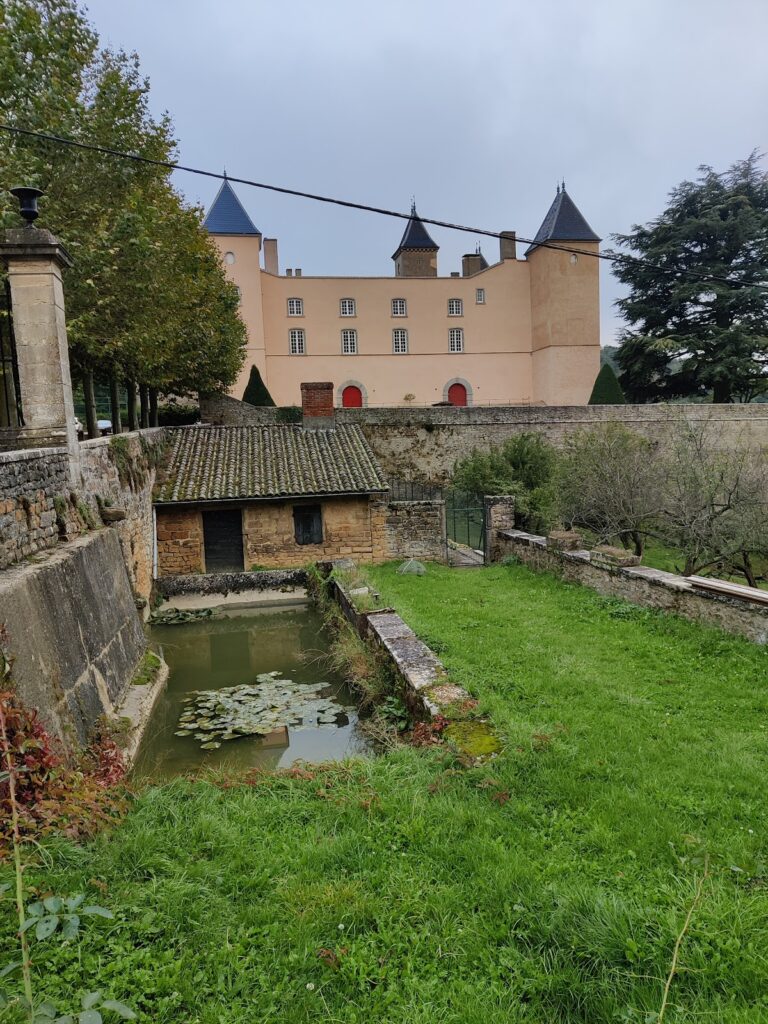
The entire property was sold as a national asset in 1790, after which the castle fell into ruin. Its first restoration took place in 1892 under Pierre Claude Bellingard. Jean Joseph Clerc, who acquired the castle in 1902, continued the work. The building was substantially altered during the nineteenth century, while medieval elements remained in limited form.
Henri Malartre purchased the castle in 1959 and inaugurated his automobile museum there in 1960. The City of Lyon has owned the property since 1972, and the castle now houses the Henri Malartre Automobile Museum.
Remains
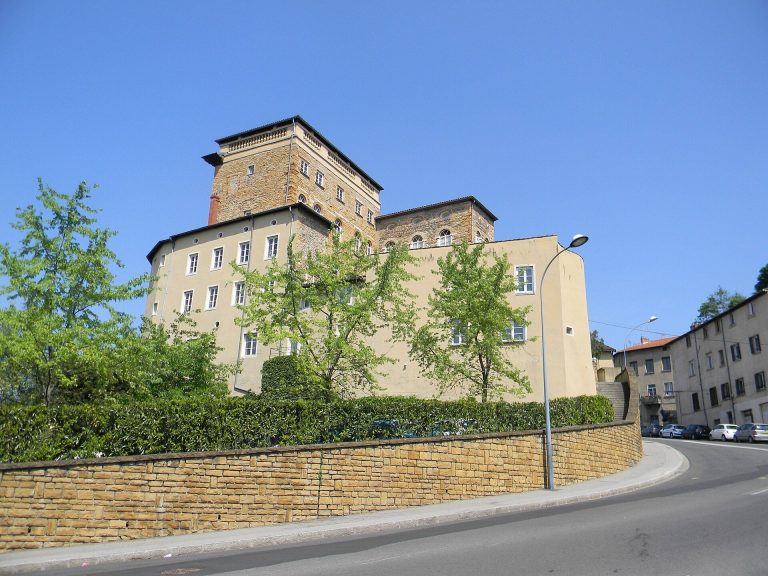
The castle stands on a spur of the Dombes plateau north of the village of Rochetaillée-sur-Saône. Its position overlooks the Saône valley on one side and the Échets valley on the other. The surviving fabric combines limited medieval remains with later additions and alterations, including a Romanesque entrance gate, a round tower, a fifteenth-century stair tower, and an eighteenth-century chapel.
Medieval entrance and tower
The Romanesque entrance gate, an element of the medieval architectural style that preceded Gothic architecture, provides access to the round tower. Together with the castle chapel, it represents part of the castle’s surviving medieval remains.
Fifteenth-century structures
The octagonal stair tower dates from the fifteenth century and contains a spiral staircase. The castle’s defensive system was reinforced during the same period. Ground-floor fireplaces and a French-style timber ceiling also belong to the fifteenth century. This type of ceiling uses exposed structural beams and joists.
Eighteenth-century chapel
The chapel was constructed in the eighteenth century as part of the later rebuilding of the castle. François de Foudras’s new chapel was completed in 1716.