Dunscaith Castle: A Medieval Stronghold on the Isle of Skye


Site at a Glance
- Rating
- 4.6
- Popularity
- Low
- Country
- United Kingdom
- Primary era
- Early Modern
- Eras represented
- Medieval, Early Modern
- Civilizations
- Kingdom of Scotland
- Site type
- Military
- Remains
- Castle
On this page8 sections
History
Dunscaith Castle is a medieval stronghold in the United Kingdom, on the coast of the Isle of Skye in north-west Scotland. The present castle is generally dated to the thirteenth or fourteenth century, and the site formed part of the political and military history of the western Highlands.
Early Origins and Clan Control
Archaeological finds indicate that a castle existed here as early as the eleventh century. The surviving stronghold is variously dated to the thirteenth or fourteenth century. One tradition places its origin in the 1300s, when it served as a stronghold on Skye for a Viking group led by Gilbert MacAskill, the grandson of the Norse explorer Ascall Mar Ragsnaill.
Dunscaith became associated with the Clan MacDonald of Sleat, a Highland Scottish lineage that held territorial and political power in the medieval and early-modern Highlands. During the fourteenth century, Clan MacLeod captured the castle and briefly entrusted it to allied MacAskills. The MacDonalds recaptured Dunscaith during the fifteenth century.
Royal Capture and Abandonment
The castle was drawn into the fifteenth-century struggle to curb the power of Clan Donald. Its chief held the title Lord of the Isles, the leading position among the rulers of the Hebrides and associated western territories. Forces of King James IV of Scotland captured Dunscaith during this conflict, although the MacDonalds were later allowed to retain possession.
The MacDonalds abandoned the castle in the early seventeenth century. Afterward, Dunscaith progressively fell into ruin. It is now a protected scheduled monument, a historic or archaeological site given legal protection because of its national importance.
The Fortress of Shadows
Dunscaith is also linked with Scáthach the Shadow, a figure in Irish heroic mythology associated with martial training. In the Ulster Cycle, a body of medieval Irish legendary narratives, she is presented as a Scottish warrior woman who trained the hero Cú Chulainn. The name Dun Scáthaigh, from which the castle’s alternative name Dun Scaich derives, means the fortress associated with Scáthach, giving the site its traditional title, the “Fortress of Shadows.”
Remains
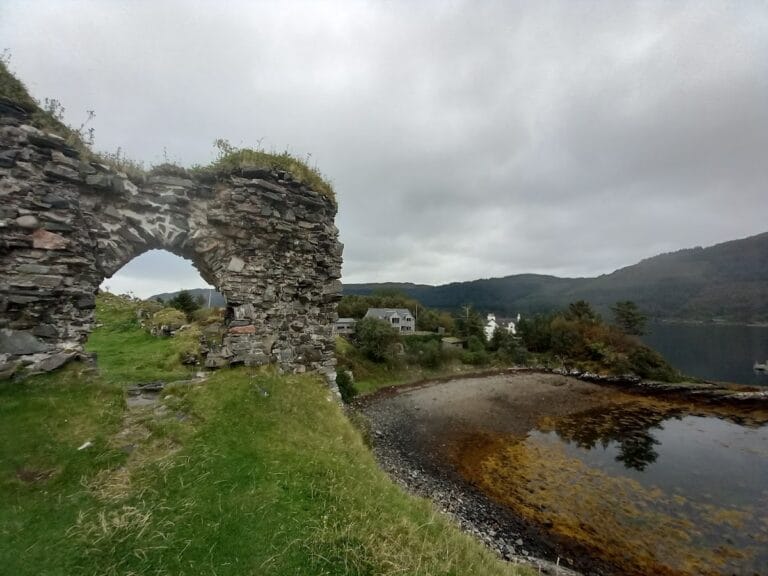
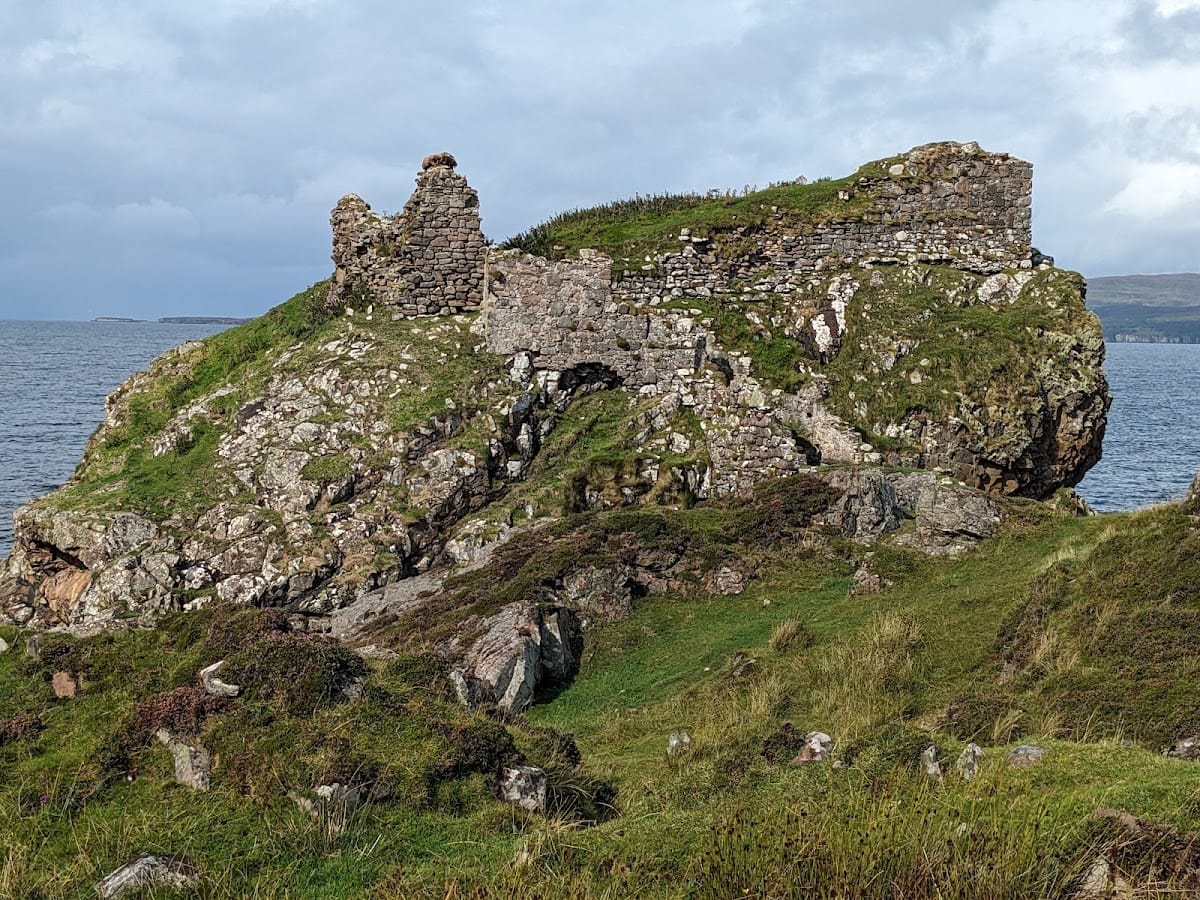
Dunscaith Castle occupies an offshore rock rising about 12 metres above sea level and separated from the mainland by a gap of roughly 6 metres. The surviving layout centres on a defended approach, a raised entrance route, and a small castle area bounded in part by a curtain wall, the main defensive perimeter wall of a castle. Most of the inner buildings have disappeared, while parts of the outer defences and access structures remain.
Bridge and Entrance Approach
The former approach crossed the gap on a fortified stone bridge. Its arches were spaced about 1.8 metres apart, and the bridge led to a drawbridge, a bridge that could be raised to restrict access. Pivot holes for the drawbridge remain visible on the far side. Beyond it, a doorway opened onto a stairway enclosed by walls on both sides, carrying the approach upward into the castle.
Walls and Early Buildings
Sections of the curtain wall survive along the cliff edge. The wall was about 1.5 metres thick and built from rubble stones of varied sizes, using one of the earliest surviving lime mortars in the region. Earlier buildings, including what must have been a keep or residential tower, can now be identified only through grass-covered mounds.
The existing drawbridge, surviving walls, and other remaining building elements are attributed to the late sixteenth and early seventeenth centuries. These remains therefore preserve parts of a later phase of the castle, while the grass-covered mounds indicate the position of earlier structures.
Courtyard and Southern Stairway
A well survives within the courtyard. In the south-east, the remains of a stairway probably led either to a now-lost tower or to a wall-walk, a passage along the top of a defensive wall. Together with the entrance stairway, the courtyard well, and the surviving cliff-edge walls, this stairway forms part of the fragmentary physical record of the castle’s defensive and residential arrangement.