Frauenburg Castle: A Medieval Spur Castle in Germany


Site at a Glance
- Rating
- 4.5
- Popularity
- Low
- Country
- Germany
- Primary era
- Medieval
- Eras represented
- Medieval
- Civilizations
- Holy Roman Empire
- Site type
- Military
- Remains
- Castle
On this page6 sections
History
Burg Frauenburg is a ruined medieval spur castle in Germany, built by the Counts of Sponheim before 1327 near Frauenberg in the Birkenfeld district of Rhineland-Palatinate. It belonged to the Hinter County of Sponheim and occupied a strategically elevated position near the Nahe River.
Sponheim Rule
From 1331, Countess Loretta of Sponheim used Frauenburg as her widow’s residence, a home assigned to a noble widow after the transfer of her governing responsibilities. She had handed administrative affairs to her son Johann III, a member of the Sponheim dynasty. The castle later served as the administrative seat of a Sponheim official.
Frauenburg is distinct from the castle near Birkenfeld that Baldwin of Luxembourg, the medieval archbishop and elector of Trier, built in 1328. The two sites belong to different building histories despite their similar names.
Destruction and Preservation
Lorraine troops destroyed Frauenburg in 1673 during the Wildfang Feud, a seventeenth-century territorial conflict over the recruitment and jurisdiction of subjects in the western German borderlands. The castle subsequently remained a ruin.
Maintenance and renewal work, including changes that diverged from parts of the original complex, was completed in 1988. A major restoration campaign to preserve the surviving building fabric began in 2013 and concluded in 2015. Frauenburg is designated a cultural monument.
Remains
Castle Layout
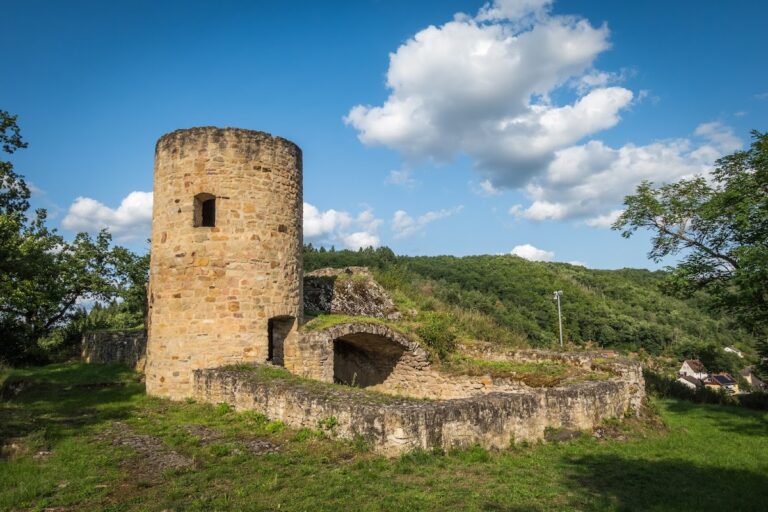
The ruins occupy a narrow mountain spur at approximately 328 metres above sea level. The Aubach and Ellenbach streams form the spur, which lies near the Nahe River. Frauenburg had a rectangular ground plan, with round towers at its corners and another round tower along the northeastern long side. This additional tower protected the former entrance and formed part of the castle’s defensive arrangement.
Towers and Defenses
The round towers on the attack side survive approximately to their full height. A neck ditch, a defensive ditch cut across the narrow connection between a spur and the higher ground behind it, lies in front of them. The southern tower rises 33 metres and survives as a prominent vertical element of the ruins. It can be climbed as a viewing tower by arrangement.