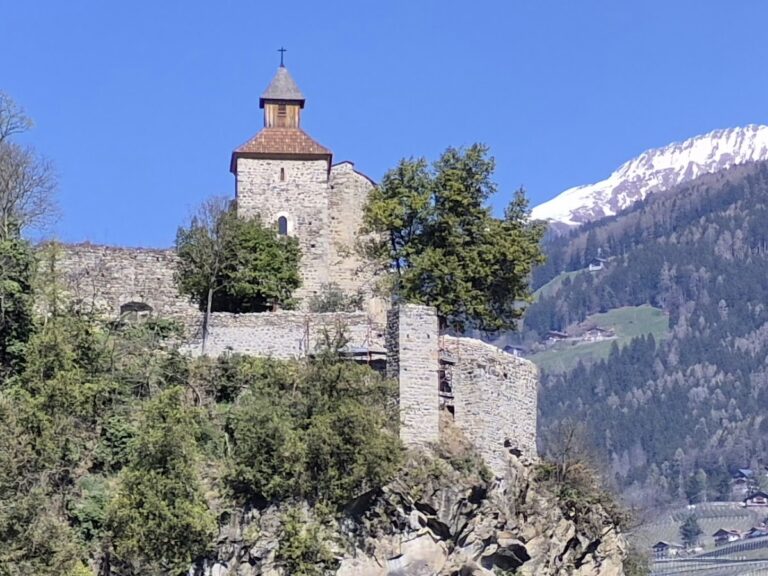
Brunnenburg: A Medieval Hillside Castle in Italy


Site at a Glance
- Rating
- 4.4
- Popularity
- Low
- Country
- Italy
- Primary era
- Medieval
- External website
- Open
- Eras represented
- Medieval, Modern
- Civilizations
- Holy Roman Empire
- Site type
- Military
- Remains
- Castle
On this page7 sections
History
Medieval origins and ownership
Brunnenburg is a medieval hillside castle in Italy, near Dorf Tirol in South Tyrol. Its construction is dated either to 1241 or to around 1250, while its earliest securely established parts belong to the thirteenth century. The castle is attributed to Wilhelm Tarant or to the Tarant noble family and stood within the territory of the Diocese of Chur. It was built in the service of Count Albert III of Tyrol.
In 1269, Bishop Bruno of Brixen granted Count Meinhard II of Tyrol control of fiefs formerly held by Wilhelm of Brunneberg. The castle then passed through several documented holders. Adelheid of Brunnenberg was mentioned in 1274, and in 1334 King Henry granted it to Petlein, described as either the widow or daughter of Wilhelm of Brunnenberg. The brothers Heinrich and Johann von Bopfingen acquired Brunnenburg in 1356. Heinrich was parish priest of Tirol, a delegate of Ludwig von Brandenburg, and captain of the County of Tyrol until 1359, while Johann was a medieval German court poet and singer.
Brunnenburg belonged to the Vögte of Matsch in 1361. In 1380, Hans Schenk von Metz and Eckhard Bilang von Pophingen received control of the castle in return for service and allegiance. It later passed to the Swiss noble family von Mülinen. Ulrich Putsch, chaplain to Duke Frederick IV of Austria and later bishop of Brixen, acquired it in 1421. Hans, or Johann, von Kripp bought Brunnenburg in 1457, and the von Kripp family retained it until 1812.
Decline and reconstruction
By 1600, Brunnenburg was already described as an old ruined castle. It subsequently came into peasant ownership, and its condition reflected a history of repeated destruction and rebuilding. In 1705, the farmer Gregor Hofer began structural restoration. The property passed to Michael Sonnenburger, a farmer and mayor of Tirol, in 1884.
A shooting range opened at the castle in 1889 during a parade of the Tyrolean Schützen, traditional regional rifle or militia associations. Archduke Franz Ferdinand attended as guest of honour. In 1903, the German industrialist Karl Schwickert of Pforzheim acquired Brunnenburg and undertook an extensive restoration. He radically reshaped the castle according to his own taste, giving it a historicist appearance that reinterpreted earlier styles and recalled Neo-Gothic castles associated with Ludwig II of Bavaria and the Rhine castle tradition. The work remained unfinished after Schwickert’s death in 1927, and the castle again fell into decay.
The de Rachewiltz family and literary use
Boris de Rachewiltz, a professor and Egyptologist, acquired Brunnenburg in 1955. He had married Mary Pound in 1946, the daughter of the American modernist poet Ezra Pound and the violinist Olga Rudge. Ezra Pound lived at Brunnenburg from 1958 to 1962 and composed the final six of his 116 Cantos there. The association with the poet became part of the castle’s modern cultural history.
The Brunnenburg Agricultural Museum was established in 1974 by Siegfried de Rachewiltz, Peter Lloyd, and Franz Haller. It presents the customs and working practices of South Tyrolean farmers. The castle also houses the Ezra Pound Center for Literature, affiliated with the University of New Orleans, and remains the seat of the de Rachewiltz family.
The name Brunnenburg probably refers to a spring that may once have existed near the castle. The historical forms Prunnenberch, used in 1285, and Brunnberg, recorded in 1437, support this interpretation. Another explanation connects the name with one of the castle’s many owners.
Remains
Castle form and restoration
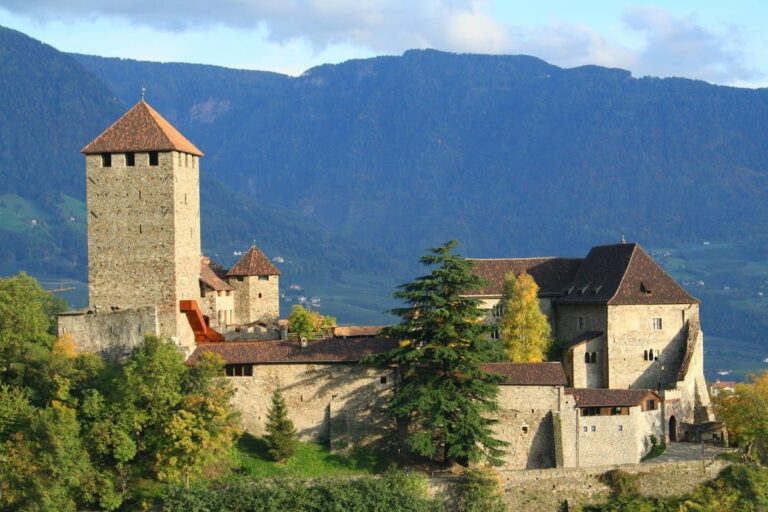
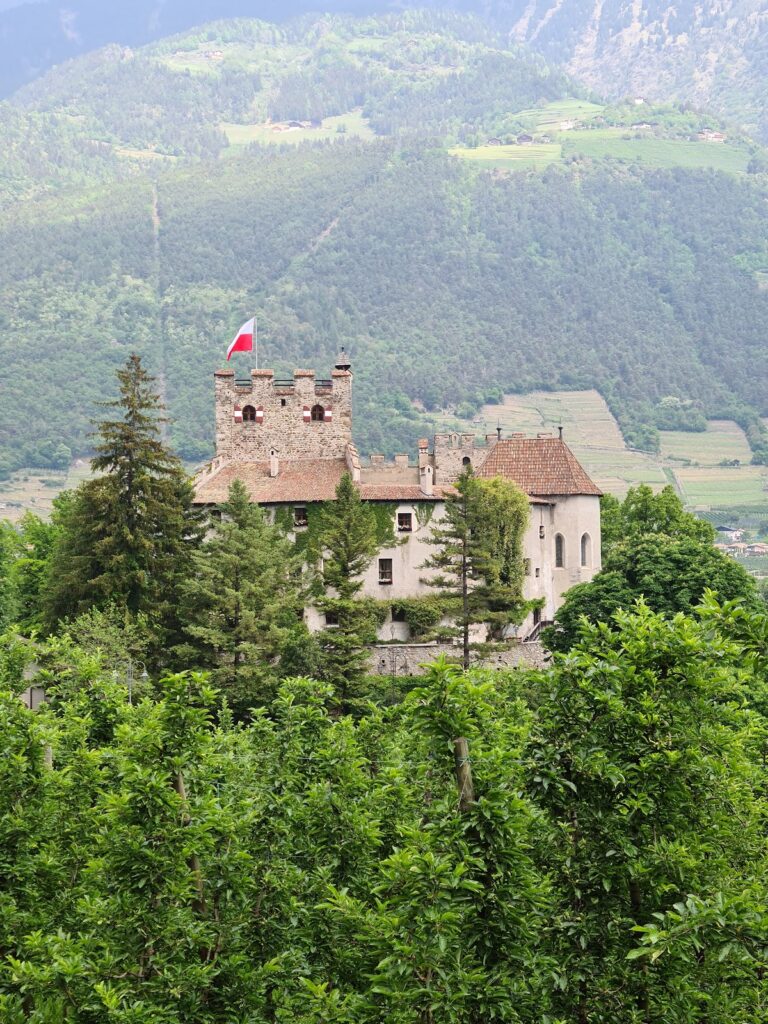
Brunnenburg is a high medieval slope castle positioned below Schloss Tirol near Meran. It occupies a hillside rather than a summit or level ground, and substantial parts of the medieval castle survive within its present structure. The appearance, however, is not historically original. Karl Schwickert’s early twentieth-century work extensively reinterpreted the castle in a historicist style, with Neo-Gothic associations and comparisons to Bavarian and Rhine castle architecture.
Present cultural institutions
The castle contains the Agricultural Museum of Brunnenburg, whose displays concern South Tyrolean rural culture, farming customs, and working practices. It also houses the Ezra Pound Center for Literature, where students from around the world study Pound’s work. These institutions occupy the surviving castle complex and connect its medieval fabric and later architectural form with regional history and literary study.
Nearby sites