Osma Castle: A Medieval Fortress in Spain




Site at a Glance
- Rating
- 4.4
- Popularity
- Low
- Country
- Spain
- Primary era
- Medieval
- Eras represented
- Medieval
- Civilizations
- Crown of Castile, Kingdom of León
- Site type
- Military
- Remains
- Castle
On this page7 sections
History
Osma Castle is a medieval fortress near El Burgo de Osma in Spain, built between the tenth and eleventh centuries and later modified during the fourteenth and fifteenth centuries. It stands on a hill between the Ucero and Abión rivers, close to the ancient city of Uxama Argaela. The castle formed part of a strategic landscape shaped by Roman routes and by the military struggles between Muslim and Christian powers during the Reconquista, the long medieval expansion of Christian kingdoms into territories ruled by Muslim states in the Iberian Peninsula.
Uxama Argaela before the castle
The earlier history of the hill is connected with Uxama Argaela, a major Celtiberian and later Roman urban centre. The Arevaci, a Celtiberian people of the central Iberian Peninsula, established the independent city before it came under Roman control from the second century BC. Uxama was mentioned by Claudius Ptolemy, Pliny the Elder, and the Antonine Itinerary, a Roman compilation describing roads and their stations across the empire.
Under Roman rule, Uxama was rebuilt and its walls were constructed over an earlier Arevaci fortification. The city issued its own coinage and possessed cisterns, pipes, and aqueducts. Water came from the source of the Ucero River, about 20 kilometres to the north. Near Ucero, a surviving 100-metre section of the aqueduct gallery is known as Cueva de la Zorra.
From late antiquity to the medieval fortress
Uxama remained inhabited during the Visigothic period. Burials and the existence of a diocese dating from before the sixth century indicate the city’s continued religious and civic importance. After the Arab conquest, it was known as Waxsima. Watchtowers were built at the city and on nearby hills, extending the system used to observe and communicate across the surrounding territory.
Roman communication routes continued to function during the medieval period and supported movement during raids and military activity associated with the Reconquista. Uxama was eventually abandoned in the Late Middle Ages as its population moved to present-day Osma. The castle was built on the hill during the tenth or eleventh century, while the Christians constructed Osma’s town walls in the fifteenth century.
Later tradition and conservation
A later tradition places Prince Ferdinand of Aragon at the castle on the night of 6 October 1469, when he was supposedly travelling secretly through Castile to marry Isabella. The story says that he arrived disguised as a merchant and was nearly killed by a crossbow bolt fired by a gatekeeper who failed to recognize him. There is no historical basis for confirming either Ferdinand’s visit to Osma Castle or the incident itself.
Between 2016 and 2020, the castle underwent consolidation and restoration. The work stabilized the surviving fabric and added interpretive signs and walkways to improve movement through the enclosure and explain its remains. Osma Castle is listed as a Spanish Asset of Cultural Interest, the country’s legal designation for protected cultural heritage, including historic monuments. It was also included on the Red List of Endangered Heritage from 2008 to 2014.
Remains
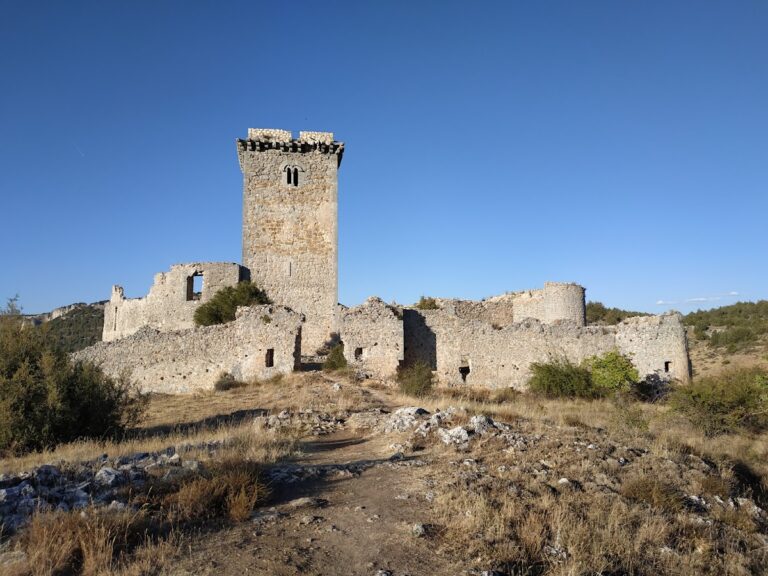
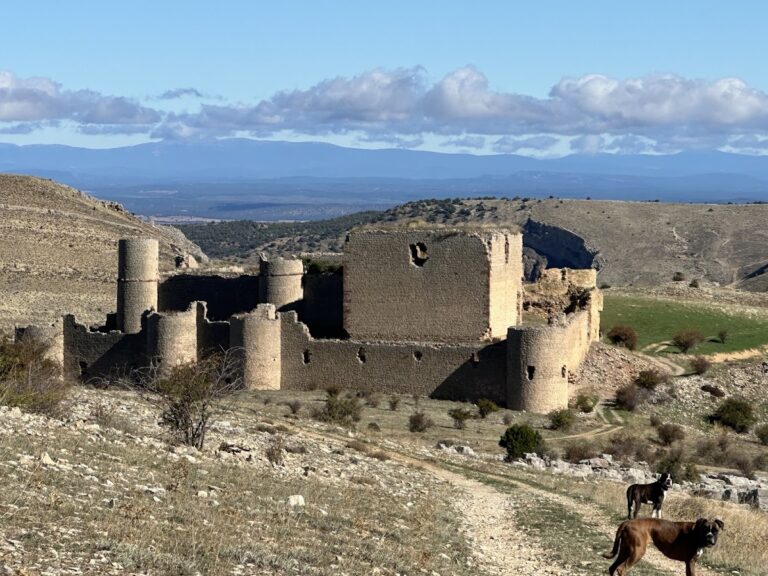
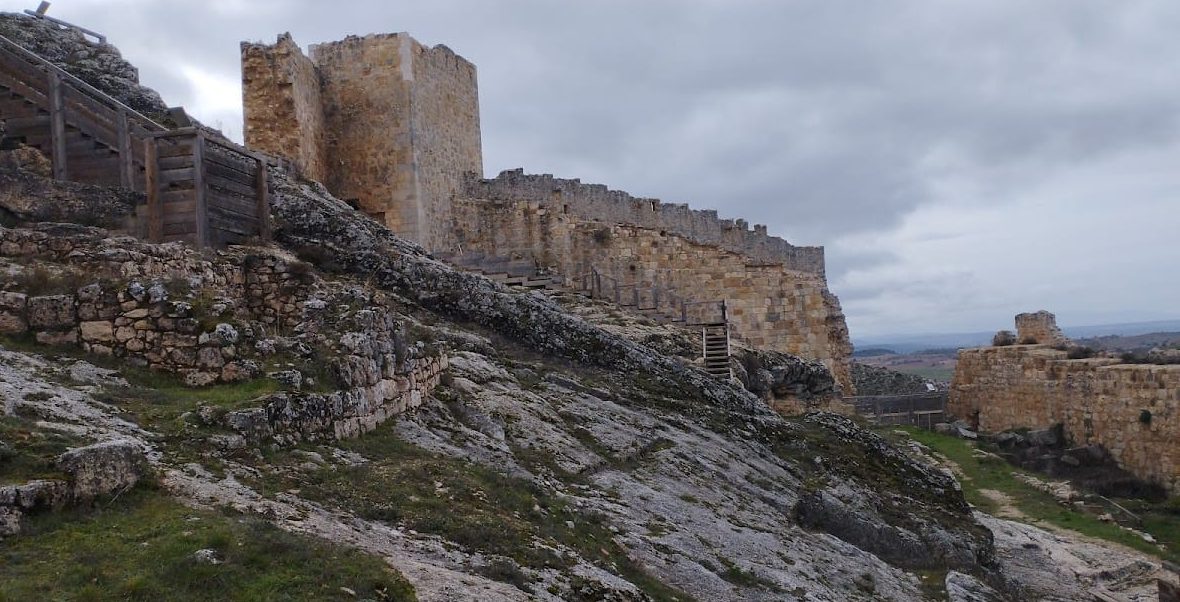
The fortress followed the contours of the hill through three irregularly shaped walled enclosures. The inner enclosure preserves comparatively high walls and an entrance gate, while the second and third enclosures survive only in fragmentary form. The castle was built mainly with rubble masonry and roughly dressed stone, incorporating reused Roman building materials such as ashlar blocks, cornices, and columns, particularly in the Water Tower.
Inner and outer enclosures
The inner enclosure retains its entrance and two towers at its eastern ends. One was the keep, or Tower of Homage, the principal fortified tower of a medieval castle and a defensive and representative stronghold. The other tower marked the point from which the second enclosure extended. The entrance gate may originally have contained a horseshoe arch, which curves inward beyond a semicircle and is characteristic of several architectural traditions of the Iberian Peninsula.
The second enclosure surrounded the first, although only scant remains survive. The third enclosure is also largely lost, leaving the Water Tower as its most prominent surviving feature. The surviving walls and towers were stabilized during the restoration campaign, which also introduced walkways through the enclosure.
Water Tower and signalling system
The Water Tower stands at the northern foot of the hill beside the Ucero River. Built to protect access to the bridge and the collection of water, it contains much of the reused Roman stone associated with the fortress. Its position connected the lower water access with the higher fortified enclosures.
Additional watchtowers stood at higher elevations around the fortress, including those at Uxama, Valdenarro, and Lomero. These fortified observation posts monitored the surrounding territory and communicated with Osma Castle through visible signals.