Uniejów Castle: A Medieval Frontier Fortress and Episcopal Residence in Poland


Site at a Glance
- Rating
- 4.5
- Popularity
- Medium
- Country
- Poland
- Primary era
- Medieval
- External website
- Open
- Eras represented
- Medieval, Early Modern, Modern
- Civilizations
- Kingdom of Poland
- Site type
- Domestic
- Remains
- Castle
On this page7 sections
History
Uniejów Castle is a fourteenth-century Polish fortress and residence in Uniejów, Poland, built between 1360 and 1365 in the Gothic period. Archbishop Jaroslaw Bogoria Skotnicki of Gniezno initiated its construction on the site of wooden fortifications destroyed during a Teutonic invasion of the town in 1331. The castle formed part of a frontier-fortification system protecting access from the north toward the centre of the state.
Fortress and Episcopal Centre
Alongside its military role, the castle became an important administrative and diocesan centre. It housed the valuable library, archive, and treasury of Gniezno Cathedral. Its importance also made it a suitable setting for major ecclesiastical meetings. In 1376, a synod took place there with the participation of a papal nuncio, a diplomatic representative of the pope sent on an official church mission.
Renaissance and Baroque Transformations
A fire in 1525 led to a major rebuilding campaign. Stanislaw of Gomolina, the local starosta, an administrative official responsible for governing a territory or managing an estate, reconstructed the castle as a Renaissance residence. The work was completed in 1534, and the rebuilding removed most of the earlier Gothic character.
During the first half of the seventeenth century, the castle ceased to function primarily as a defensive stronghold and took on an early Baroque form. It became the residence of Bishops Jan Wężyk and Maciej Łubieński. The entrance portal from this period bears the coats of arms of both churchmen.
Damage, Aristocratic Ownership, and Restoration
Saxon troops devastated the castle in 1704. A fire in Uniejów in 1736 then destroyed the roofs above the residential buildings and the tower. Bishop Krzysztof Antoni Szembek subsequently arranged repairs to the damaged roofs and buildings.
In 1836, the tsar granted the castle and a comital title, a rank equivalent to that of count or earl, to Karol Toll, an Estonian-born general, for his services in suppressing the November Uprising. Toll never lived at Uniejów Castle. His son Aleksander undertook a Classicist reconstruction in a Romantic style in 1848. The Toll family became Polonized and retained ownership until the end of the First World War.
The castle suffered severe devastation during the Second World War and the postwar period. Restoration carried out between 1956 and 1967 adapted the building for use as an archive. Uniejów Castle is a principal historic landmark of the town and is protected as a cultural heritage monument in Poland under register entry 256/714, dated 21 October 1967. The complex now accommodates a hotel, conference centre, and restaurant.
Remains
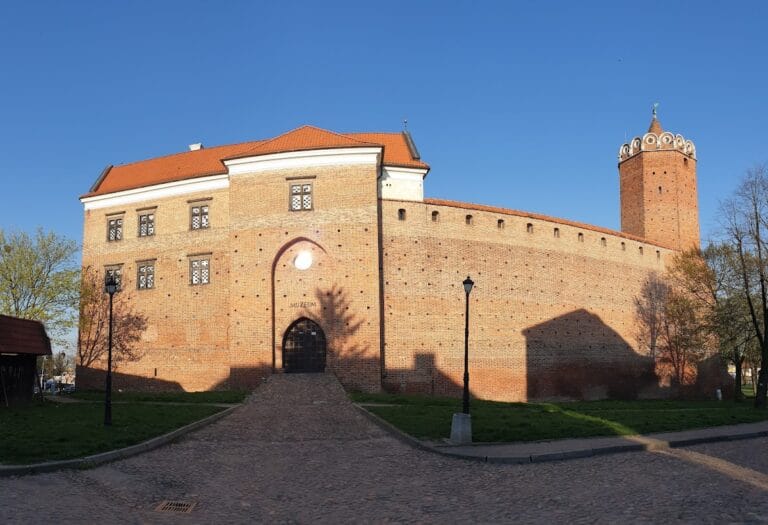
Uniejów Castle stands on the left bank of the Warta River and is arranged on a quadrilateral plan. Its surviving form reflects successive changes from a Gothic frontier fortress to a Renaissance residence and then an early Baroque episcopal seat. The castle’s original defensive design included a cylindrical tower 25 metres high. This keep-like tower was intended to provide a strong defensive refuge and command point, although its roofs were destroyed in the 1736 fire and later repaired.
Castle Residence
The sixteenth-century rebuilding reshaped the Gothic complex as a Renaissance residence, while alterations in the early seventeenth century produced its early Baroque appearance. The entrance portal belongs to the period associated with Bishops Jan Wężyk and Maciej Łubieński and preserves the coats of arms of both bishops. Later restoration and adaptation changed the building for archival use before the complex assumed its current hospitality and conference functions.
Romantic Landscape Park
West of the residence is a Romantic landscape park established by Aleksander Toll’s wife. The park contains many species of native and foreign trees and forms part of the historic castle complex alongside the restored residence and tower.