Burg Parsberg: Hilltop Castle and Seat of the Parsberg Family


Site at a Glance
- Rating
- 4.6
- Popularity
- Low
- Country
- Germany
- Primary era
- Early Modern
- External website
- Open
- Eras represented
- Medieval, Early Modern
- Civilizations
- Duchy of Bavaria, Holy Roman Empire
- Site type
- Military
- Remains
- Castle
On this page10 sections
History
Medieval origins and rebuilding
Burg Parsberg is a hilltop castle in Parsberg, Germany, first recorded in 1205 as Castrum Bartesperch. A confirmation document from 1224 uses the name Parsperch. The castle was the ancestral seat of the Parsberg family, whose members included knights, landed nobles, and ministeriales, medieval service nobles who held official, military, or administrative positions for higher-ranking lords.
The first castle was probably destroyed after a short siege in 1315, during the conflict between Duke Rudolf I of Bavaria and his younger brother, Ludwig IV. Dietrich von Parsberg was one of Rudolf I’s leading followers. The castle was rebuilt on the hill after its destruction. Much of the later building sequence remains uncertain. An expansion is provisionally dated to around 1450, while Haug von Parsberg is thought to have brought the complex into its present form during the mid-sixteenth century.
War, administration, and changing use
A tradition holds that Swedish forces destroyed Burg Parsberg in 1632 during the Thirty Years’ War, the European conflict of 1618 to 1648 that involved religious, dynastic, and territorial struggles across the Holy Roman Empire and neighbouring states. This account is considered unlikely. The claim that the entire complex was rebuilt after the war, along with a proposed mid-seventeenth-century enlargement of the Lower Castle, remains hypothetical.
In 1799, following the dissolution of the administration of the cabinet estates, Parsberg came directly under the Electoral Court Chamber in Munich, a Bavarian court authority that administered the elector’s estates and related finances. In 1803, the Imperial Deputation Act reorganized territories within the Holy Roman Empire and transferred numerous ecclesiastical and imperial holdings to secular rulers. Under this settlement, Parsberg became part of the Electorate of Bavaria.
Also in 1803, the Royal Bavarian District Court of Parsberg was formed from the district court offices of Parsberg, Velburg, and Lupburg. During the second half of the nineteenth century, it became a local court based in the castle, and the complex was remodelled for judicial and residential use. Since 1918, Burg Parsberg has belonged to the Free State of Bavaria, the successor to the Kingdom of Bavaria.
Museum and modern preservation
After the District of Parsberg was dissolved in the 1972 administrative reform, offices and authorities left the castle. The complex remained unused until 1974, when the City of Parsberg leased it from the Free State for municipal administration, representational purposes, and housing. The city administration moved to the former district office, now the town hall, in 1980.
A provisional museum opened in seven rooms of the Lower Castle in 1981. From 1981 to 1982 onward, the building was progressively converted into the Parsberg Castle Museum, devoted to folklore and contemporary history. The museum has attained considerable importance within Bavaria. Burg Parsberg is protected under Bavarian heritage law as both an archaeological monument, covering medieval and early-modern remains in the area of the former palace and castle ruins, and an architectural monument.
Remains
Castle buildings and entrances
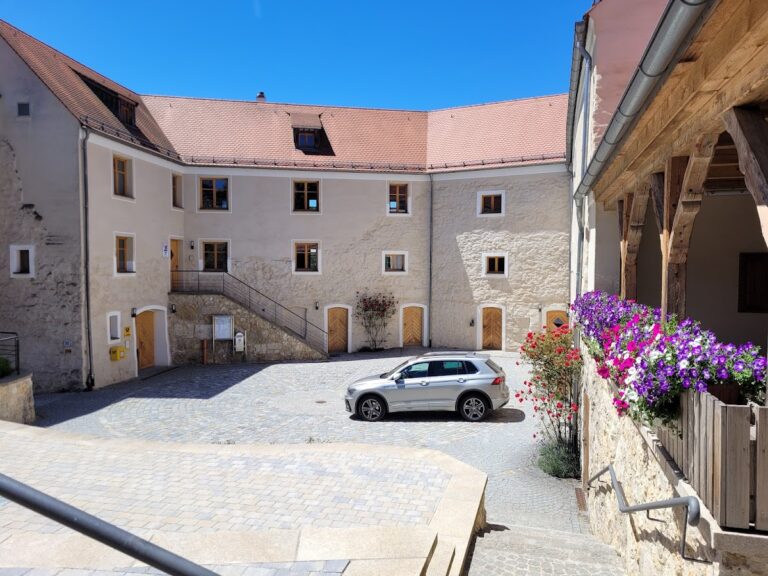
Burg Parsberg stands at approximately 550 metres above sea level and consists of an Upper Castle, a Lower Castle, and a ruin on the summit. The complex survives in whole or substantial parts, preserving the principal upper and lower buildings and their connected entrances.
Upper Castle
The Upper Castle is distinguished by towers crowned with onion-shaped domes. An onion dome is a bulbous, often tapering dome used as the crowning element of a tower or roof. The upper buildings form part of the arrangement already shown in a depiction of Burg Parsberg dated 1600.
Lower Castle
The Lower Castle was enlarged during the later development of the complex and now houses the Parsberg Castle Museum. Its present use reflects the building’s later transformation for institutional and residential purposes while retaining its place within the historic castle complex.
Gateways and defensive passage
The outer arched gateway opens into the gate courtyard and carries frescoed coats of arms associated with the Parsberg family, the Counts of Schönborn, and the Bavarian state. The frescoes were later painted over and would need to be exposed again. A simpler archway leads into the inner courtyard; beside it is a small stone plaque with the Parsberg coat of arms, the inscription “Parsperg,” and the date 1600. The entrance was formerly protected by a triple gate zwinger, a fortified space between defensive barriers that exposed attackers to defensive fire. Scant traces of this arrangement survive.
Summit ruin
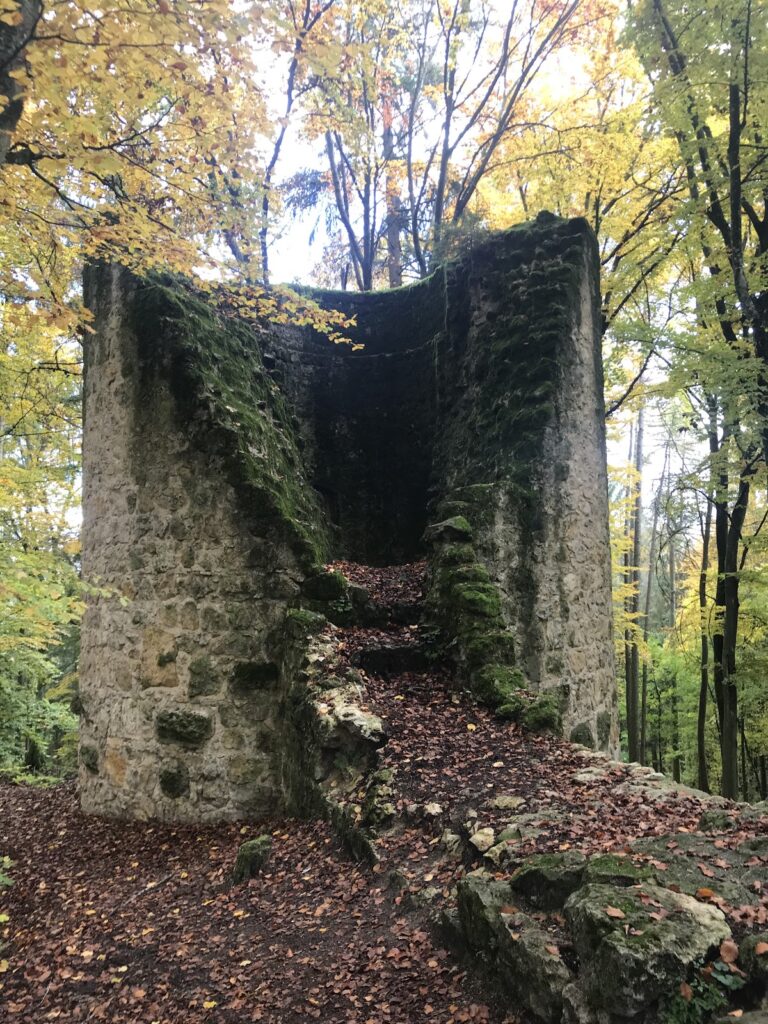
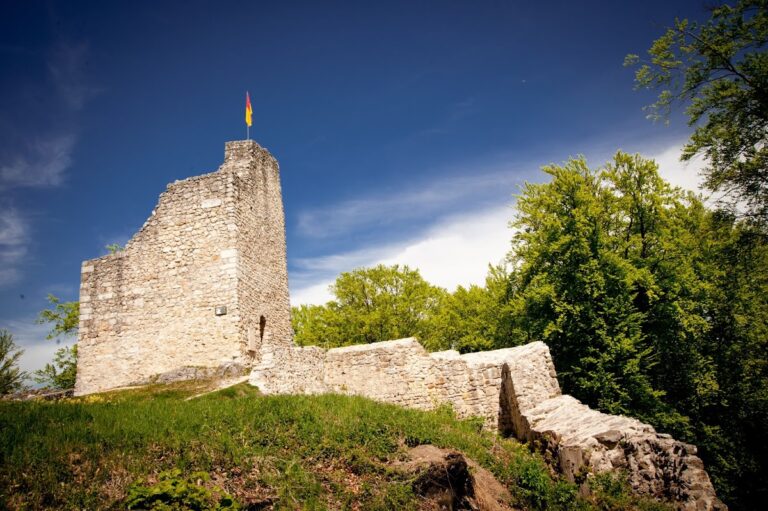
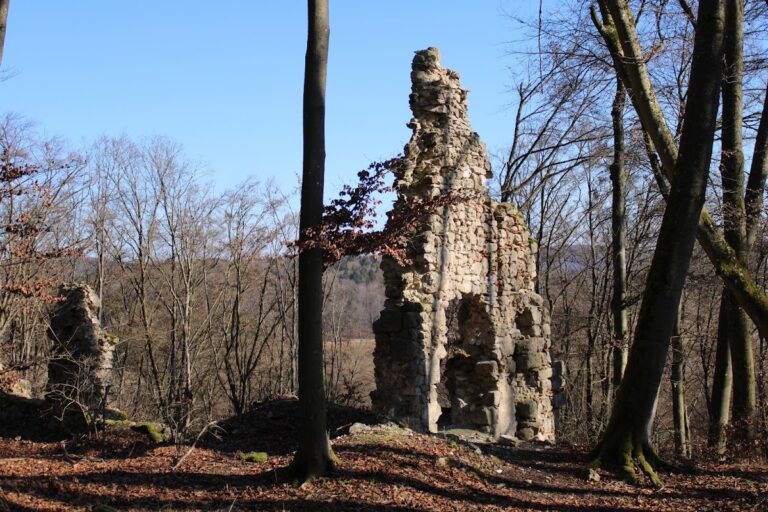
An older castle ruin stands on the hilltop summit as a distinct surviving part of Burg Parsberg. It forms the highest element of the site alongside the preserved Upper and Lower Castles and represents the earlier castle remains within the wider complex.