Bungay Castle: A Norman Fortress in England


Site at a Glance
- Rating
- 4
- Popularity
- Low
- Country
- United Kingdom
- Primary era
- Medieval
- Eras represented
- Medieval
- Civilizations
- English, Norman
- Site type
- Military
- Remains
- Castle
On this page8 sections
History
Bungay Castle is a Norman fortress in the United Kingdom, built by Roger Bigod around 1100 beside a bend in the River Waveney. Its Norman architecture reflects the culture and building traditions associated with Norman rulers and their successors in medieval England. The site’s natural position offered defensive protection, while its later history connected it to royal authority, rebellion, aristocratic inheritance, destruction, and restoration.
Norman origins and the Bigod family
Roger Bigod established the castle around 1100. His son Hugh became a prominent participant in the Anarchy, the civil war fought mainly between supporters of Empress Matilda and King Stephen during the succession crisis following Henry I’s death. After Hugh’s loyalty was questioned during the early part of Henry II’s reign, the king confiscated Bungay Castle. It was returned to the Bigod family in 1164.
Roger Bigod built a large square Norman keep in 1165. A keep was the principal fortified stronghold within a medieval castle. Hugh Braun, who later directed excavations at Bungay, estimated that constructing the keep would have cost about £1,400.
Rebellion, siege, and rebuilding
Roger Bigod supported the losing side in the revolt of 1173–1174, an uprising against Henry II’s authority. Royal forces besieged Bungay, mined its defenses, and then slighted the castle. Slighting meant deliberately partly demolishing or disabling a fortification so that it could no longer serve effectively in war. Historian Sidney Painter regarded Bungay as one of at least 21 castles demolished on Henry II’s orders.
The castle was later restored to the Bigod family. Roger Bigod, 5th Earl of Norfolk, developed it further in 1294 and probably built the massive gate towers. Roger subsequently fell out with Edward I, who reigned from 1272 to 1307. After Roger’s death, Bungay reverted to the Crown and deteriorated. In 1310, Edward II granted income from Bigod lands, including Bungay, to support his younger half-brothers Thomas of Brotherton and Edmund of Kent.
Later medieval ownership
Thomas of Brotherton received the vacant earldom of Norfolk and Bungay Castle in 1312. He was Edward II’s younger half-brother and became a powerful English nobleman. After Thomas died in 1338, the castle passed to his daughter Alice Montagu.
Alice Montagu had married Edward Montagu, the younger brother of William, 1st Earl of Salisbury. At Bungay Castle, Edward Montagu and two retainers beat Alice so severely that she died in January 1352. Edward retained the castle until his death in 1361.
Decline, literary association, and protection
The Dukes of Norfolk reacquired Bungay Castle in 1483 and held it until the twentieth century, except for a brief period in the late eighteenth century. In 1766, Robert Mickleborough purchased the site and quarried the keep and curtain walls for road-building material. A curtain wall was the defensive wall enclosing a castle’s interior.
Daniel Bonhôte, a local solicitor, bought Bungay Castle in the early 1790s, but it was sold back to the Dukes of Norfolk around 1800. Dwellings constructed on the site were removed in 1841. Elizabeth Bonhôte later used the castle as the setting for her Gothic romance Bungay Castle, published in 1796, a few years after her husband acquired the property.
Bungay Castle was scheduled for protection in 1915, among the first sites protected under the Ancient Monuments Consolidation and Amendment Act 1913. A scheduled monument is an archaeologically or historically important site protected under United Kingdom law. The castle became a Grade I listed monument in 1949, the highest category of listed-building protection in England.
Excavations led by the amateur archaeologist Leonard Cane preceded restoration supervised by Hugh Braun, which began in 1934. In 1987, the 17th Duke of Norfolk gave the castle to the town of Bungay. The Bungay Castle Trust now owns the site.
Remains
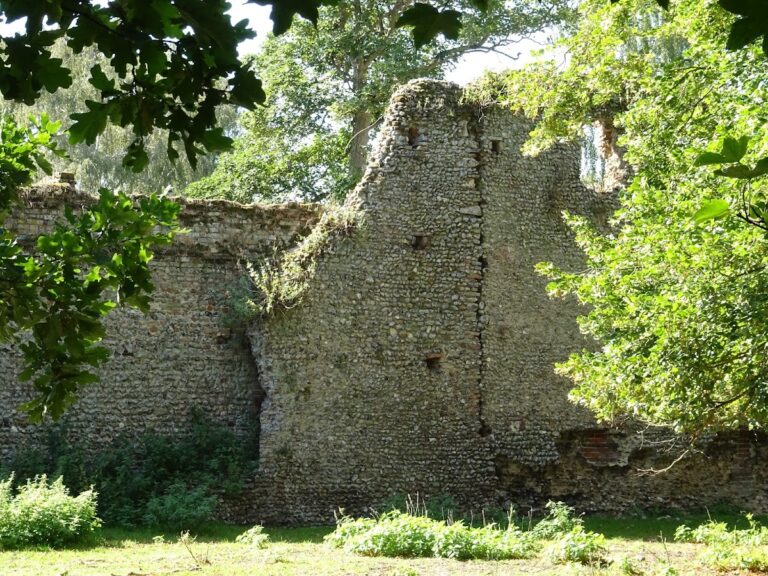
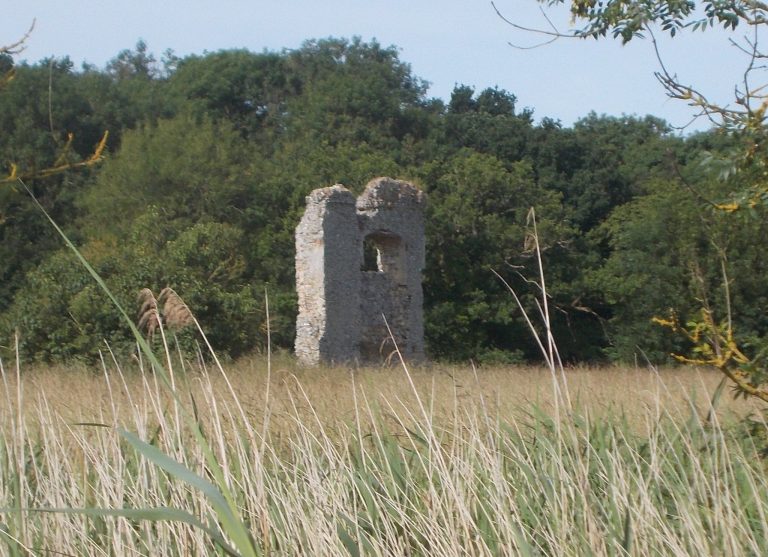
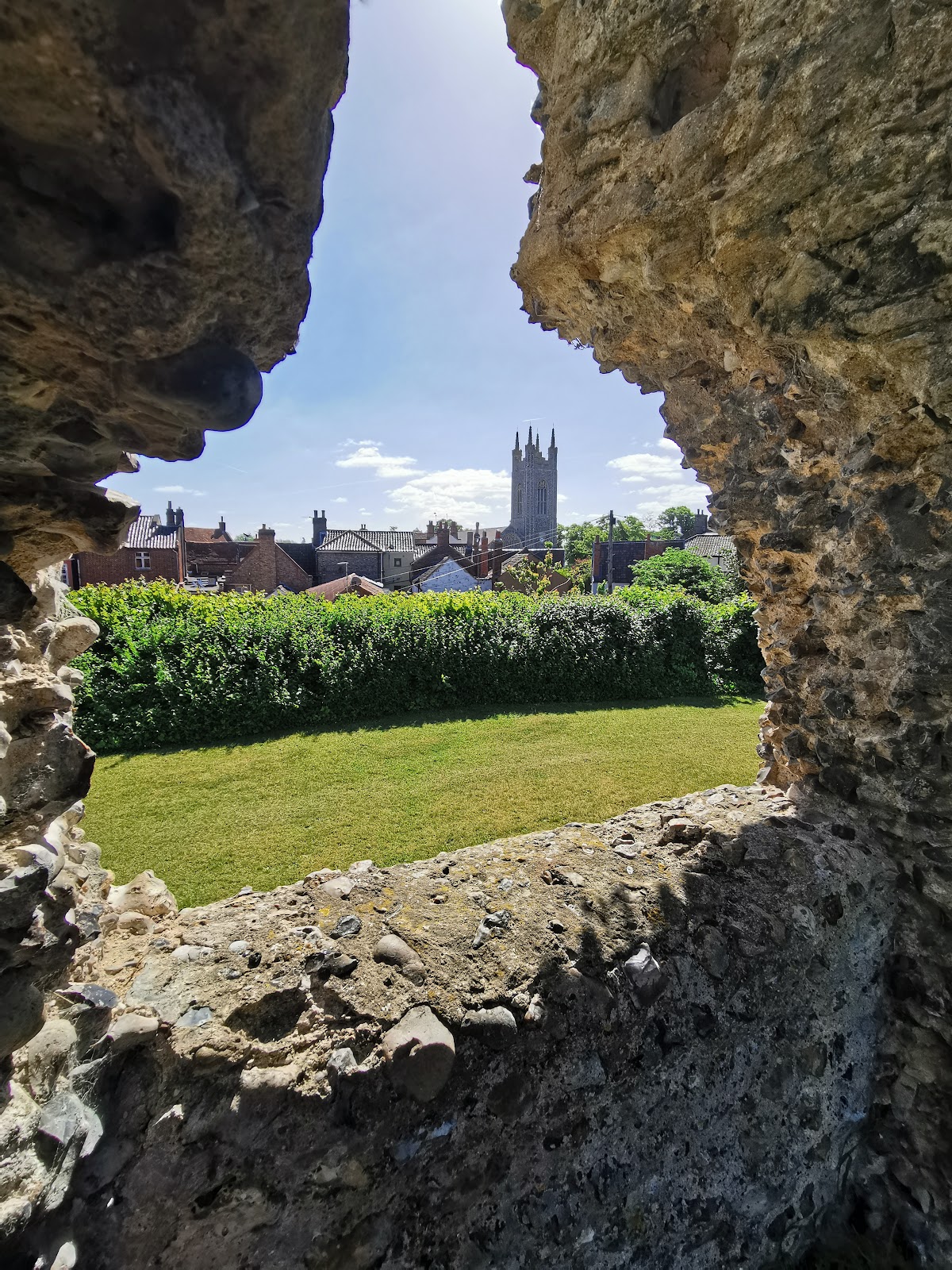
Bungay Castle occupies ground beside a curve in the River Waveney, whose course provided a natural defensive element. The surviving structure is a restored ruin built of stone, consisting of a fragment of the large square keep, sections of curtain wall, and a gatehouse with twin towers. Parts of the keep and curtain walls were quarried for road-building material in 1766, while restoration work began after archaeological excavations in the 1930s.
The Norman keep
The large square keep was built in 1165 as the castle’s principal fortified stronghold. Only a fragment survives. Its remaining stone fabric forms part of the restored ruins and preserves evidence of the major rebuilding undertaken by Roger Bigod during the castle’s Norman phase.
The curtain walls and gatehouse
The castle’s curtain walls enclosed its interior and remain in partly surviving form. The gatehouse controlled entry through this defensive enclosure and included twin towers. These massive gate towers were probably constructed during Roger Bigod’s redevelopment of the castle in 1294. The walls and towers now survive as restored ruins, alongside the fragment of the keep.