Castelpagano: A Medieval Hilltop Fortress in Italy
Site at a Glance
- Rating
- 4.7
- Popularity
- Very Low
- Country
- Italy
- Primary era
- Medieval
- Eras represented
- Medieval
- Civilizations
- Byzantine, Norman
- Site type
- Military
- Remains
- Castle
On this page12 sections
History
Castelpagano is the ruin of a medieval hilltop fortress in Italy, in the territory of Apricena in Apulia. Probably built before Apricena was founded during the second half of the ninth century, it occupied an elevated position suited to controlling the surrounding territory. The castle is classified in one interpretation as Byzantine in style, although its foundation remains uncertain. Its history is closely linked with the settlement around it and with San Marco in Lamis, especially the monastery of Santa Maria di Stignano.
Norman and Imperial Rule
By the eleventh century, Castelpagano was a flourishing settlement under Henry of Monte Sant’Angelo, a Norman count. After a long and severe war, the fief passed from Rainulf, Count of Aversa, to Roger, Lord of Rignano. Its high position was regarded as almost impregnable, but the fortress was captured in 1137 by Lothar III, the Holy Roman Emperor, during his campaign against Roger. Fighting for Rignano and the Castelpagano fief killed hundreds of people.
In 1177, William II, king of Sicily, granted the monastery of San Giovanni de Lama, now known as the monastery of San Matteo, together with Santa Maria di Pulsano and other lands, as an appanage to his wife, Queen Joanna, daughter of Henry II of England. An appanage was land or revenue assigned to a member of a ruling family. Castelpagano also appears in a document dated 21 September 1231, which tells of Leonardo di Falco, a blind beggar said to have regained his sight after an apparition of the Virgin Mary.
Frederick II, the medieval emperor of the Holy Roman Empire who also ruled the Kingdom of Sicily, lived in nearby Apricena and restored Castelpagano. He adapted the castle for hunting and placed there a loyal garrison made up exclusively of Saracens, a medieval European term for Muslims associated with Islamic regions of the Mediterranean. The traditional explanation for the name Castelpagano refers to the medieval Italian use of pagani for non-Christians.
Later Ownership and Abandonment
The settlement later became a fief of Manfred, Frederick II’s son and the founder of Manfredonia, before returning to royal control. In 1496, Ferdinand II of Aragon granted Castelpagano to Ettore Pappacoda of Naples. Pappacoda sponsored the construction of the sanctuary of Santa Maria di Stignano in 1515. When his family became extinct, the castle returned to the royal demesne.
On 10 March 1580, Antonio Brancia purchased the castle complex from Philip II of Spain for 90,000 ducats. The Mormile family owned the estate in 1732. It later passed to Don Garzia of Toledo and, in 1768, to Prince Cattaneo di Sannicandro. Earthquakes repeatedly damaged Castelpagano and its surroundings. Records of the earthquake of 1627 describe extensive destruction at Apricena and across the surrounding area.
The settlement was gradually abandoned at the beginning of the seventeenth century, probably because of serious water shortages, and its inhabitants moved to Apricena. Local shepherds later plundered the deserted complex and reused its stones for shelters in the valley of Sant’Anna. Castelpagano is recognized as Italian national heritage.
Traditions and Religious Associations
The story of Leonardo di Falco became one of three local traditions connected with Castelpagano. According to the account, the Virgin Mary directed him toward an image on a large oak near the place where the sanctuary of Santa Maria di Stignano was later built.
A second tradition describes a battle in the valley of Stignano between the Archangel Michael and the Devil, who had taken the form of a gigantic serpent. The supposed bones of the serpent were later taken to the sanctuary of Stignano.
A third legend tells of a Saracen prince of Castelpagano who loved a princess living in a castle on Monte della Donna. He was supposedly required to construct a bridge of animal skins between the mountain and Castelpagano, and went mad while attempting the task. The story is unproven, although Saracen influence in the area and Frederick II’s Saracen military corps provide a historical background for part of the tradition. No castle is known on Monte della Donna. A semicircular watchtower once stood on the raised ground called Volta Pianezza, where only its perimeter wall survives.
Remains
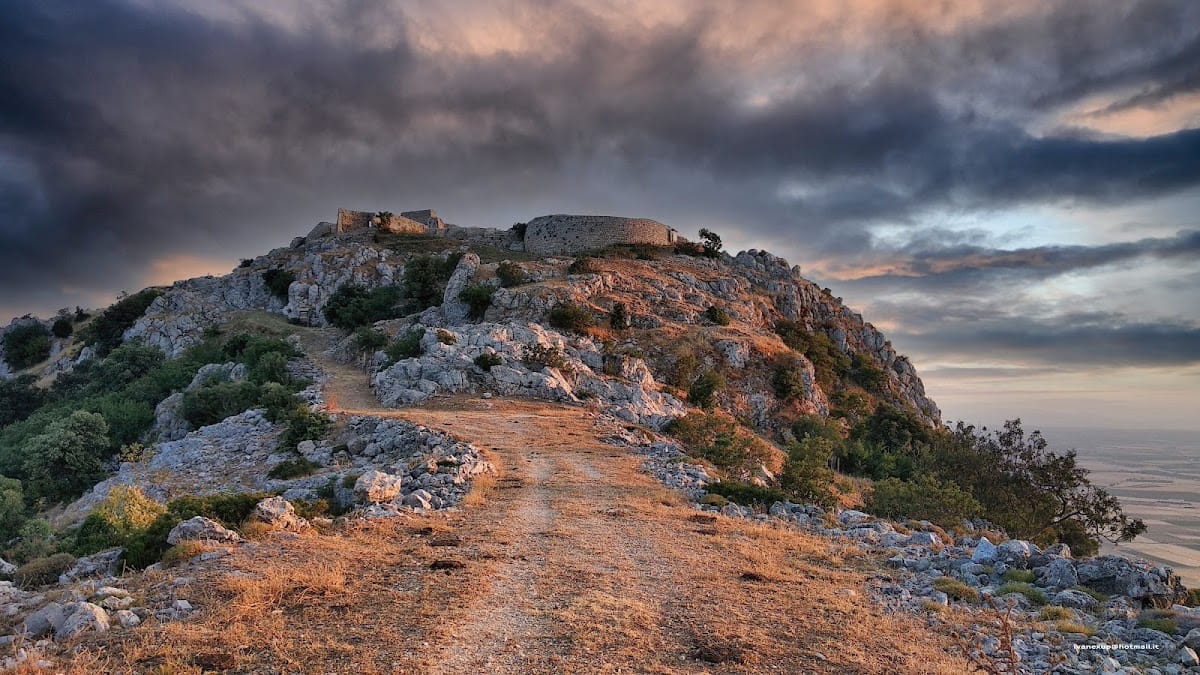
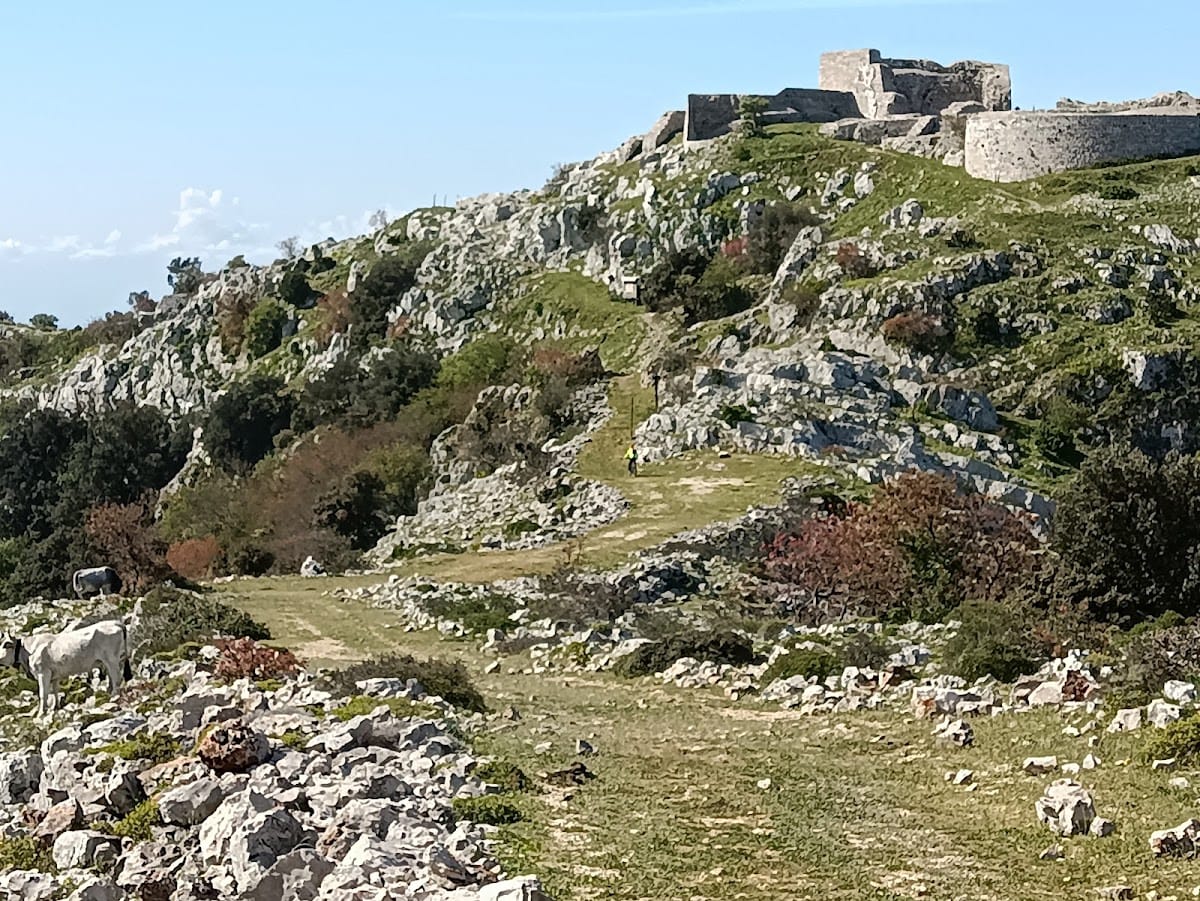
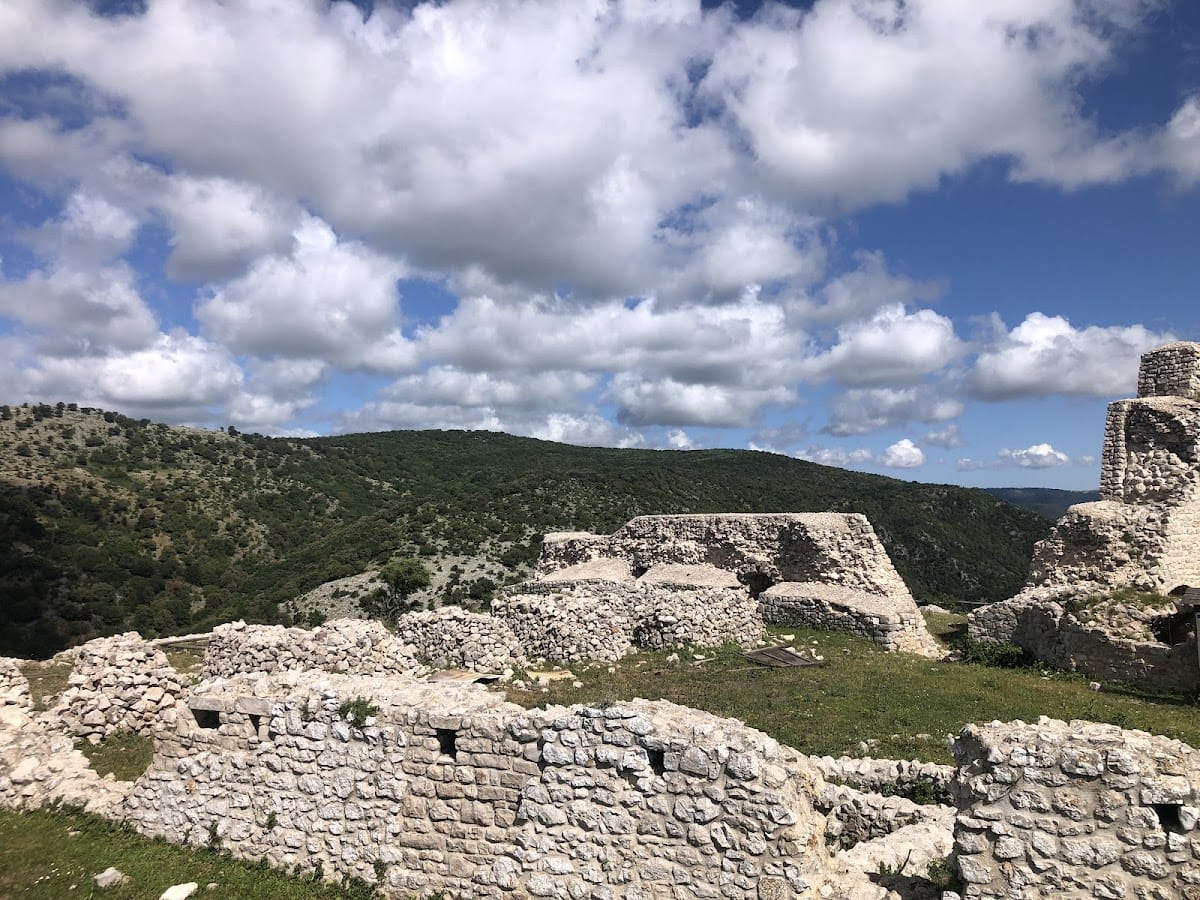
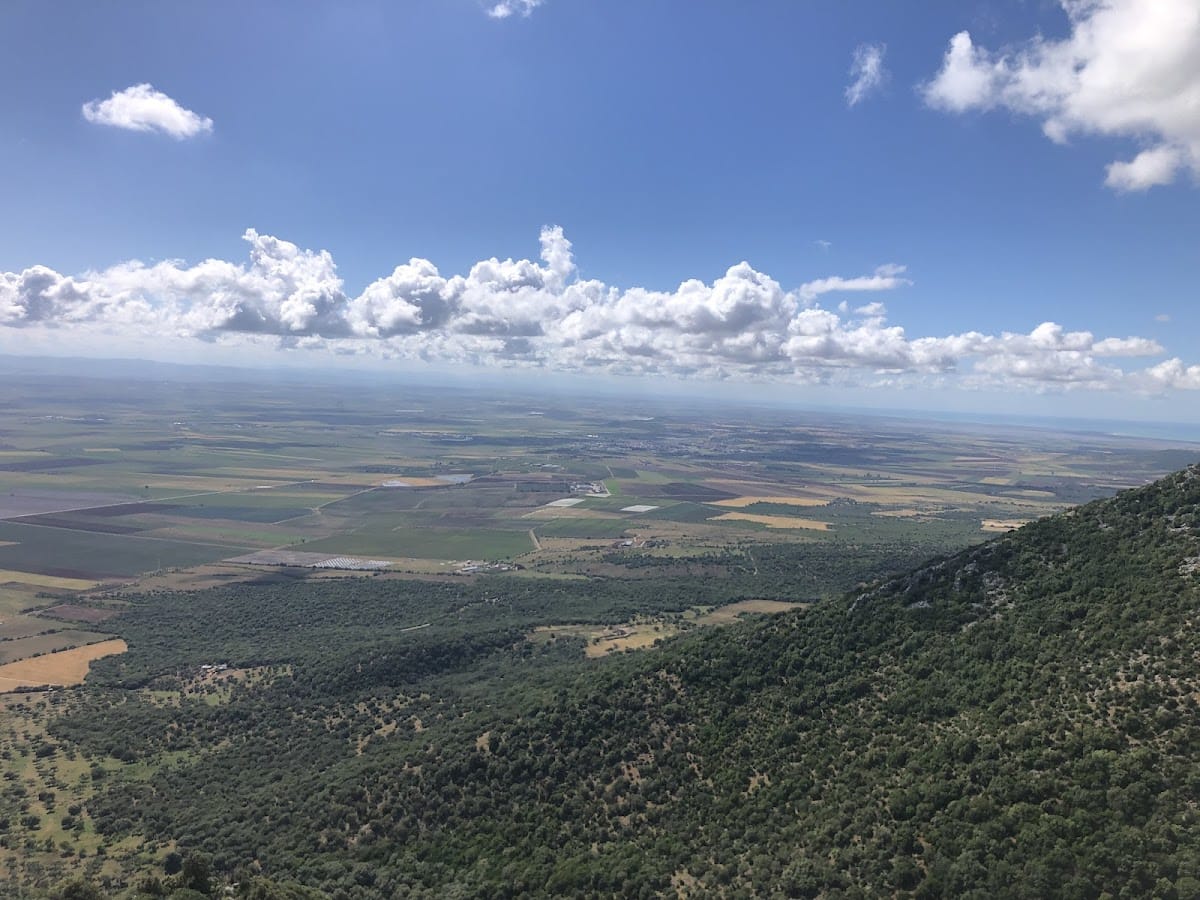
The ruins occupy a rocky spur of the Gargano in the southwestern part of the massif, approximately 500 metres above sea level. The medieval fortress was built with rough stone masonry, using irregular stones rather than regularly cut blocks. Its elevated position provided control over the surrounding territory, with views toward the Gargano and the mountains of Molise on one side and across the Tavoliere delle Puglie on the other.
Fortification Walls and Towers
Main Enclosure Wall
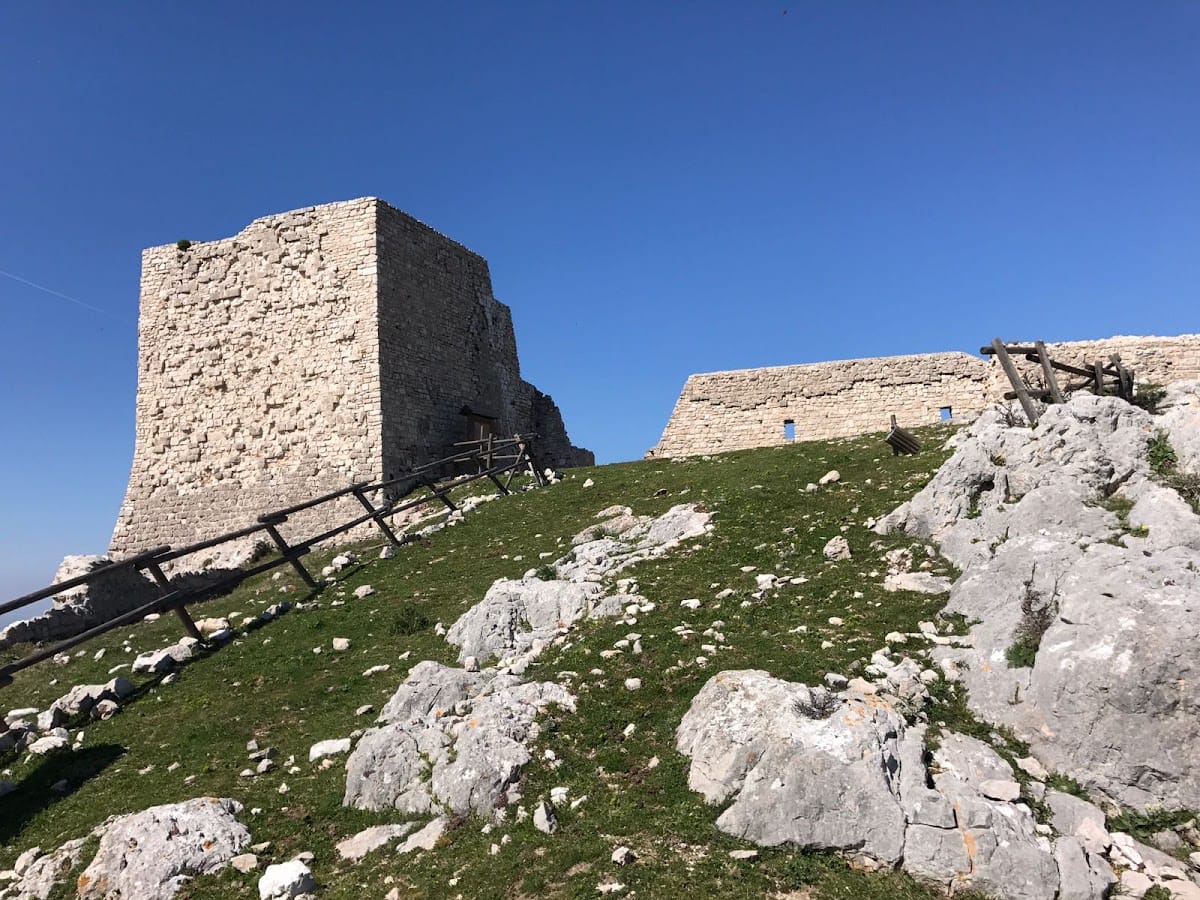
The principal surviving wall extends for approximately 50 metres and rises no more than 1.5 metres. Two openings in it were formerly doorways with dressed stone jambs. At the left end, the wall turns a corner and continues into a very short masonry remnant. At the right end, it meets a circular tower. From that tower, a continuous wall descends steeply toward the valley. The wall is slightly battered, meaning that it slopes inward as it rises. A third wall closes the enclosure on the south, producing a roughly quadrilateral plan.
Circular and Corner Towers
The circular tower at the end of the principal wall survives to no more than 5 metres in height. A larger tower rises at one corner of the enclosure. It has five faces and stands approximately 6 to 7 metres high. Additional wall traces remain inside the quadrilateral enclosure, but they do not allow the internal arrangement of the castle to be reconstructed.
Caves and Archaeological Evidence
Lia Cave
Numerous ravines, cavities, and caves occur around the ruins. The Lia Cave, approximately 200 metres deep, is described as a refuge used by brigands in the fourteenth century.
Settlement Evidence
Artefacts found around the ruins predate the medieval period, indicating activity before the castle’s medieval phase. Human remains point to the former presence of a cemetery. Numerous wells and cisterns also survive or have been identified around the settlement. Their concentration reflects the need to collect and store water in a dry landscape without streams, a condition that helps explain the settlement’s later abandonment.
Volta Pianezza Watchtower
On the raised ground called Volta Pianezza, before Monte della Donna, a formerly semicircular observation tower survives only as a perimeter wall. This remnant is associated with the local tradition concerning the Saracen prince and the princess of Monte della Donna, although the legendary castle on the mountain has not been established.