Dingwall Castle: A Medieval Fort and Royal Castle in Scotland


Site at a Glance
- Rating
- 3.7
- Popularity
- Very Low
- Country
- United Kingdom
- Primary era
- Medieval
- Eras represented
- Medieval
- Civilizations
- Kingdom of Scotland
- Site type
- Military
- Remains
- Castle
On this page12 sections
History
Dingwall Castle was a medieval fort and royal castle in Dingwall, Scotland, United Kingdom. Its origins are uncertain, but it is believed to have been established by Norse settlers in the eleventh century. Tradition also associates the site with the birthplace of Macbeth, king of Scots. The castle is securely attested by the late twelfth century, when William the Lion ordered an existing structure to be strengthened.
Norse Origins and the Earls of Ross
The castle later came into the possession of the Earls of Ross, the hereditary rulers of the earldom of Ross in northern Scotland, who further reinforced it. During the Wars of Scottish Independence, the late-thirteenth- and early-fourteenth-century conflicts in which Scotland resisted English efforts to establish political control, the castle was held by forces of Edward I of England. Scottish forces later captured it for Robert the Bruce under the leadership of Uilleam, Earl of Ross.
In 1314, the Earl of Ross led the men of Ross from Dingwall to fight the English at Bannockburn, where Robert the Bruce defeated the English forces. In 1321, Robert the Bruce granted Dingwall Castle, together with the town and lands of Dingwall, to the Earl of Ross as a reward.
Conflict and Lordship in the Fourteenth and Fifteenth Centuries
In 1370, a feud between William de Moravia, 5th Earl of Sutherland, and Iye Mackay, 4th of Strathnaver, brought the rivals to the castle for a meeting intended to settle their dispute. Iye Mackay and his son Donald Mackay were murdered there while asleep by Nicholas Sutherland, the earl’s brother.
At the beginning of the fifteenth century, Thomas Munro, brother of Hugh Munro, 9th Baron of Foulis, is said to have killed the castle’s governor in a duel at Maryburgh. Robert Stewart, Duke of Albany, had appointed the governor. The killing is described as an assassination, after which a Mackay took the governor’s place.
In 1411, Domhnall of Islay, Lord of the Isles, captured Dingwall Castle while pursuing his claim to the Earldom of Ross through his wife, Mariota Leslie. The capture took place shortly before the Battle of Harlaw. During the 1430s, Alexander of Islay, Earl of Ross, received official recognition of the title and made Dingwall Castle his residence. His son, John of Islay, later lost the earldom when it was confiscated, and the castle returned to royal possession in the 1470s. James III, king of Scots from 1460 to 1488, subsequently granted it to his younger son James, who became Duke of Ross, a Scottish royal title associated with the Ross region.
Royal Governors and Later Fortification
After the return to royal control, John Munro, 11th Baron of Foulis, became governor, followed by Andrew Munro, 2nd of Milntown. Sir James Dunbar held the office from 1488. Later governors included John Stewart, 2nd Earl of Atholl, James Stewart, 1st Earl of Moray, David Sinclair, George Munro of Milntown, also known as of Docharty, Sir Andrew Keith, Lord Dingwall, and Sir John Preston, later Earl of Desmond. A castle governor administered and defended the stronghold on behalf of its holder.
In 1507, Andrew Stewart, Bishop of Caithness, improved the castle after attacks by the MacDonalds and Mackenzies, and a new great hall was built. Continued assaults by Highland clans led later governors to enlarge the defensive perimeter. Supporters of Mary, Queen of Scots, captured the castle in October 1568.
Abandonment and Ruin
The Crown abandoned Dingwall Castle around 1600. The complex then fell into ruin and ceased to be maintained after the death of James VI of Scotland in 1625. Stone from the ruined castle was reused for houses on lands associated with Clan Mackenzie from about 1750. The remaining usable stones were employed in new buildings in Dingwall during the early nineteenth century. The castle was finally levelled in 1817, and its surviving remains are protected as a scheduled monument, a site receiving statutory protection because of its national importance.
Remains
Dingwall Castle was a fortified medieval complex whose defensive perimeter was enlarged after repeated attacks. Its documented buildings included a great hall, the principal communal and ceremonial hall of a medieval castle or great residence. The gardens of a later private residence contain the surviving fragments of the medieval structure.
Surviving Castle Fabric
Medieval Castle Remains
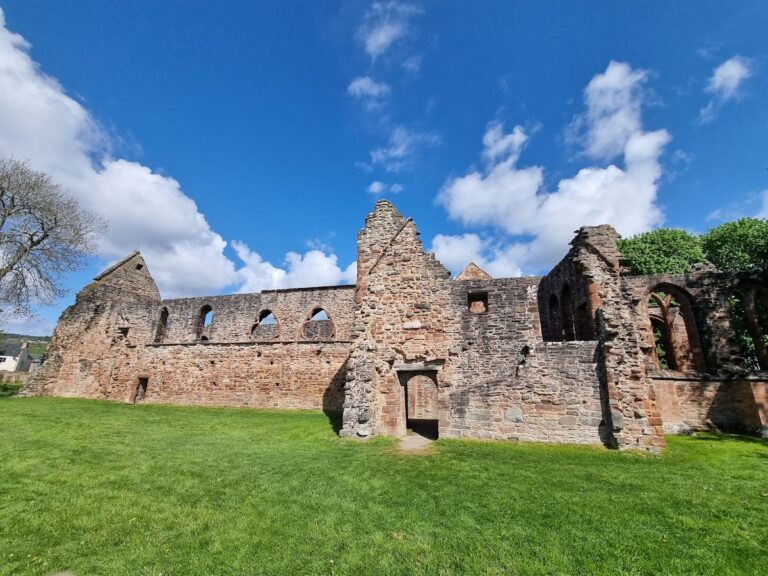
The surviving wall portions are small and overgrown with vegetation. They represent the remaining visible fabric of the medieval fort and royal castle after the site was levelled and its stone was reused. The great hall belonged to the improvements carried out in 1507, while the enlarged defensive perimeter reflects the castle’s later response to Highland-clan attacks.
Underground Passage
A tunnel formerly connected the castle site with the basement of nearby Tulloch Castle. The passage has collapsed, but it can be viewed through an air vent on the front lawn of the Tulloch Castle grounds.
Later Building and Reused Stone
Modern Dingwall Castle
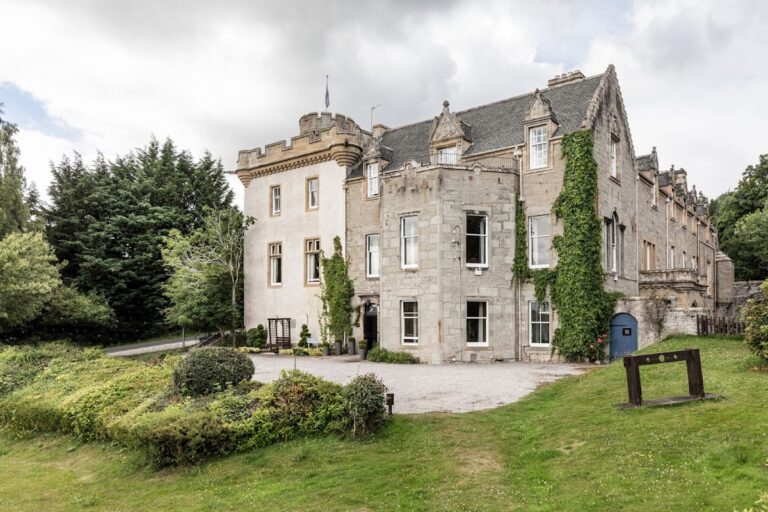
A building also called Dingwall Castle was erected nearby in 1821 as a private residence. It is substantially unrelated to the medieval castle, although its gardens contain the few surviving remains of the original structure.
Reused Castle Masonry
Stone from the ruined castle was incorporated into houses on lands associated with Clan Mackenzie from about 1750. The last usable stones were later employed in new buildings in Dingwall during the early nineteenth century.