Aurouze Castle: A Medieval Fortified Castle in France


Site at a Glance
- Rating
- 4.4
- Popularity
- Very Low
- Country
- France
- Primary era
- Medieval
- Eras represented
- Medieval
- Civilizations
- French
- Site type
- Military
- Remains
- Castle
On this page8 sections
History
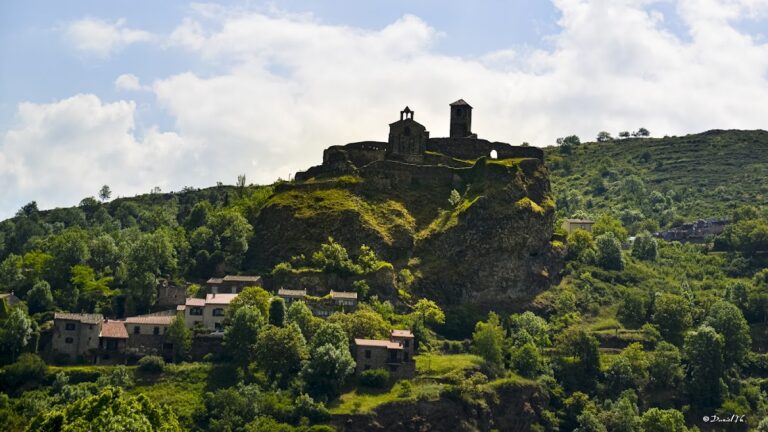
Aurouze Castle is a former medieval fortified castle in France, overlooking the village of Aurouze in the commune of Molompize. Its surviving ruins belong to a castle begun in 1309 by Bertrand de Rochefort d’Aurouze with the authorization of Philippe IV, known as Philippe le Bel, who ruled France from 1285 to 1314.
Origins and the Rochefort lords
The history of the title and lordship reaches back before construction began. On 10 May 1295, the squires Chatard and Guillaume de Saint-Germain concluded a transaction with Bertrand de Rochefort, although the title “d’Aurouze” was not then specified for him. Bertrand, son of Ithier and lord of Mardogne, became lord of Aurouze in the fourteenth century.
The Rochefort family was connected to other noble lineages in the region. Around 1240, Bertrand’s sister Françoise brought Mardogne Castle to the Bréon family as her dowry when she married Maurin, lord of Lugarde. Later, Béraud de Rochefort d’Ally, son of another Bertrand de Rochefort and Guérine de Dienne, married Marguerite de Châteauneuf d’Apchier after 1374. They had no descendants, and Aurouze belonged to the Lastic family during this period.
Capture and transfer of the lordship
In 1383, Aymerigot Marchès, a bandit aligned with the English party during the conflicts between England and France, seized Aurouze. He used the castle as a base for raids and extortion in the surrounding country. Marchès sold it to Jean III d’Armagnac, viscount of Murat and Carlat, for 500 florins, a decision he later regretted because his plundering had brought him more than 20,000 livres each year.
The following year, Jean III d’Armagnac granted Aurouze to Jean de Courcelles, lord of Breuil. Jean’s son Louis de Courcelles married Alix d’Orlhac, heiress of Conros, around 1445. Their son Louis II de Courcelles became lord of Aurouze and Conros and was appointed bailiff of the Mountains of Auvergne by Charles VII. A bailiff was a royal or seigneurial official who administered a territorial jurisdiction, including judicial and sometimes military duties.
Inheritance and the later owners
On 12 January 1462, Louis II de Courcelles married the thirteen-year-old Isabeau de Langeac. They had no children, and Louis made Isabeau heir to all his possessions. Jean d’Estaing, co-lord of Cheylade and brother of Alix’s mother, challenged the testament in 1476.
After Louis II died without an heir, King Louis XI confiscated his lands and granted them to his captain Jean d’Urfé, who had become Isabeau de Langeac’s second husband. Jean’s son François d’Urfé, lord of Aurouze and Conros, fought in Italy and died at Pavia in 1525. His sister Anne subsequently inherited the castle.
Anne had married Gaspard de Bouillé du Charriol on 3 July 1493. The Bouillé family came originally from the County of Maine, established itself in the Brivadois, the historical region around Brioude in the Auvergne area, from the eleventh century, and became one of the leading noble families of Auvergne. The castle later passed from Rose de Lignerac, widow of François de Bouillé, to the La Vernède family.
Revolutionary damage and protection
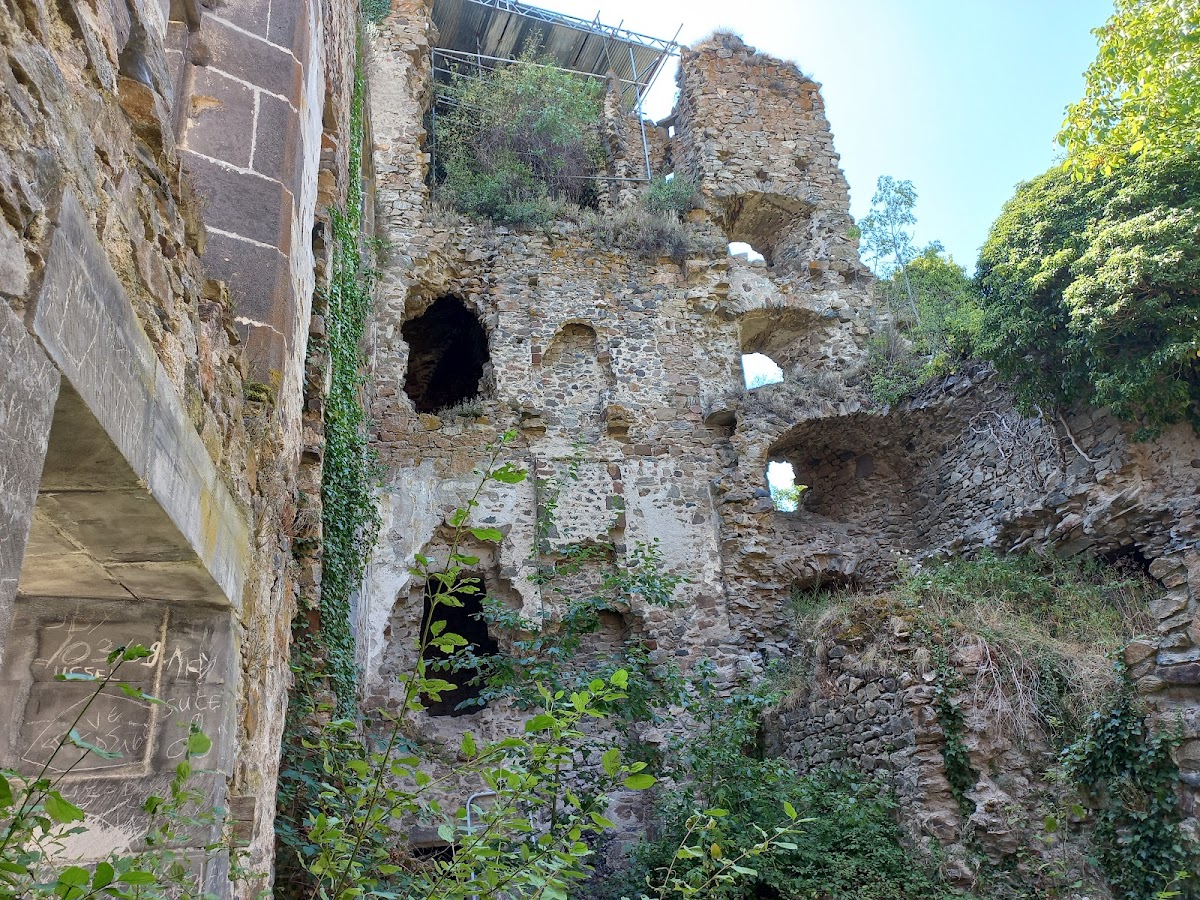
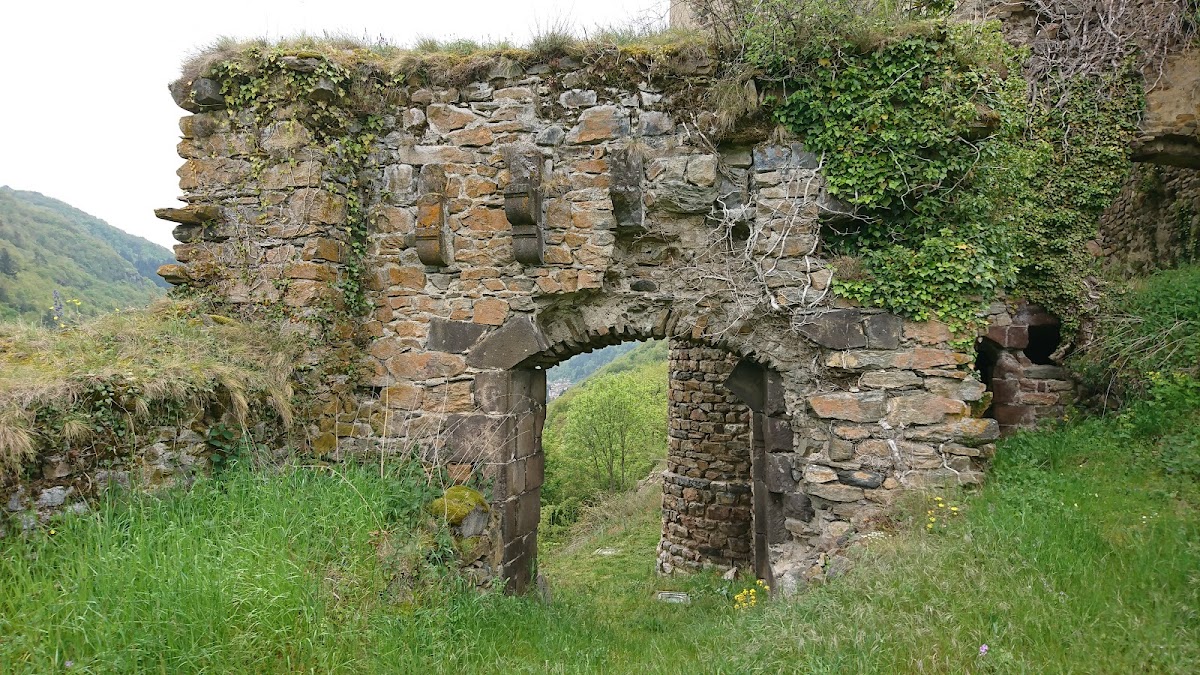
During the French Revolution, the period of political upheaval in France from 1789 to 1799, the castle was bought by the Gillet d’Auriac family. It was then burned and looted, contributing to the ruined condition seen today.
Georges de Bussac and Jean Rieuf worked to secure the site’s inclusion in the inventory of sites, achieved on 8 May 1968. Aurouze Castle was registered as a French historic monument in 1972, placing it under a formal level of heritage protection. The commune of Molompize is its current owner.
Remains
The ruined castle stands above Aurouze in an elongated complex. Its façade is pierced by mullioned windows, which are divided by vertical stone members, and by cross-barred windows with both vertical and horizontal divisions. A keep, the principal fortified tower of a medieval castle, and a turret flank the façade, while the complex ends in a projecting terrace shaped like a spur.
Hall and heraldic features
Until approximately the middle of the twentieth century, a large hall could still be distinguished on the ground floor. It contained the Bouillé helmet, the arms of the Rochefort d’Aurouze family, and, to the right, the arms of the Astorg d’Orlhac family. The Rochefort arms had a red field with three silver horizontal bands, each bearing blue lozenges arranged in groups of three, three, and two. The Astorg d’Orlhac arms showed a blue field with a gold diagonal band surrounded by six silver scallop shells.
Vault keystone
A stone escutcheon, or heraldic shield, was carved into the vault keystone by Louis de Courcelles. Its quartered design brought together the Aurouze lozenges, the Courcelles fusils arranged in horizontal bands, and the Orlhac scallop shells. This carved element preserves the connection between the castle’s architecture and the families who held its lordship.