Castle Šenkenberk: A Medieval Spur Castle in Czechia


Site at a Glance
- Rating
- 4.4
- Popularity
- Very Low
- Country
- Czechia
- Primary era
- Medieval
- Eras represented
- Medieval
- Civilizations
- Holy Roman Empire, Kingdom of Bohemia
- Site type
- Military
- Remains
- Castle
On this page7 sections
History
Castle Šenkenberk, also known as Šimberk, Šimperk, Schenkenberg, or Schimberg, is a thirteenth-century Romanesque-Gothic ruin in Czechia. Its foundation is traditionally attributed to the Austrian-origin Pincern family, which settled in the Znojmo region toward the end of the first quarter of the thirteenth century. The castle occupied a defensible spur above the Plenkovický potok and later became the centre of a small lordship.
Foundation and early holders
Wolfram, who used the designation “de Schenkenberg,” was probably the first recorded holder. From 1239, he is also known as a royal burgrave of Frain, an official responsible for administering and defending a royal castle or domain. Frain was the historical German name for Vranov nad Dyjí. Wolfram’s role as founder remains an attribution. A possible reference to the castle dates from 1247, while its first documented mention comes from 1325.
In that year, King John of Luxembourg, King of Bohemia from 1310 to 1346, authorized Hrut of Rukstein to sell the village of Chlupice near Hostěradice to Jindřich of Šenkenberk. Jindřich, a member of the Jíkve family, appears as a witness in documents from 1337 to 1343. The castellologist Miroslav Plaček considered it probable that Jindřich had acquired the castle through marriage. In 1349, Jindřich transferred his property to his wife, Anna of Pavlice.
Division of the lordship
After Jindřich, Markvart and Protiva of Šenkenberk administered the castle. Their holdings were divided in 1353. One half went to Jindřich Přibík of Jíkve, while Protiva retained the other. Around 1360, Přibík’s successor, Proček of Šenkenberk, sold his half to Jimram of Jakubov, Oldřich of Želetava, and Raško of Bor for 510 grivnas. A grivna was a medieval unit of weight and monetary value whose exact worth varied by place and period.
The remaining half belonged to Proček’s brothers, Markvart and Boček. From 1361, Boček shared his portion with Oldřich of Želetava, who later acquired Markvart’s share as well. Following these divisions, the Šenkenberk family probably died out or lost possession, and the castle apparently reverted to the territorial lord.
Later ownership and decline
In 1406, Margrave Jobst of Luxembourg, a member of the Luxembourg dynasty and ruler of Moravia, sold Šenkenberk hereditarily to Přech of Kojetice. The transaction also included the villages of Vlkov, Hostěrádky, Žerůtky, and Milíčovice, together with the deserted village of Epice. Přech later assigned the lordship to his wife Catherine as a marriage gift and made Jindřich Ctibor of Bořečkovice a co-owner. In 1418, Přech’s second wife, Maná, received the lordship in the same way.
Osvald of Eitzing subsequently acquired Šenkenberk. His possession was contested by Přech of Kojetice’s relative, Štědroň of Kojetice, who argued that the transfer was unlawful. In 1436, King Sigismund confirmed Osvald’s possession as pledged property. Sigismund was later King of Bohemia and Holy Roman Emperor.
The castle’s destruction cannot be dated with certainty. Archaeological interpretations place its end either during the Hussite Wars, the religious and political conflicts in Bohemia associated with the reform movement of Jan Hus, or during feudal conflicts before the middle of the fifteenth century. By 1517, when Michael of Eitzing sold Šenkenberk to Adam of Bačkovice of Joslowitz, the castle was already described as dilapidated and was included only as an appurtenance. The village below it probably disappeared at about the same time and was recorded as deserted from 1549. The ruins have been protected as a Czech cultural monument since 3 May 1958.
Remains
Setting and defensive layout
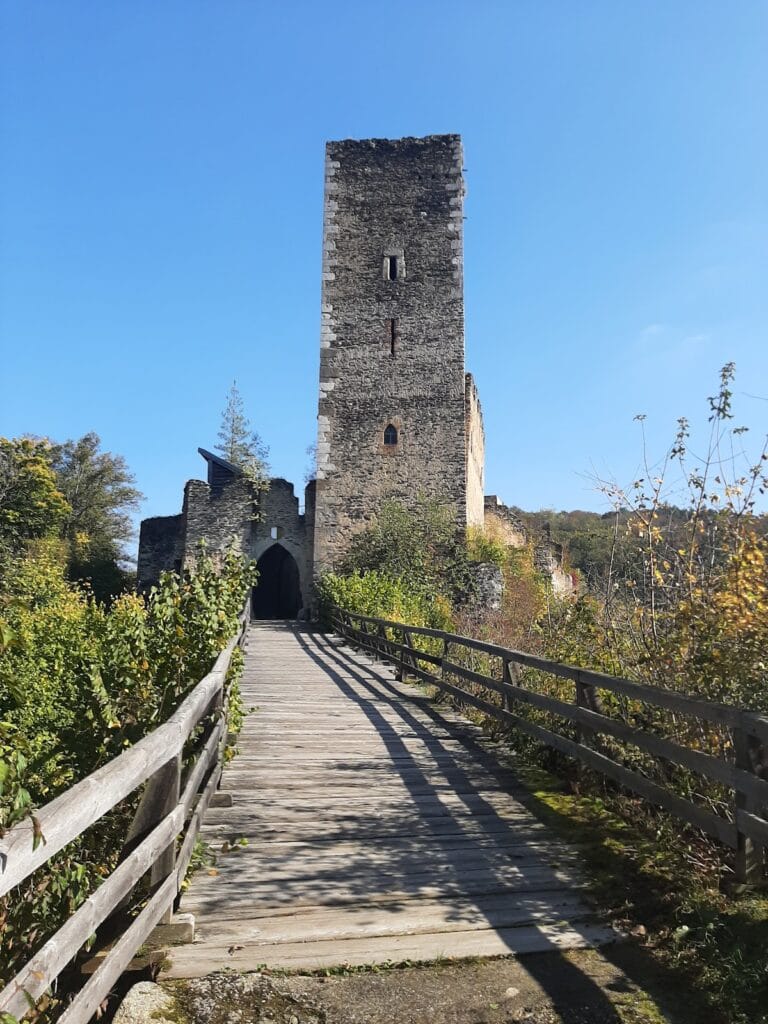
The ruin stands at approximately 412 metres above sea level in a forested part of the Jevišovice Hills, on a rocky spur above the right bank of the Plenkovický potok. The stream surrounds the spur on three sides, while the Vlkov pond lies to the south. Šenkenberk was a two-part spur castle, a fortified site built on a projecting ridge or rocky spur. Its main castle and outer ward both had trapezoidal plans, and an additional ditch separated the outer ward from the main castle.
To the east, a deep neck ditch cut across the connection between the castle spur and the ridge. This defensive cut is approximately 9 metres wide and 1.5 metres deep. The front of the main castle measures 32 metres, its southern side 29.5 metres, and its western side at the end of the spur 18.5 metres. A diagonally aligned connecting wall extends for 31 metres.
Main castle and surviving walls
The castle was built in the Romanesque-Gothic tradition. Sections of the outer walls survive together with the palas, the principal residential and representative building in a medieval castle complex. The northern corner is the best-preserved part of the ruin, with masonry surviving to a height of up to 3.6 metres.