Roquemartine: Medieval Castle and Former Commune in France

Site at a Glance
- Rating
- 4.4
- Popularity
- Very Low
- Country
- France
- Primary era
- Medieval
- External website
- Open
- Eras represented
- Medieval
- Civilizations
- County of Provence
- Site type
- Military
- Remains
- Castle
On this page11 sections
History
Roquemartine is a medieval castle complex and former commune in France, located in the territory of present-day Eyguières. The stronghold, a castrum combining defensive, residential, and communal functions, controlled a major passage between the Durance valley and the southern Alpilles. Its surviving castle is broadly associated with the twelfth and thirteenth centuries, although the date of the present structure remains uncertain.
Early lordship and comital conquest
The castrum appears in written records around 1096 under the name Roca Martina. Its lords, Raimond, Gérald, and Pons, sold their shares of the tithe to Saint-Victor Abbey of Marseille, a major medieval Benedictine institution in Provence, to help finance their participation in the First Crusade, the late-eleventh-century western European expedition to the eastern Mediterranean preached by Pope Urban II.
Between 1147 and 1162, Raimond Catel transferred Roquemartine to Hugues Sacristain. In the early thirteenth century, Hugues’s granddaughter Porceleta brought the stronghold to Peire de Lambesc as her dowry. After Peire died in 1221, the castle passed to his children and grandchildren. The following year, the armies of Raimond Bérenger V, count of Provence, destroyed the castrum during his campaign to reassert comital control over the county. Roquemartine and its toll were then entrusted to Albe, or Albeta, of Tarascon, a supporter of the count whose rights were confirmed in December 1237.
Conflict and rebuilding
The castle known today is attributed to the Albe, or Aube, family, although proposed dates for its construction range from the mid-thirteenth century to the mid-fourteenth or the second half of the fifteenth century. Roquemartine later became involved in the conflicts that followed the death of Queen Joanna I, the fourteenth-century queen of Naples and countess of Provence. From 1382 to 1387, the community joined the Union of Aix, a Provençal coalition supporting Charles of Durazzo against Louis I of Anjou during the succession crisis.
In July 1384, Tuchins, insurgent bands active in southern France, led by Étienne Augier, known as Ferrugat, captured the castle without difficulty. In 1389, Raimond Roger de Beaufort, Viscount of Turenne, seized Les Baux and Roquemartine after setting Roquemartine on fire. Forces of the Papal States, territories governed by the papacy in central Italy, made several attempts to recover the stronghold. Marshal Boucicaut finally liberated it in 1399 by buying off its defenders.
After this destruction, the castle was restored and modernized. The Castellas was abandoned at the beginning of the seventeenth century in favor of a new Château de Roquemartine built in the plain. The estate was raised to a marquisate in 1672, a territorial lordship or title held by a marquis, and remained with descendants who lived in the plain.
Commune and protection
Roquemartine also gave its name to an independent commune that existed from 1790 until 1830. Its church was attached to Eyguières in 1805, while the commune’s administrative affiliations changed during the nineteenth century. The castle and Saint-Sauveur Church were listed together as a protected historic monument in 1926.
Remains
Castle on the cliff
Fortified complex
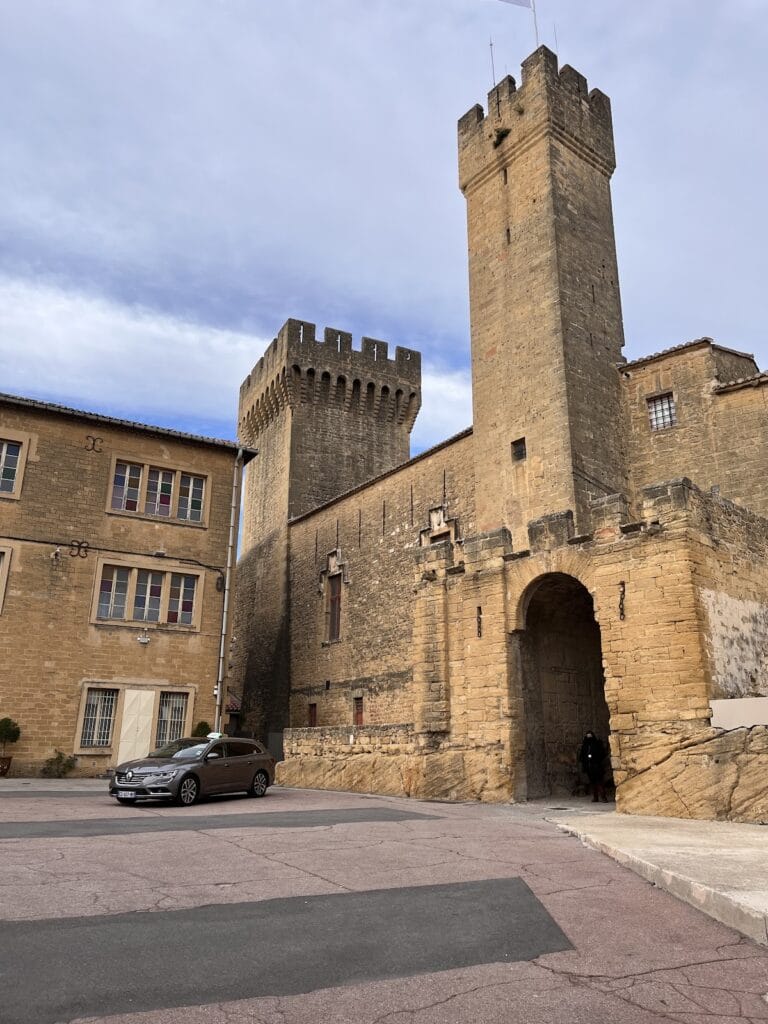
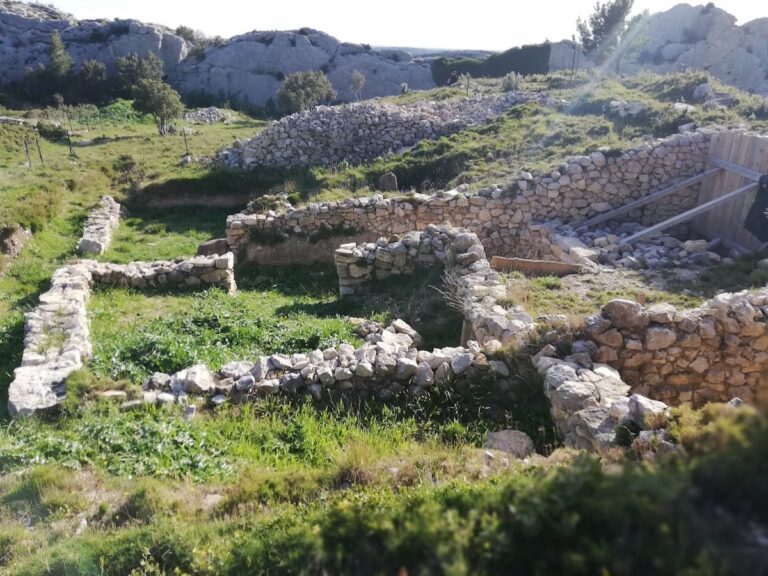
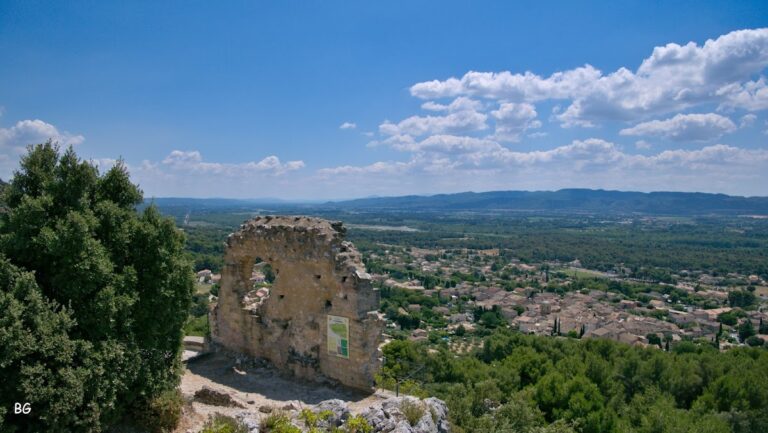
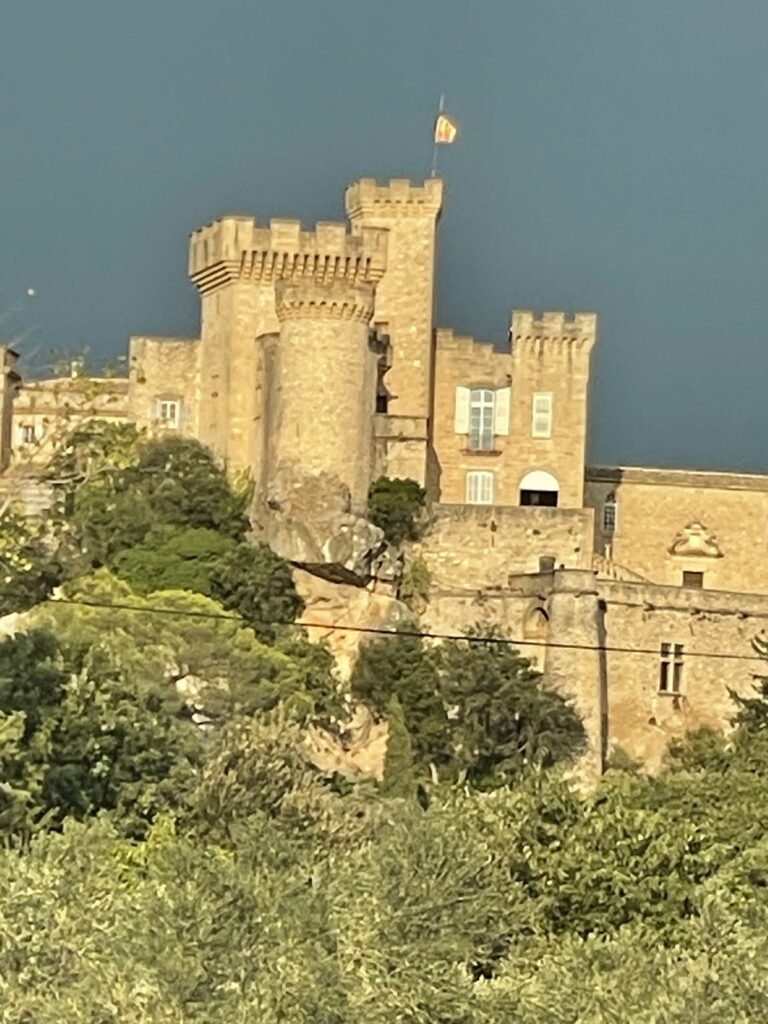
The Castellas de Roquemartine, also called the Château de la Reine Jeanne, stands on the summit of high, bare cliffs on a spur above the Roquemartine plain. The castle and church form an elevated complex within a grassy landscape used by sheep. The ruined stronghold has an external appearance that has been compared with the Château des Baux. Its surviving fabric belongs broadly to the medieval period, with later additions reflecting restoration and defensive modernization.
Later medieval additions
A chapel was built within the castle in the fifteenth century. A late-fifteenth-century mullioned window, divided into separate openings by vertical stone members, survives alongside a fireplace in the western residential building and a gun loop in the southern building. The gun loop is a narrow opening in the fortified wall through which a firearm could be used defensively.
Saint-Sauveur Church
Parish church
Saint-Sauveur Church lies below the castle and formerly served as the parish church of the Roquemartine settlement. A place of worship existed on the site by the late eleventh century, while the present building dates from the fourteenth century. Two arched entrances open on the north and south sides. Inside, the church has a nave, the main central space, divided into two bays, followed by a semicircular apse. Its roof is made of stone slabs, and its walls use rubble masonry built from irregular, roughly shaped stones.
Medieval wall paintings
Medieval wall paintings survive in the chapel of Saint-Sauveur, though they are in poor condition. One retains details of a haloed figure, probably a saint. Another shows Jesus on the cross with Mary and an apostle against a blue background scattered with red stars.
Nearby sites