Arnad Upper Castle: A Romanesque Hilltop Fortress in Italy

Site at a Glance
- Rating
- 3.8
- Popularity
- Very Low
- Country
- Italy
- Primary era
- Medieval
- External website
- Open
- Eras represented
- Medieval
- Civilizations
- Duchy of Savoy
- Site type
- Military
- Remains
- Castle
On this page8 sections
History
Arnad Upper Castle is a ruined Romanesque hilltop fortress in Arnad, Italy, built during the medieval period on a rocky promontory above the entrance to the Machaby valley. It is considered one of the oldest castles in the Aosta Valley, and its position allowed it to oversee the ancient Via Francigena, a major medieval pilgrimage route to Rome, as well as the route toward the Gressoney Valley.
Origins and early ownership
The castle’s beginnings and first owners remain uncertain. Its earliest known mention appears in a papal bull of 1207, a formal document issued by the pope for ecclesiastical, legal, or administrative matters. The document refers to the castle’s chapel, which was dedicated to Saint Mary Magdalene and Saint Michael the Archangel.
One historical interpretation places the construction of the castle in the twelfth or thirteenth century and associates it with Xavier d’Arnad, or more broadly with the de Arnado family. Another tradition holds that the Lords of Bard already possessed the castle in the twelfth century. According to this account, the House of Savoy, a ruling dynasty that governed Savoy and later territories including the Aosta Valley, granted it to Guillaume de Bard together with Pont-Saint-Martin Castle after armed conflict between Guillaume and his brother Hugues de Bard.
The Vallaise period
In 1239, half of the castle was granted as a fief to Ruffino de Arnado for economic reasons. The entire complex passed to the Vallaise family through a sale in 1293. The Vallaises occupied the castle throughout the fourteenth century, when its central building took the form associated with their period of ownership.
The castle also hosted Amadeus VI, count of Savoy, for lunch in 1351. From the fifteenth century, it was abandoned because its structure was considered inadequate and its military role had become obsolete. In the seventeenth century, the Vallaise family moved to the fortified house of La Côte, at a lower elevation in Arnad. This relocation ended the upper castle’s prominence as the family residence.
Remains
Hilltop fortress
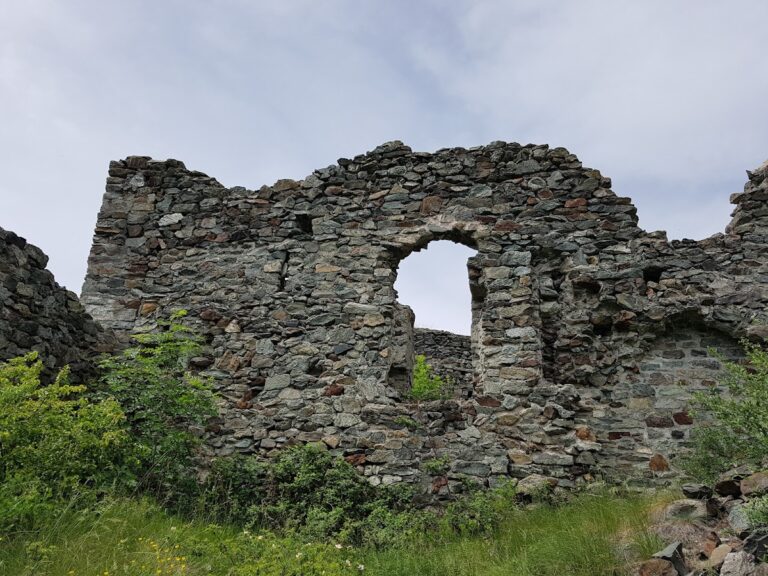
Arnad Upper Castle stands at approximately 596 metres above sea level on a natural rocky promontory overlooking the hamlet of Ville and the entrance to the Machaby valley. Built of rubble stone, the ruined complex retains its Romanesque character, a medieval architectural tradition marked by massive masonry, round arches, and strongly defensive construction. The castle’s elevated position formed part of its defensive and route-controlling function.
Vallaise-period buildings
Central building
The surviving central building dates from the fourteenth century and belongs to the period of Vallaise occupation. It included crenellations and large fireplaces, while contemporary coats of arms were executed as wall frescoes and graffiti. The building remains in a ruined condition and preserves the complex’s medieval architectural character without later stylistic alterations.
Latrine tower
A slender tower adjoins the central building and contained latrines, with toilets arranged so that waste could be discharged outside the structure. This arrangement was described as unique in the Aosta Valley for its period and was probably inspired by a similar tower built several years earlier at the Papal Palace at Avignon, the principal residence of the popes while the papacy was based there.
Arnad Upper Castle is distinct from the lower Castle of Arnad, also called Vallaise Castle. The lower castle is a separate complex acquired by the Autonomous Region of Aosta Valley in 2010. Together with the contemporary Castle of Ussel at Châtillon, the upper castle is regarded as a rare historical and architectural example in the region.