Burgstall auf dem Heideknock: Medieval Spur Castle in Germany


Site at a Glance
- Rating
- 4.8
- Popularity
- Very Low
- Country
- Germany
- Primary era
- Medieval
- Eras represented
- Iron Age, Medieval
- Civilizations
- Celtic, Holy Roman Empire
- Site type
- Military
- Remains
- Castle
On this page8 sections
History
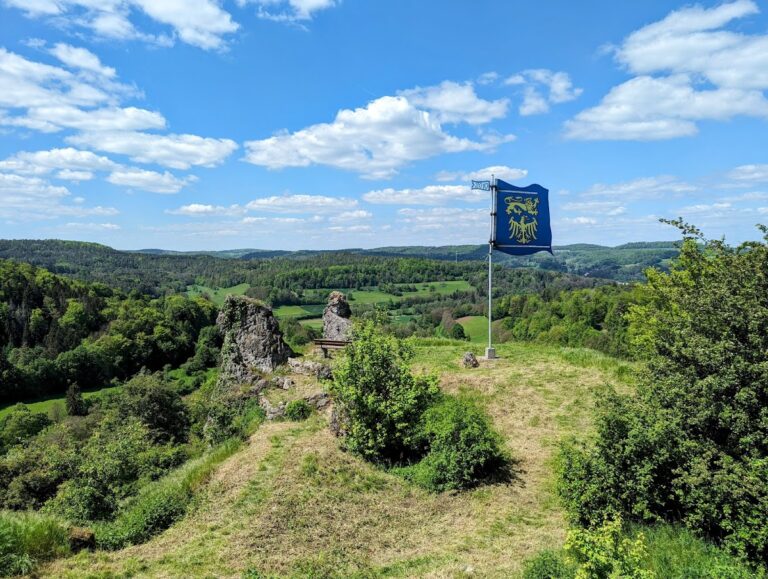
Burgstall auf dem Heideknock is the remnant of a medieval spur castle in Germany, near Weismain in Upper Franconia, built over an earlier Celtic sectional fortification above the Kleinziegenfelder Valley. A spur castle used a projecting ridge and its steep natural slopes for defense. The medieval castle probably dates to the first half of the twelfth century and is thought to be identifiable with Burg Leuchnitz, the ancestral castle of the free noble Leuchnitz family.
Prehistoric occupation
The Heideknock was already associated with settlement before the medieval castle was built. An upland settlement of the Urnfield period, a later Bronze Age tradition linked with cremation burials in urns, occupied the area. Further settlement belongs to the Late Hallstatt and Early La Tène periods, successive Iron Age phases in central Europe. Pottery from the Iron Age was found near the prehistoric defenses, indicating occupation of the fortified upland.
The nearby Heideknock Cave has produced finds from the Urnfield period, the Late Hallstatt and Early La Tène periods, and the Middle Ages. Together, the cave, prehistoric settlement, and castle reflect repeated use of the Heideknock and its surroundings over a long period.
The Leuchnitz castle
The Leuchnitz family is documented from 1118 onward. The castle was first recorded in 1165, when it belonged to Stevinc and Ludewig de Luchinze. A document of 1232 names Cuonrad de Luochenz as a ministerial of the Meranian lords. A ministerial was a dependent official or military-administrative retainer who could hold authority and property in the service of a ruler or noble lord. This reference indicates that the castle was still standing at that time.
The castle is thought to have remained with the Leuchnitz family until its destruction sometime after 1232. Oral tradition held that it had already fallen into ruin by about 1340. The names Alte Burg and Altes Schloss, meaning Old Castle and Old Palace, survived as local field names and preserved the memory of the site after its superstructure disappeared.
Archaeological protection
Today, Burgstall auf dem Heideknock, the associated prehistoric settlement, and the Heideknock Cave are protected archaeological monuments. The complex is listed by the Bavarian State Office for Monument Protection under monument number D-4-5933-0083 and is designated a cultural monument.
Remains
Hilltop setting and prehistoric defenses
The site occupies the Heideknock, a mountain spur projecting eastward into the Kleinziegenfelder Valley, about 800 metres south of Arnstein. It stands at 465.4 metres above sea level and consists of two small plateaus. Steep rock slopes protect the spur on its eastern, southern, and northern sides.
The western side contains a prehistoric defensive installation. Its main feature is a flattened sectional rampart, a barrier that blocks access across one part of the terrain. The rampart is about 3 metres wide and was preceded by a neck ditch approximately 21 metres wide and 3 to 4 metres deep. It reaches its greatest height at the southern end. Iron Age pottery fragments from this area point to prehistoric occupation.
Medieval ramparts and ditches
A separate defensive system occupies the inner plateau and is attributed to the medieval castle. Its successive ramparts and ditches divide the northern plateau from the southern plateau and the wider Jurassic upland. The northern plateau measures approximately 50 by 90 metres, while the castle area extends 97 metres from north to south and averages 40 metres in width.
The principal medieval neck ditch is 21 metres wide and 4 to 5 metres deep. A partly surviving rampart follows its inner edge. In front of the ditch, an outer rampart approximately 100 metres long enclosed the entire castle site. Beyond it lay another ditch, about 10 metres wide, cut into the natural rock. This ditch survives only in the southern section. A third rampart stood in front of it and separated the castle site from the second plateau.
Entrance and interior
A gap about 2.5 metres wide passes through all the ramparts. Its position suggests an entrance on the southeastern edge of the site, immediately beside the steep slope. Within the formerly levelled interior, near the presumed entrance, are two rectangular excavations and an embankment along the edge.
A bronze belt fitting found in the 1980s dates to the Salian period, the era when the Salian dynasty ruled the German kingdom and the Holy Roman Empire during the eleventh and early twelfth centuries. The object supports placing the medieval castle in the first half of the twelfth century. The surviving castle is now represented archaeologically by its preserved ditches and rampart remains.