Créneaux d’Aujols: Remains of a Medieval Castle in France

Site at a Glance
- Rating
- 4.5
- Popularity
- Very Low
- Country
- France
- Primary era
- Medieval
- Eras represented
- Medieval, Early Modern
- Civilizations
- French
- Site type
- Domestic
- Remains
- Castle
On this page8 sections
History
Créneaux d’Aujols is the surviving remnant of a medieval castle in Aujols, France, built as a residence during the second half of the thirteenth century. The castle was probably constructed by the Cardaillac-Bioule family, whose lordship was held from the chapter of Cahors Cathedral, an ecclesiastical body responsible for cathedral administration and associated territorial rights.
Lordship and medieval construction
Tradition attributes the castle to the Knights Templar, a medieval religious-military order associated with landholding and commanderies, or administrative centers. The political history of Aujols provides a different explanation. During the first half of the thirteenth century, the lordship belonged to the chapter of Cahors, which granted it as a fief, meaning land or jurisdiction held under feudal obligations, to the Cardaillac-Bioule family. This grant was made despite claims by descendants of the former viscounts of Cahors.
Connections with the Templars nevertheless remain part of the site’s historical context. Aujols church had an architectural design similar to that of the Templar commandery at La Capelle-Livron. The Knights of Vayrols, who had transferred several houses in Cahors to the Templars around 1194, also held land at Aujols at the end of the twelfth century. These links leave open the possibility that the chapter acquired the church and fief to establish a priory, a religious house governed by a prior, near the church of Saint John the Baptist.
The first recorded homage, a formal feudal acknowledgment of a superior lord’s authority, made for Aujols by a member of the Cardaillac-Bioule family dates to 1252. Bertrand de Cardaillac-Bioule then rendered homage to the chapter of Cahors for several lordships, including Aujols. His descendants Bertrand II and Hugues performed the same act for the fief in 1316 and 1339. An act of 1310 required parishioners to cross the castle to attend Mass, supporting the possibility that the castle and church stood within a shared enclosure.
War, division, and abandonment
After the Hundred Years’ War, the prolonged conflict between the English and French monarchies from the fourteenth to the fifteenth century, the Cardaillac-Bioule family rendered homage to the king for Aujols, Cieurac, and Saint-Cirq-Lapopie. This suggests that the chapter of Cahors had lost its overlordship of the fief. Like many lordships in Quercy, Aujols emerged from the war devastated.
In 1455, Jean de Cardaillac, one of the co-lords, or several lords holding rights over the same lordship, leased land belonging to Aujols to establish new inhabitants. His son Raymond joined the League of the Public Weal, a fifteenth-century coalition of powerful nobles opposed to aspects of royal centralization. In 1487, on the orders of Anne de Beaujeu, elder sister and regent for King Charles VIII, royal armies devastated Raymond’s lands and destroyed the Cardaillac castle at Saint-Cirq-Lapopie. They may also have passed through Aujols. Raymond subsequently began constructing the Château de Cieurac.
Jacques de Cardaillac, seneschal of Quercy, a high administrative and judicial official, and co-lord of Saint-Cirq-Lapopie, rendered homage for Aujols in 1503. From 1520, the Cardaillac family sold part of Aujols to the Dayrac family, although Antoine de Cardaillac still rendered homage for the lordship to the chapter of Cahors in 1543. In 1598, Antoine II de Cardaillac reached an agreement with the inhabitants over unpaid rents. His widow, Antoinette de Paluels, sold the consuls rents connected with the parishes of Aujols and Laburgade. Bertrand II de Cardaillac-Bioule had earlier left the castle to his widow as an inheritance.
Later transformation and protection
The Cardaillac-Bioule family lost the lordship at the end of the sixteenth century, after which the castle was abandoned. In 1631, Antoine de Fontanges, lord of Laroque-des-Arcs, sold half of the lordship and the castle to Mademoiselle de Vanis. This share later passed to the Dadine de Hauteserre family.
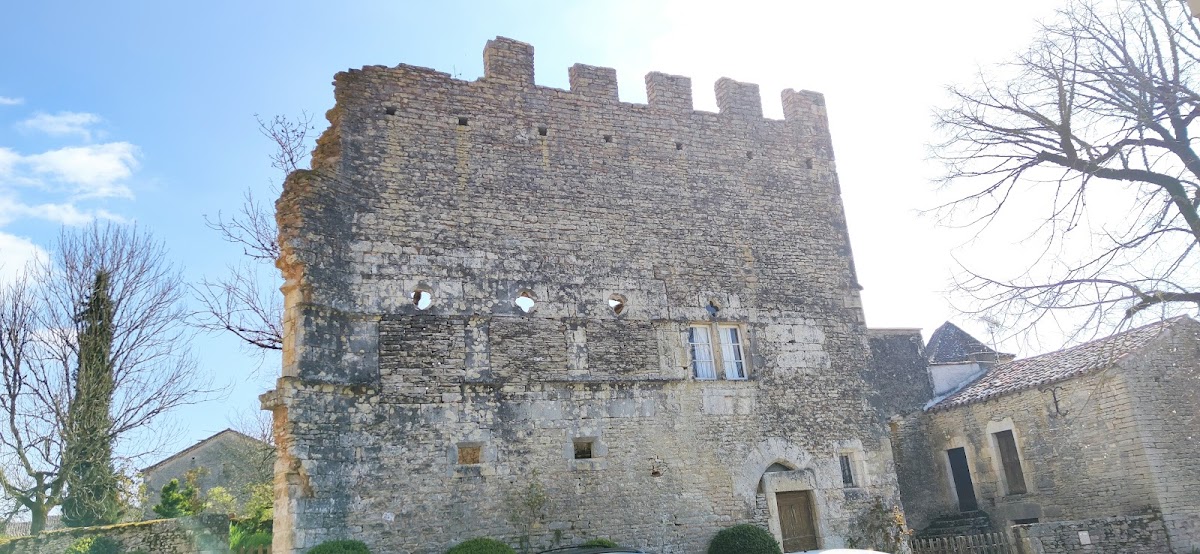
By the eighteenth century, the castle had become ruinous. A new residence was then established within the remains, retaining two façades of the medieval building. Créneaux d’Aujols was listed as a historic monument in France on 25 June 1929, recognizing the surviving structure as part of the country’s protected architectural heritage.
Remains
The remains stand at place de l’Église in Aujols and are directly associated with the village church. The surviving structure belongs to the former castle rather than to a complete medieval building. When an eighteenth-century residence was installed within the ruins, two medieval façades were retained, preserving part of the castle’s original enclosure and fabric.
Surviving medieval fabric
Retained façades
Two façades of the medieval castle form the principal surviving elements. They were incorporated into the later residence after the castle had fallen into ruin. Their survival preserves the physical connection between the medieval domestic building and the eighteenth-century reuse of the site.
North façade screen
The north façade includes an openwork screen, a permeable structure made from spaced or patterned elements rather than a solid wall. This feature was undergoing restoration when documented. It forms part of the surviving castle fabric and contributes to the present appearance of the remnant.