Tomen yr Allt: Medieval Defensive Castle and Administrative Centre in the United Kingdom
Site at a Glance
- Rating
- 5
- Popularity
- Very Low
- Country
- United Kingdom
- Primary era
- Medieval
- Eras represented
- Medieval
- Civilizations
- Unclassified
- Site type
- Military
- Remains
- Castle
On this page7 sections
History
Tomen yr Allt is a medieval defensive castle in the United Kingdom and was the principal administrative centre of Mechain Uwch Coed, a medieval Welsh territorial unit within the larger division known as the cantref of Mechain. The castle may have been built in the tenth century, making it part of the early development of Welsh fortified lordship.
Mechain and the Welsh principalities
Until 1160, Mechain belonged to the Kingdom of Powys. In that year Powys was divided, and the area became part of the principality later called Powys Wenwynwyn, the southern successor state created from the former kingdom. By 1208, the region was under the control of Llywelyn the Great, a powerful Welsh ruler.
After Llywelyn the Great died in 1241, his heir reached an agreement with Henry III of England. Under its terms, Powys Wenwynwyn passed to Gruffydd ap Gwenwynwyn, a Welsh lord who supported the English king. This change placed Tomen yr Allt within a contested political landscape as rival Welsh rulers and English allies competed for authority.
The siege of 1257
From 1255, Llywelyn ap Gruffudd, Llywelyn the Great’s grandson and Prince of Gwynedd, began expanding his territory. In May 1257, he reportedly besieged the “castle of Bodyddon”, apparently in an effort to force the lords of Mechain into submission. Tomen yr Allt lies less than 1 kilometre east of Bodyddon and overlooks it, so it is presumed to be the castle named in the account, although that identification remains uncertain.
The keep at Tomen yr Allt was probably destroyed during this campaign. By 1258, the lords of Mechain had allied themselves with Llywelyn ap Gruffudd. The castle and the surrounding woodland of Coed yr Allt later formed part of the historic estate of Bodfach Hall. The original building on the hall’s site may have been constructed to replace the castle.
Archaeology and protection
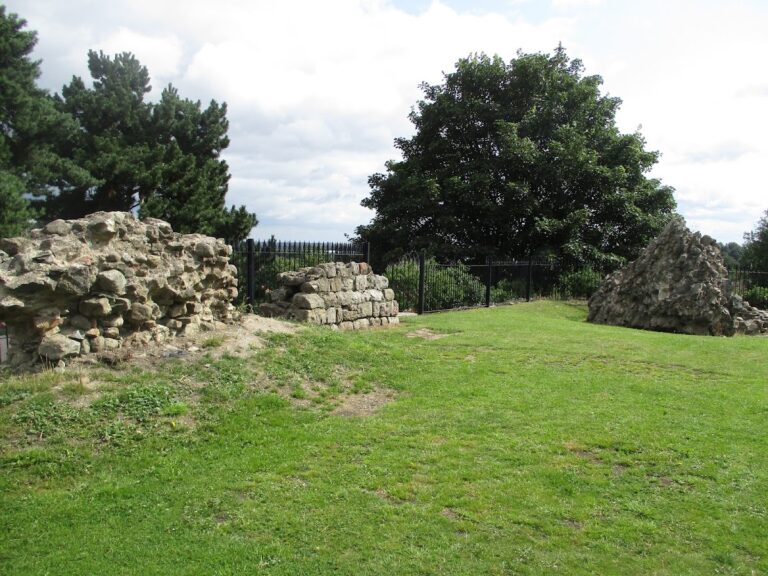
The Clwyd-Powys Archaeological Trust excavated Tomen yr Allt in 1978. The castle is now a ruin, with its surviving evidence concentrated in the earthworks, which are heavily overgrown. It is protected as a Cadw scheduled monument, a legally protected archaeological or historic site considered nationally important, under identifier MG027.
Remains
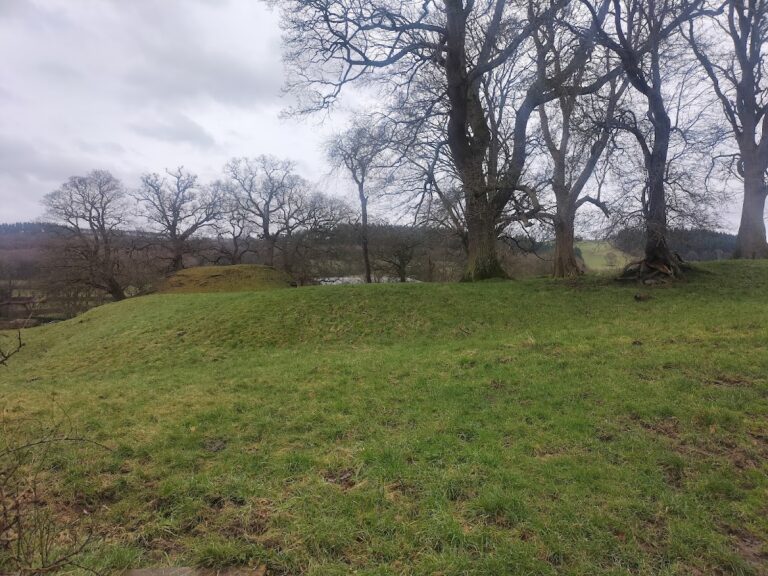
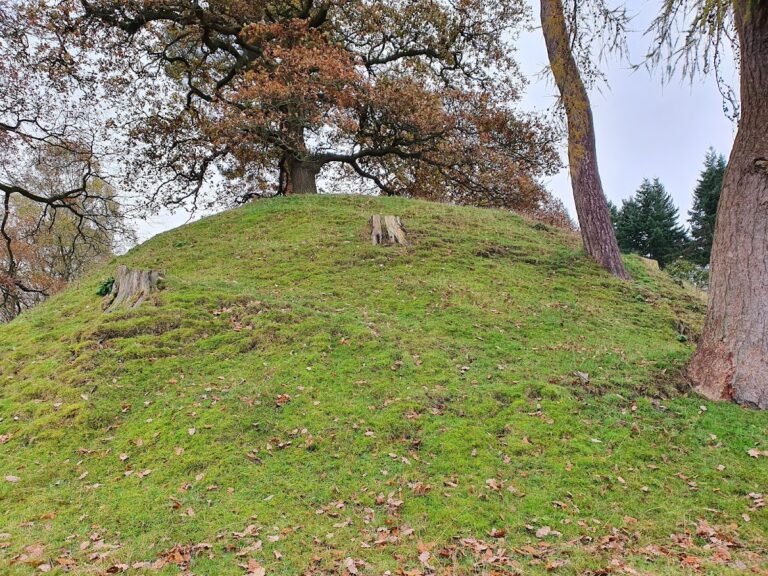
Tomen yr Allt is an earthwork castle built with earth and timber. The site covers approximately 40 metres by 40 metres, or more than 40 metres in diameter, and lies within or beside the wooded area of Coed yr Allt. It overlooks Bodfach Hall about 1 kilometre to the south-east. The surviving earthworks remain substantially visible despite dense vegetation.
Earthwork layout
The central motte, an artificial mound carrying the main stronghold, measures about 13 metres by 10 metres and rises nearly 10 metres above the surrounding ground. A continuous stony ditch encircles the earthworks. The ditch is doubled on the north-east side, where the natural slope provided less protection. On the south-east side, the bank is flattened where it meets the fields. The site is described as lacking the adjoining enclosed area, or bailey, normally associated with a motte-and-bailey castle, and no bailey is apparent in this direction.
Evidence for the keep
The keep was probably constructed from timber on the motte. Excavation in 1978 uncovered a piece of daub, a clay-based building material often used with timber frameworks, together with the remains of a burnt layer. These finds are consistent with a timber structure that was later affected by fire. The mound, ditch, banks, and other earthworks preserve the principal physical form of the castle, while the surviving remains are now in a substantially overgrown condition.