Rumlaborg: A Medieval Castle at Huskvarna, Sweden


Site at a Glance
- Rating
- 3.9
- Popularity
- Very Low
- Country
- Sweden
- Primary era
- Medieval
- External website
- Open
- Eras represented
- Medieval
- Civilizations
- Swedish
- Site type
- Military
- Remains
- Castle
On this page6 sections
History
Rumlaborg was a medieval castle at Huskvarna in Sweden, established as a fortified position on routes toward Östergötland. It also gave its name to Rumlaborg County, a historical administrative county, until the mid-sixteenth century. The site was originally known as Humlaborg, after the bishop’s estate Humblarum, which had been established in the thirteenth or early fourteenth century.
Foundation and medieval conflicts
In 1366, Albrecht of Mecklenburg, a fourteenth-century king of Sweden, ordered the construction of a fortified house at the site. Rumlaborg protected the Western and Eastern Holavedsvägen, historic roads leading toward Östergötland, and helped guard against Danish troops advancing inland. The wider defensive system included Varpa Redoubt, a small earth-built fortified position, north of the castle near Brunstorp Farm, and Garpa Redoubt beside the Huskvarna River to the south.
The castle was drawn into the political and military struggles of the fifteenth century. During Engelbrekt Engelbrektsson’s major Swedish uprising of 1434 against royal and aristocratic rule, Otto Snaps, a knight serving Eric of Pomerania, defended Rumlaborg. The rebels burned the castle, and Karl Knutsson Bonde rebuilt it in 1448.
Danish forces besieged Rumlaborg in 1452. Its commander, Eggert Krummedige, changed sides and joined the Danes, after which Eric Nipertz captured the castle. Rumlaborg faced another siege in 1464, during Karl Knutsson’s renewed seizure of power. Kettil Karlsson Vasa took the castle and arranged for his brother, Erik Karlsson Vasa, to become its commander.
Decline and archaeological investigation
During the rule of Sten Sture the Elder, a Swedish regent of the late fifteenth and early sixteenth centuries, the castle was destroyed and then allowed to decay. After Gustav Vasa became king, defensive efforts were concentrated instead on Jönköping Castle.
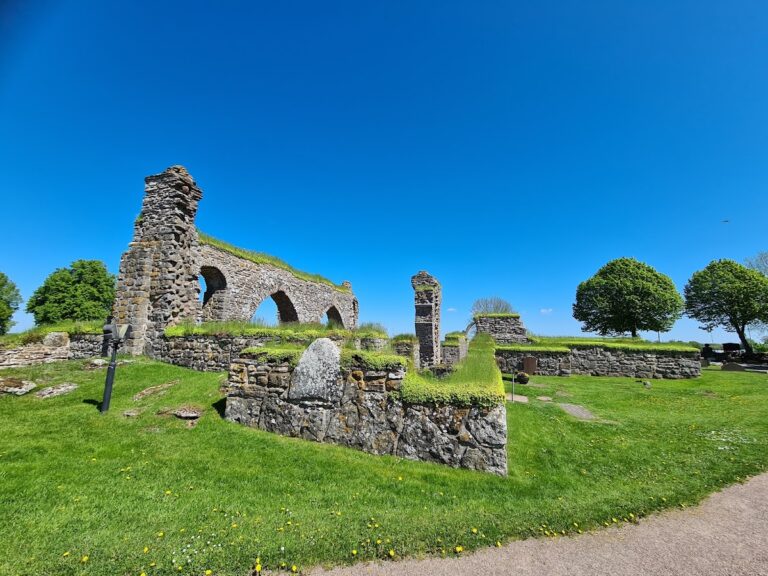
In the 1850s, H.C. Mörk levelled and redesigned the area as an English landscape park and built a pleasure pavilion there. The ruin was restored in the 1930s, when Georg Sahlström and the Huskvarna Local Heritage Association carried out archaeological investigations under the supervision of the Swedish National Heritage Board. Collections from those excavations are held at the Huskvarna City Museum, located in the former Gunpowder House on the shore of Lake Vättern.
Remains
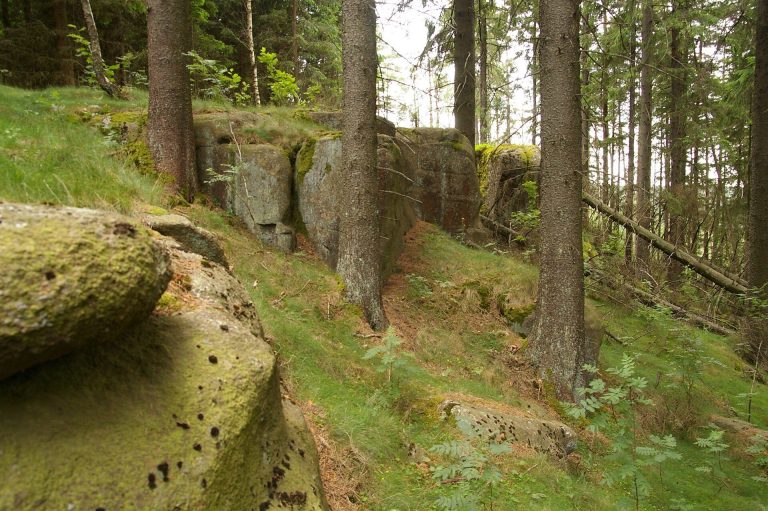
The surviving fortification is organized around an irregular mound, two redoubt ramparts, and three moats. Together, these earthworks express the defensive layout of the castle and its associated positions. The mound forms the core of the remains, while the ramparts and moats mark elements of the surrounding protection system.
Associated redoubts
Varpa Redoubt formed part of the northern defenses near Brunstorp Farm. Garpa Redoubt stood to the south beside the Huskvarna River. Both were small fortified positions built chiefly from earth and belonged to the wider system that supported Rumlaborg’s defense.
Kavlabron crossing
The road across the Huskvarna River at Rumlaborg used a bridge called Kavlabron. Its construction employed logs laid transversely across the crossing, providing a distinctive example of the infrastructure connected with the castle’s routes and defenses.