Castello di Montecopiolo: A Medieval Montefeltro Fortress in Italy

Site at a Glance
- Rating
- 4.3
- Popularity
- Very Low
- Country
- Italy
- Primary era
- Medieval
- External website
- Open
- Eras represented
- Medieval
- Civilizations
- Duchy of Urbino, Papal States
- Site type
- Military
- Remains
- Castle
On this page14 sections
History
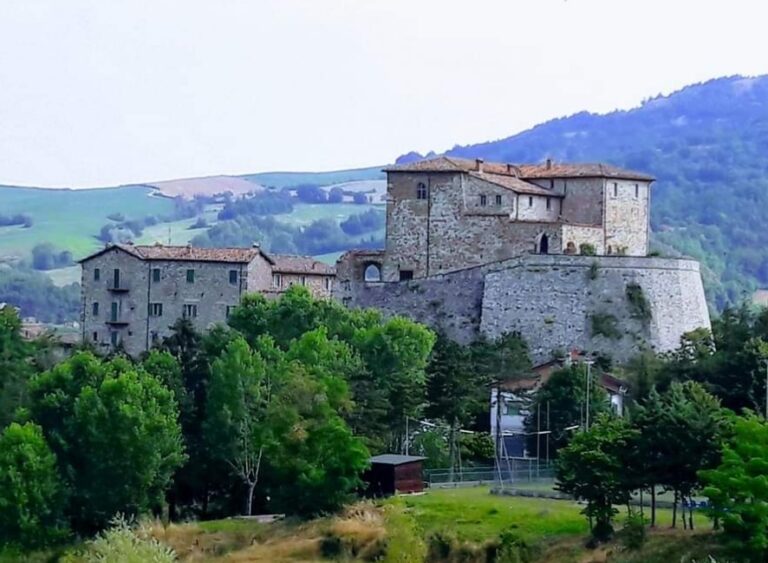
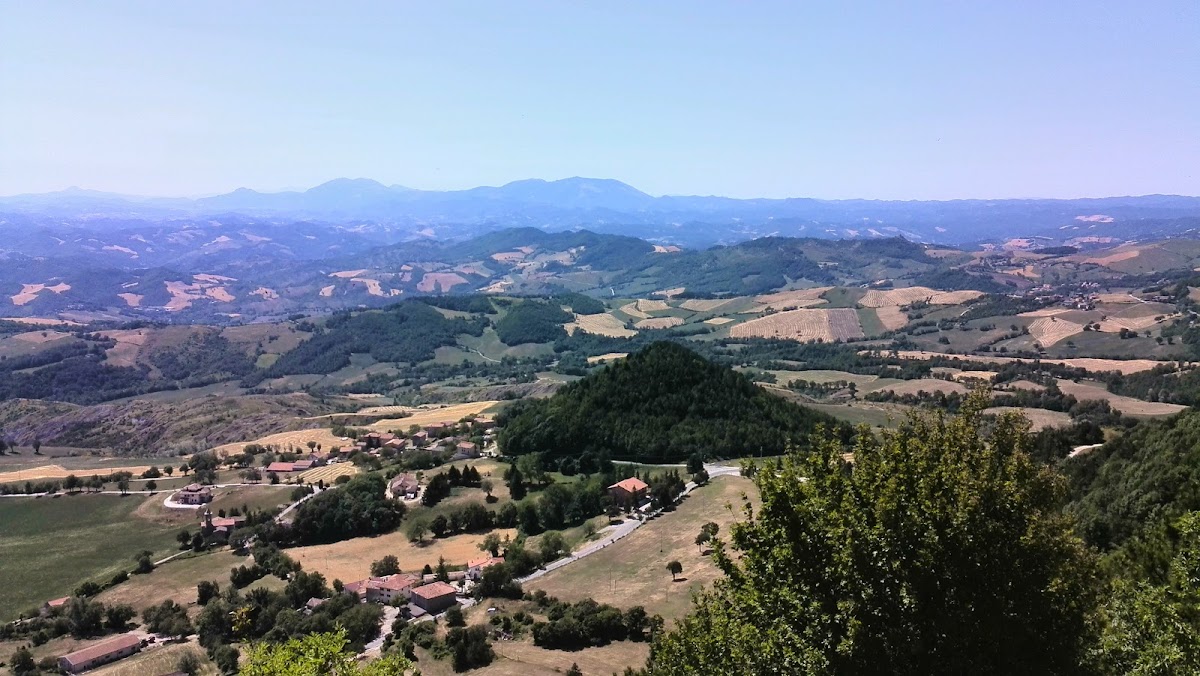
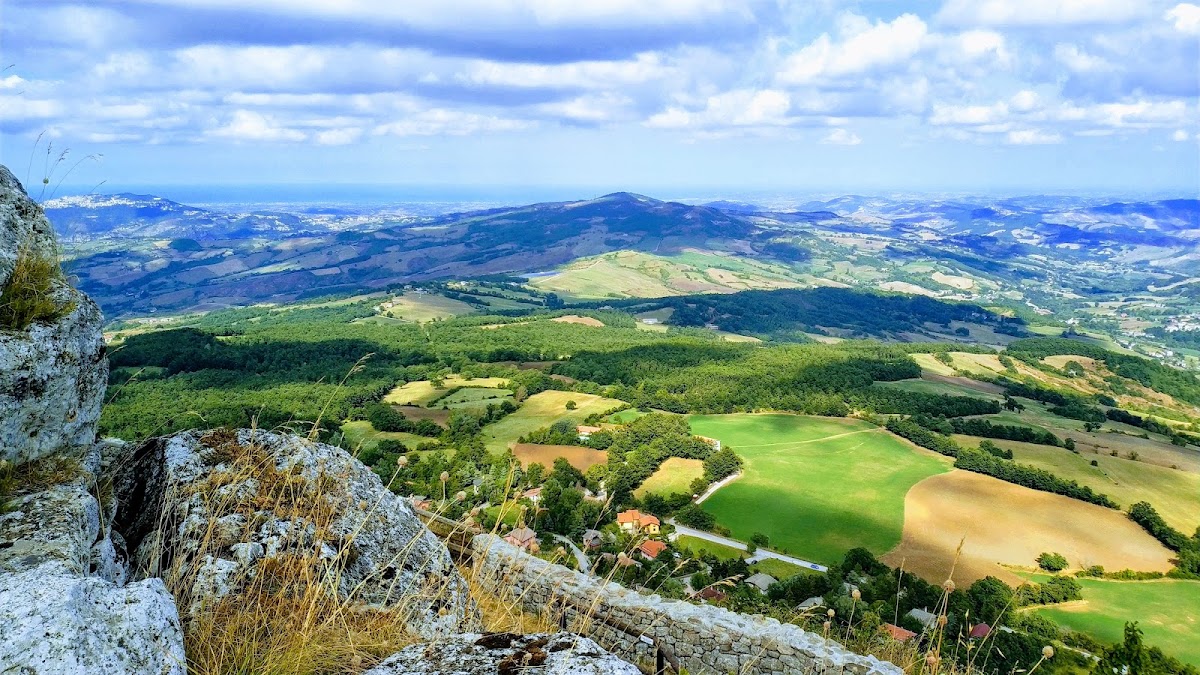
Castello di Montecopiolo is a medieval hilltop castle in Italy, above Villagrande di Montecopiolo in Emilia-Romagna. Founded in the tenth century, probably through the initiative of the bishops of Montefeltro or their long-term landholders, the counts of Carpegna, it became the centre from which the Montefeltro dynasty emerged and a major stronghold of the later Duchy of Urbino.
Before the medieval castle
The limestone ridge had been used long before the castle was built. Neanderthals sheltered in its natural karst cavities, and occupation increased during the Copper Age before continuing through the Middle Bronze Age. Activity persisted at a lower level during the Iron Age. The ridge stood beside routes crossing the Apennines between the Tiberine side, the Adriatic, and the valleys of the Foglia, Conca, and Marecchia.
In the Roman period, the area probably belonged to the municipium of Pitinum Pisaurense, a Roman community incorporated into the state while retaining some local administration. A road later known as the Via Vetere ran along Monte Copiolo’s eastern slopes. In late antiquity, it connected Urvinum Mataurense with the fortified settlement of Mons Feleter. Rural farmsteads occupied the surrounding territory, while other Roman material came from later deposits on the ridge. These finds range from the second century BC to the fourth century AD.
Foundation and Montefeltro power
The Castrum Montis Cupioli, a fortified settlement on Monte Copiolo, was established in the tenth century. Its comital residence made the site the principal centre of power in medieval Montefeltro and the nucleus of the family’s territorial lordship. The first surviving document concerning the castle dates to 1150, when it belonged to Montefeltrano I da Montefeltro, regarded as the progenitor of the Montefeltro family. By that time, four circuits of walls already protected the complex.
A women’s monastery was founded at Castelbegni in 1228 within the castle’s curtis, a medieval landed estate and administrative centre belonging to the counts of Montefeltro. Around the same period, the Hospital of Santa Maria della Misericordia was established outside the walls on Lateran land. It assisted pilgrims, poor people, and the sick.
During the first half of the thirteenth century, the Montefeltro divided into a Guelph branch, which supported papal authority, and a Ghibelline branch, which supported the emperor. Montecopiolo became the principal possession of the Ghibelline branch. In 1253, Cavalca di Montefeltro, identified as the castle’s castellan, arranged a division of property between himself and his nephews after the death of his brother Montefeltrano II.
Papal rule and renewed Montefeltro control
In 1328, Emperor Louis IV granted Castello di Montecopiolo to Count Speranza di Montefeltro. A papal document from 1341 accused the counts Nolfo and Galasso da Montefeltro of holding the castle by force while also controlling the episcopal city of San Leo. Montefeltro returned to papal jurisdiction in 1355, although the castle was described in 1360 as enjoying communal and administrative independence. By 1365, it had entered territories subject to the pope.
A description from 1371 called Montecopiolo one of the strongest and most heavily armed centres in Montefeltro. The castle stood on a high, defensible rock and contained sixty hearths, a contemporary measure of households. Its garrison included a captain and twelve paid personnel supported by the Apostolic Chamber, the papal financial administration.
In 1376, Antonio II da Montefeltro seized the commune of Montecopiolo, expelled the papal legates, and restored the castle to the family. A truce with the Malatesta, the ruling family of Rimini and a major regional rival, still associated the castle with Antonio II in 1380. In 1389, Pope Boniface IX confirmed his possession. During the later fourteenth century, Montecopiolo remained in Montefeltro hands and served as a frontline defence against the Malatesta lords of Rimini.
The fortress in the fifteenth century
Guidantonio da Montefeltro became count of Urbino in 1404 and was succeeded by his son Oddantonio. In 1440, the authorities ordered Montecopiolo’s castellan to be ready to send military assistance to San Marino. The following year, Federico da Montefeltro used the fortress as the base for a garrison besieging San Leo. He wrote from Montecopiolo to announce that he had captured San Leo from the Malatesta. After Oddantonio’s murder in 1444, Federico became lord of Urbino, and Pope Nicholas V confirmed his possession of Montecopiolo in 1447.
Sigismondo Pandolfo Malatesta besieged the castle in 1448, but the assault failed and the town gates were not breached. The castle’s curtis was plundered in retaliation. In 1455, Alessandro Gambacorta, captain of the fortress and Duke Federico’s master of arms, led troops from Montecopiolo against Malatesta forces retreating from Carpegna and Pietrarubbia.
During fifteenth-century remodelling, the fortress was adapted for firearms. Rectangular towers were replaced by round towers, the enclosing walls were raised, and some buildings on the summit were demolished to create wider areas for artillery manoeuvres. The changes reflected the transformation of siege warfare and strengthened the castle’s military role.
Crisis under Cesare Borgia and the sixteenth century
After Federico da Montefeltro died in 1482, his son Guidobaldo succeeded him. In 1502, Cesare Borgia, the son of Pope Alexander VI, forced Guidobaldo to flee Urbino. Dionigi Agatoni de’ Maschi, captain of Montecopiolo, sent men to meet the duke and escort him safely to the fortress. An armed rising against Borgia began at Montecopiolo in 1503 and spread to other centres of Montefeltro.
In 1516, Pope Leo X excommunicated Francesco Maria della Rovere, Guidobaldo’s adopted son, deprived him of the Urbino fief, and assigned Montefeltro to Lorenzino de’ Medici. Francesco Maria capitulated in 1517. After Lorenzino’s death in 1519, the duchy returned to the Papal States, territories governed directly or indirectly by the popes.
Following Leo X’s death in 1521, Francesco Maria began reconquering the duchy and kept a strong force at Montecopiolo. In 1522, he and much of the garrison were at the castle preparing an attack on San Leo. Giovanni de’ Medici, known as Giovanni delle Bande Nere, led a counteroffensive with nearly 15,000 troops. The campaign devastated several settlements and castles in the region. Later tradition attributed the plundering of Montecopiolo to these troops, but archaeological interpretation indicates that the castle was not destroyed, abandoned, or structurally damaged during the campaign. Its main consequence was the gradual movement of inhabitants toward smaller villages on the lower slopes.
Abandonment and archaeological work
The castle remained inhabited throughout the sixteenth century. During the seventeenth century, several families still lived there and two churches continued to serve the settlement. After the extinction of the dukes of Urbino in 1631, the population gradually moved downstream, and the ancient castle area was completely abandoned during the eighteenth century.
The damaged castle remained visible on the summit in the early twentieth century. Between the two world wars and after the Second World War, masonry was removed for use as building material in houses on the mountain slopes. This process reduced the visible remains and erased much of the physical memory of the castle’s structures.
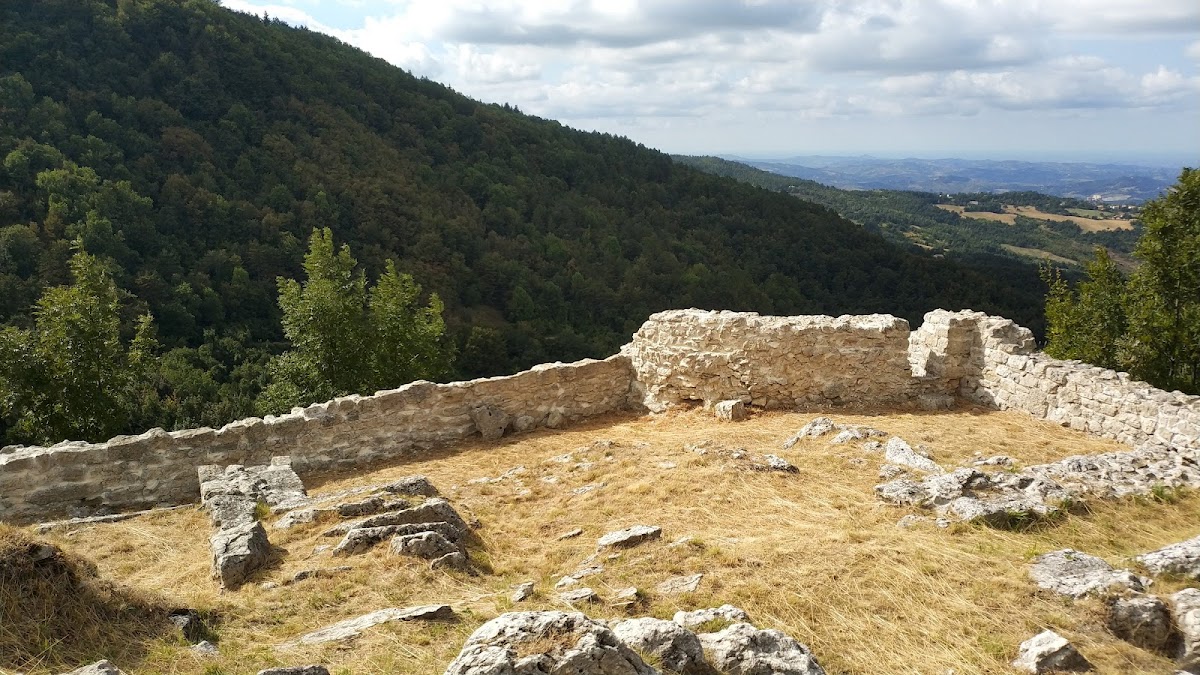
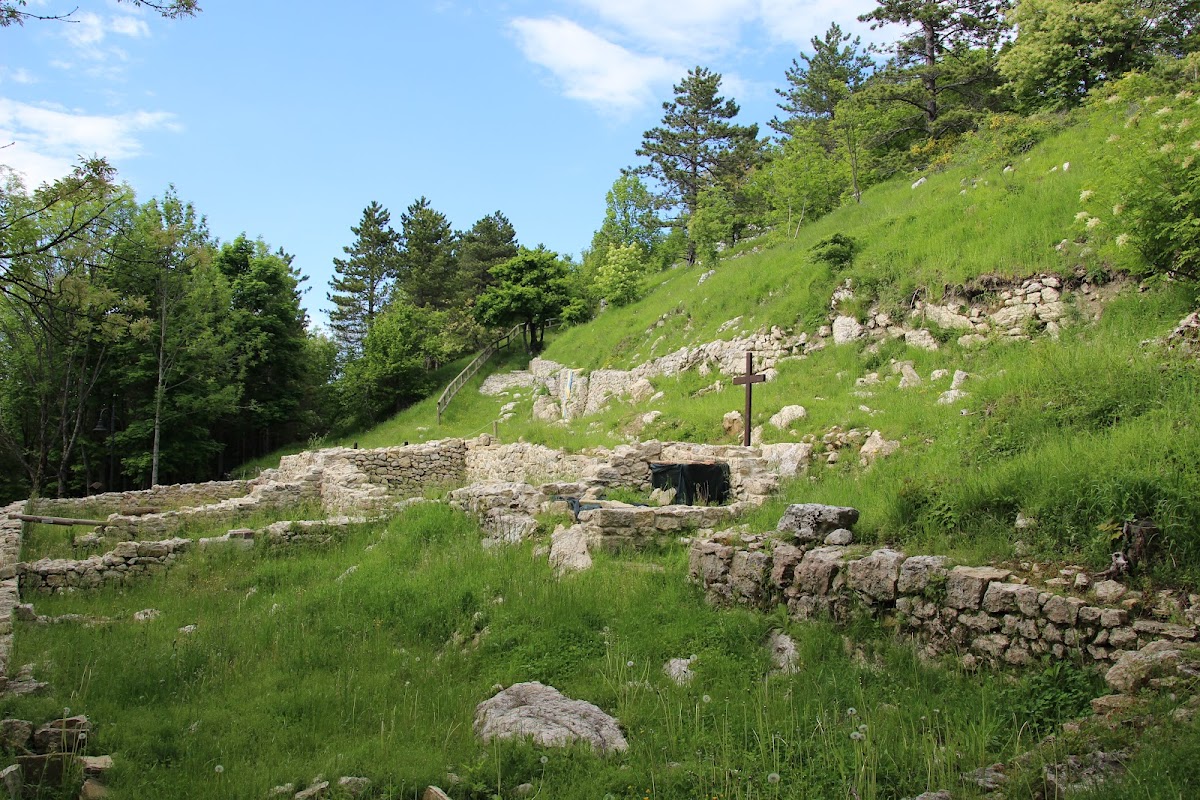
Archaeological excavation began in 2002 under the chair of Christian and Medieval Archaeology at the University of Urbino Carlo Bo, in cooperation with the archaeological heritage authorities and the Municipality of Montecopiolo. Fourteen campaigns have taken place, and investigation continues through an international summer school involving students from universities including the Universite de Lorraine, the Sorbonne, the University of Liege, and the Complutense University of Madrid. Municipal safety works carried out from 2011 secured the excavated area. Castello di Montecopiolo is listed as Italian national heritage and is regarded as an archaeological-geological site of European significance because of its medieval quarries and natural rock forms.
Remains
Setting and defensive layout
The castle occupied about 9,000 square metres on the watershed between the Conca and Marecchia valleys. The surviving remains lie at approximately 1,033 metres above sea level, on a ridge whose summit reaches about 1,083 metres. The complex developed across a summit fortress and a settlement on a lower terrace. In the fourteenth century, the lower settlement had its own wall and was overlooked by the stronger summit fortress.
By 1150, four wall circuits protected the site. Three enclosed the summit fortress, while the fourth surrounded the settlement. A fifth circuit was added later in the fourteenth century to protect another part of the inhabited area, and a sixth was constructed during the fifteenth century. At least eight large towers strengthened the complex. These successive enclosures show how the castle expanded beyond its original summit core as settlement and military demands changed.
Summit fortress and medieval buildings
The first tenth-century phase followed extensive cutting and hollowing of the limestone outcrop. Its principal structure was a summit tower measuring about 12 by 12 metres externally at the base. A stone enclosure protected the tower, while residential and practical buildings, including storage structures, stood outside it.
During the twelfth and thirteenth centuries, the fortress was extensively remodelled and a stone enceinte, or enclosing defensive wall, was built around the settlement on the lower terrace. After the summit tower collapsed through structural failure, a church replaced it within the defensive circuit. The church stood beside a palatium, a substantial residential or administrative building associated with the counts of Montefeltro.
Firearms adaptations
The fifteenth-century alterations reshaped the fortress for artillery warfare. Round towers replaced rectangular ones, the walls were heightened, and some summit buildings were cleared to form broad spaces for the movement and operation of guns. The surviving evidence therefore combines the remains of an early medieval hilltop stronghold with later adaptations to changing military technology.
Quarries and natural rock formations
Large quarries were cut into the limestone of the San Marino Formation during the tenth to twelfth centuries, contemporaneously with the castle’s construction. The ridge also contains naturally formed karst cavities and distinctive rock shapes produced by atmospheric processes. Together, the quarries and natural formations give the site both archaeological and geological importance.
Prehistoric and Roman evidence
Excavation has recovered a flint made using the Levallois technique, a method of preparing a stone core to produce flakes of planned form. The object belongs to the Mousterian, a Middle Paleolithic stone-tool tradition commonly associated with Neanderthals. Other Stone Age tools and lithic fragments, including a piece of obsidian, have also been found in secondary deposits.
Roman-period evidence includes material from the second century BC to the fourth century AD and traces of rural farmsteads in the surrounding territory. Material recovered from secondary deposits on the ridge indicates activity connected with the Roman landscape, while the later castle remains occupy the same strategically placed limestone height.
Surviving archaeological area
The ruins visible today were reduced mainly through the later removal of masonry for construction, particularly between the world wars and after the Second World War, rather than by the 1522 military campaign. Excavation remains in progress, and secured paths lead through the archaeological area while the settlement’s walls, towers, buildings, and earlier occupation levels continue to be investigated.