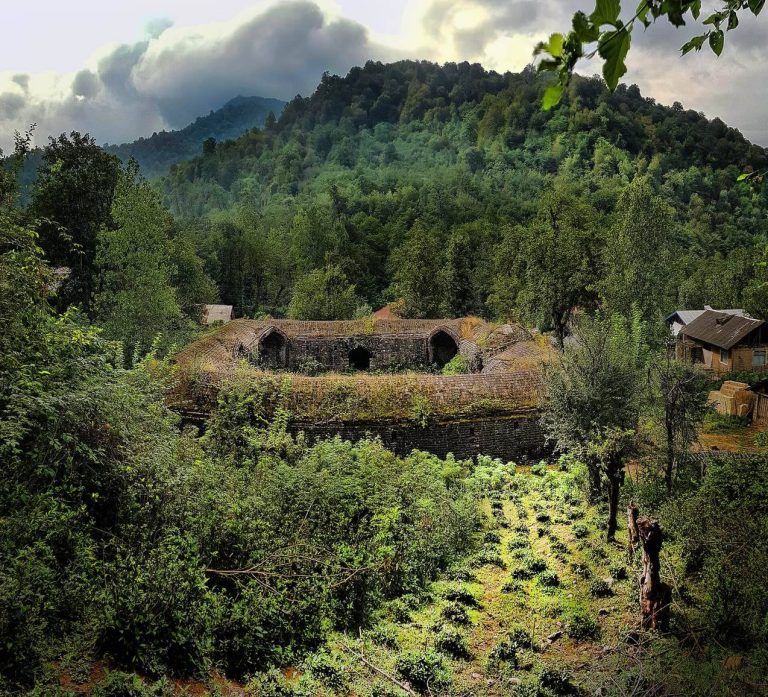
Lambsar Castle: A Nizari Ismaili Fortress in Iran


Site at a Glance
- Rating
- 4.3
- Popularity
- Low
- Country
- Iran
- Primary era
- Medieval
- Eras represented
- Classical, Medieval
- Civilizations
- Nizari Ismaili State, Sassanid
- Site type
- Military
- Remains
- Castle
On this page11 sections
History
Lambsar Castle, also known as Lamsar, Lamasar, Lambasar, Lambesar, or Lomasar, is a military fortress in Iran, northeast of Razmian in the western Alamut region. Its origins are attributed to the Sasanian period, when the Sasanians ruled the Iranian world from the third to the seventh century CE, although historical texts do not preserve its construction date. Its building methods and materials have been interpreted as reflecting Sasanian and early Islamic fortifications, with early Islamic referring to the centuries following the Islamic conquest of Iran.
Early and Seljuk Periods
The fortress was used extensively during the Seljuk period. The Seljuks, a Turkic Sunni dynasty that ruled large parts of Iran and the Middle East during the eleventh and twelfth centuries, formed part of the political setting in which Lambsar continued as a fortified mountain site.
Nizari Ismaili Stronghold
Lambsar later became one of the most important Nizari Ismaili strongholds after Alamut Castle. Nizari Ismailism is a branch of Shia Islam whose organized communities in Iran established and controlled a network of fortified centers during the medieval period. Lambsar served as a major defensive base for protecting Alamut from attacks approaching from the west.
Kiya Buzurg Ummid captured an earlier castle called Rasamuj and rebuilt it into a major stronghold with local labor. Hassan-i Sabbah, the founder and principal organizer of the Nizari Ismaili state in Iran, appointed Buzurg Ummid as governor. After Lambsar was captured, he placed Buzurg Ummid in charge of the largest Nizari Ismaili fortress in western Alamut.
Mongol Siege and Fall
During the Mongol invasion of Iran, Lambsar, Alamut, and Gerdkuh continued to resist after Meymoon-Dej surrendered in 1256 and Rukn al-Din Khurshah was captured. Rukn al-Din Khurshah was the Nizari Ismaili imam taken prisoner during the campaign, while Hulaku Khan was the Mongol ruler and commander who led the conquest of the Ismaili fortresses.
Lambsar held out for about a year, but a cholera epidemic killed many of its inhabitants. The fortress fell in January 1257. Hulaku Khan ordered it to be ruined and commanded that the survivors of the epidemic be beheaded.
Small Ismaili groups attempted to recapture Alamut in 1275 and again in 1389, but both efforts were short-lived. Lambsar was registered as an Iranian national heritage site on 29 April 2003. In July 2026, it was included in the UNESCO World Heritage listing “Alamut Castle and Related Fortifications,” a serial property comprising seven castles and historical defensive installations in the eastern and western Alamut valleys and the southern Alborz foothills.
Remains
Mountain Fortress and Defences
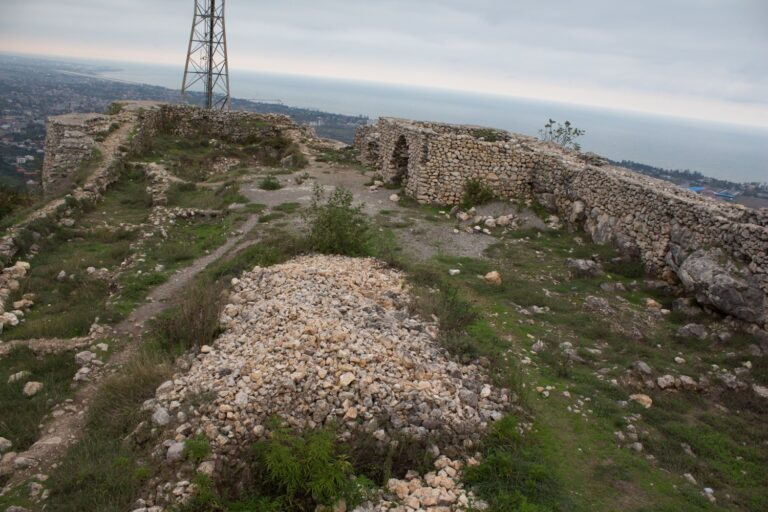
Lambsar occupies a north-south mountain slope about 480 metres long and more than 190 metres wide. Its two levels differ in height by approximately 150 metres. Deep valleys formed by the Nineh Rud and Lameh restricted access from the east and west, leaving the northern and southern fronts as the approaches through which the fortress could be entered. Two gates served these approaches.
Defensive Walls
The fortress was enclosed by enormous two-layer defensive walls built from very large stones. They exceeded 10 metres in height, but only scant traces of these fortifications survive. Stone was bonded with saruj mortar, a traditional waterproof material made from lime and other mineral or organic additives and used especially in Iranian water-related and defensive construction.
Northern Buildings
Northern Fortifications
The northern section once held substantial gates, towers, and ramparts. Its fortifications have not survived, while a large building in the same part of the fortress remains in ruinous form with four smaller extensions facing east.
Kiya Buzurg Ummid’s Headquarters
The principal northern building has walls approximately 1.2 metres thick, constructed from cut stone. It served as Kiya Buzurg Ummid’s main residence or headquarters within the fortress.
Water and Provisioning Systems
Lambsar’s water infrastructure included an elaborate arrangement for collecting and storing rainwater, along with reservoirs and a water-supply system. Grain stores in the southern and southeastern parts of the castle supported the inhabitants during prolonged sieges. The fortress also covered an unusually large area, allowing limited cultivation and helping its population maintain a degree of self-sufficiency during periods of isolation.
Only ruins of the fortress remain today.