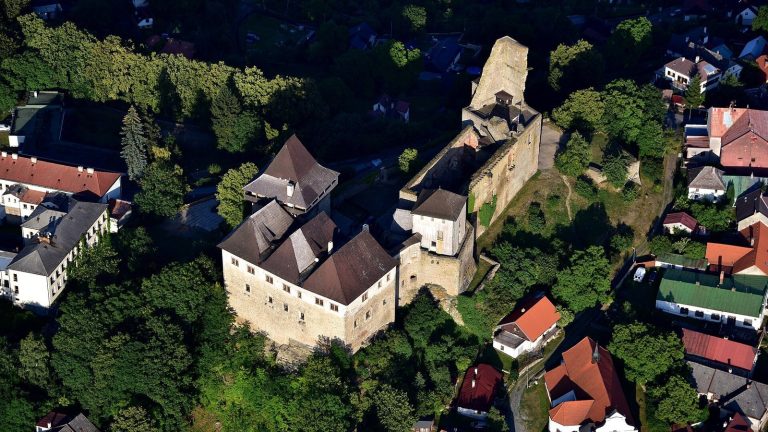
Ronovec: A Gothic Castle Ruin in Czechia
Site at a Glance
- Rating
- 4.4
- Popularity
- Low
- Country
- Czechia
- Primary era
- Medieval
- Eras represented
- Medieval
- Civilizations
- Holy Roman Empire, Kingdom of Bohemia
- Site type
- Military
- Remains
- Castle
On this page10 sections
History
Ronovec is a Gothic castle ruin in Czechia, near Dolní Krupá and north of Břevnice. Founded by the Bohemian nobleman Smil of Lichtenburg at the beginning of the second half of the thirteenth century, it probably served as an administrative centre for the surrounding silver-rich region rather than as its founder’s residence.
Foundation and the Lichtenburgs
The first written reference to Ronovec dates to 1 April 1262, when Smil issued a charter there. Four surviving charters were issued at the castle, although none directly concerns Ronovec. Smil probably stayed there frequently, despite not using it as his permanent residence.
After Smil’s death, the castle passed to his son Smil II of Lichtenburg. In 1289 it came to Hynek of Lichtenburg, who probably transferred it in 1296 to his youngest son, Čeněk. In 1314, Hynek, the nephew of Čeněk, acquired Ronovec.
Changes of Lordship in the Fourteenth Century
In 1345, Hynek exchanged Ronovec and the mines at Buchleberg near Přibyslav with John of Luxembourg, king of Bohemia from 1310 to 1346, receiving Poděbrady Castle in return. The Lords of Lipé acquired Ronovec later that year and immediately pledged it to Mareš of Radetín. Perolt, the uncle of Jindřich of Lipé, redeemed the pledge in 1346, after which the castle became part of the Lipnice estate.
Čeněk of Lipé later received Ronovec, and his son Jindřich sold it in 1362, together with its associated fief, to Ješek of Zlíchov. A fief was land or an associated right held by a subordinate in return for service or allegiance. The transaction also involved Čeněk Krušina of Lichtenburg, and Ronovec’s estate then included eight villages.
The castle probably acquired the name Ronovec during this period. The name apparently referred to the forked branch in the coat of arms of the Lords of Lipé. Earlier names included Sommerburg, meaning “Summer Castle,” and Žumburg.
Decline and Uncertain Fifteenth-Century History
After Ješek’s death, probably around 1392, his sons Jan and Petr lived at Ronovec. Regional chronicles state that they accumulated extensive debts and probably struck counterfeit coins illegally at the castle. Such counterfeiting may have continued later. The Angels of Ronovec, the family descended from Ješek, were last mentioned in connection with the castle in 1406.
Later disputes over the property of the deceased Jindřich of Lipé apparently also involved Ronovec. The castle may have suffered a military attack during this period, possibly beginning its decline. Some historians have proposed that Hussite forces captured it in 1424. The Hussite Wars were religious and political conflicts in Bohemia and neighbouring regions that began after the execution of the reformer Jan Hus in 1415, but the proposed capture of Ronovec remains uncertain.
A shell-shaped guard from a thrusting or cutting weapon was found at the ruin. Similar guards occur mainly at sites whose decline was connected with the beginning of the Hussite Wars or the second quarter of the fifteenth century, making the find an indication that Ronovec’s decline may have been connected with those conflicts. The castle’s subsequent history is unknown. Regional chronicles mention Jan of Ronovec of Libice, suggesting that the site may still have been inhabited during the second half of the fifteenth century, although his relationship to Ronovec is uncertain.
Sixteenth-Century Abandonment
In 1502, Jindřich Špetle of Prudice bought Ronovec from an unknown seller. Construction of the fortified manor at Dolní Krupá began at approximately the same time. Jan Haugvic of Biskupice acquired the castle in 1510 and soon sold it to H. Ptáček. The Lords of Lipé regained it in 1515 and used it as a summer residence.
Hynek Haugvic of Biskupice bought Ronovec together with several surrounding villages in 1533. Regional chronicles still described it as a castle, probably indicating that it remained roofed. Hynek abandoned it after several years, and in 1544 Ronovec was recorded as deserted. The Haugvic brothers’ documents contain the last known reference to the castle, dated 1572.
Later Investigation and Protection
After its abandonment, Ronovec became a refuge for members of various religious minorities, thieves, and other socially marginal people. Eighteenth- and nineteenth-century rumours of hidden treasure attracted treasure hunters, although no discovery of valuables at the castle can be documented.
Around 1870, the owner Wenzel Welz undertook probably the most extensive investigation of the ruin. The work damaged Ronovec to a condition approximately resembling its present state. In the 1950s, Josef Čapek founded a local-history circle devoted to the castle, and its members conducted amateur research there over the following decades. A memorial plaque to Čapek inside the palace was unveiled on 9 October 1988. Ronovec has been protected as a cultural monument since 1963 and is listed as a cultural monument of the Czech Republic.
Several legends became attached to the ruin. One says that knights from Lipnice, rather than the Hussites, captured it while defending the interests of the daughter of the lord of the Pohled estate. The story claims that she had gone to Ronovec at her own request, that the castle was burned, and that its owner and the nobleman’s daughter jumped from a tower. Other tales describe treasure stolen by a local administrator, wine in collapsed cellars that became solid and intoxicating, and an ornate coffin containing a general and a chest of precious objects that appeared among the ruins before sinking into the earth.
Remains
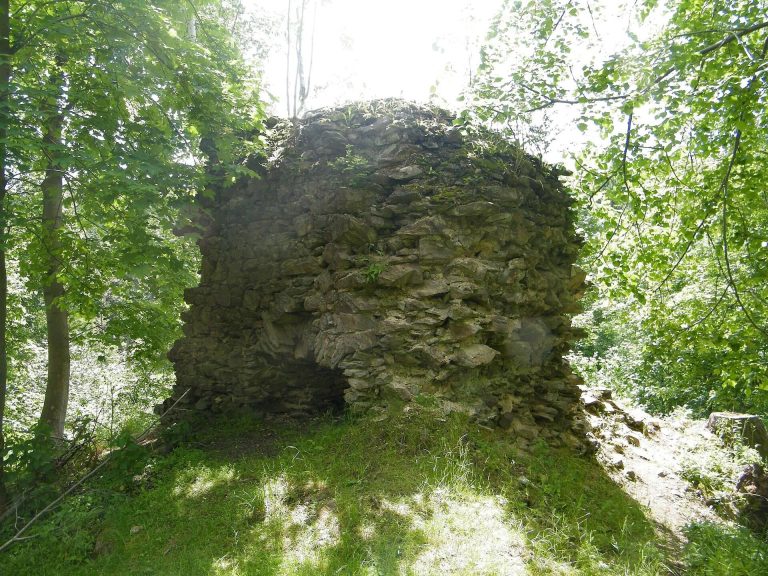
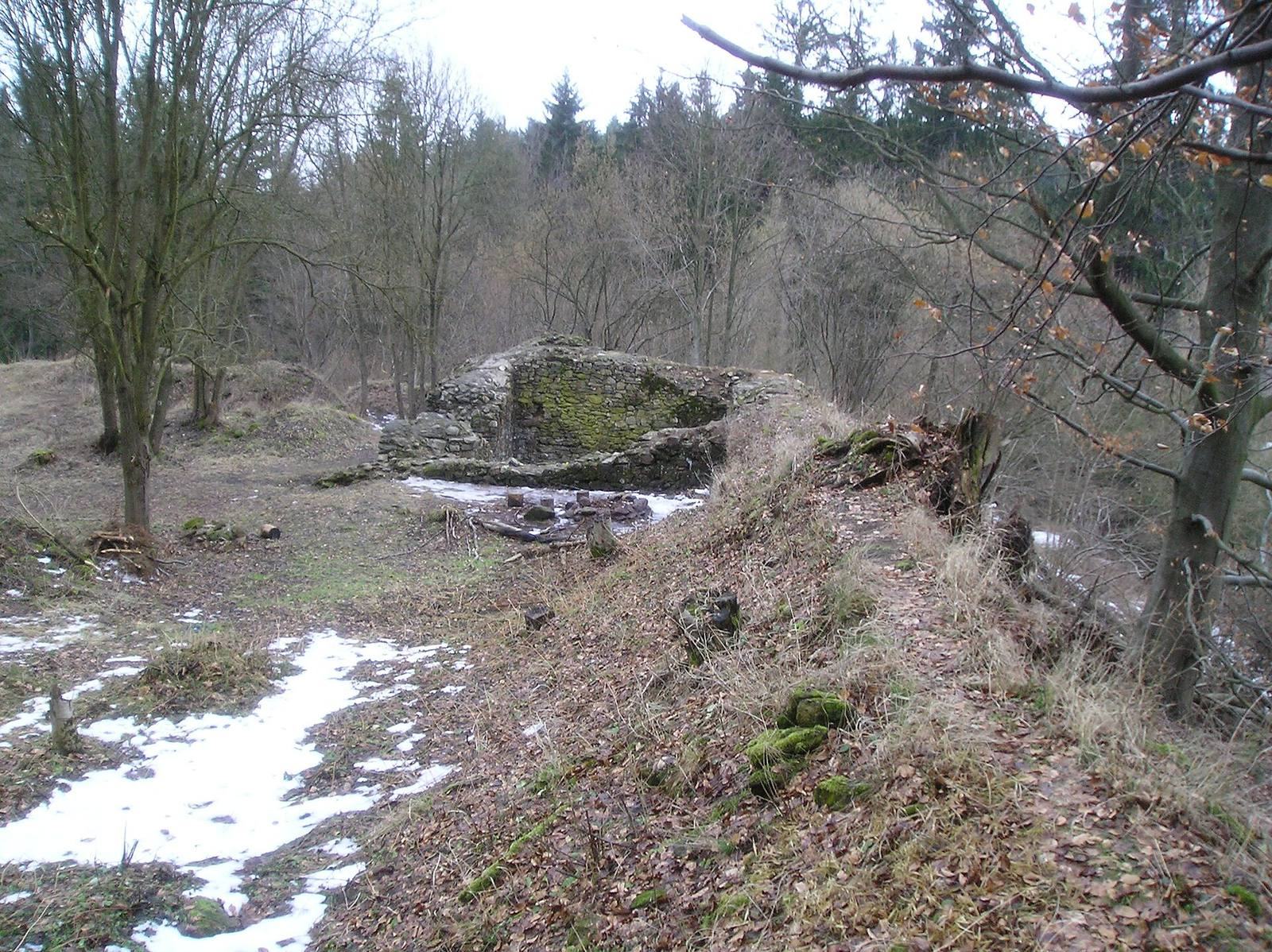
Ronovec stands on a promontory above the left bank of the Břevnický stream. Its surviving remains consist of the castle core and parts of the palace. The castle followed a two-part plan, with a forecourt outside the main enclosure and a more strongly protected core. The available evidence identifies it as a high-quality thirteenth-century noble castle and may indicate a mantle-wall design, in which a continuous outer defensive wall formed the principal enclosure.
Forecourt and Approach
The southern and eastern sides of the forecourt are marked by an earthwork rampart and ditch. The surface of this outer area preserves no traces of buildings. An approach road reached the western end of the promontory and entered directly through a gate into the castle core. A further ditch separated the core from the forecourt, adding another defensive division between the outer and inner parts of the castle.
Castle Core and Palace
The castle core had an approximately square ground plan, with buildings arranged along its side walls. A tower projected from the western curtain wall, the defensive wall enclosing or linking fortified sections, and controlled the area in front of the gate. The surviving palace forms part of this inner complex. Among the ruin’s unusual features are doors made from metal-sheet plates joined by rivets, with only a few comparable examples known in Czechia.
Memorial Tree
A large Norway spruce grows near the ruin. It was declared a memorial tree in 1988 and has a circumference of 360 centimetres and a height of 41 metres.