Château de Vaujours: An Angevin Fortress in France


Site at a Glance
- Rating
- 4
- Popularity
- Low
- Country
- France
- Primary era
- Medieval
- External website
- Open
- Eras represented
- Medieval
- Civilizations
- French
- Site type
- Military
- Remains
- Castle
On this page12 sections
History
Château de Vaujours is a former medieval fortress near Château-la-Vallière in France, built in the Angevin period to defend the eastern limits of Anjou. Its documented setting belonged to the seigneurie of Chasteaux, later Château-la-Vallière, within the sénéchaussée of Baugé, a major medieval judicial and administrative district, and the diocese of Angers, an ecclesiastical territory governed by a bishop.
The Alluye and Montfort Lords
Hugues I d’Alluye, recorded as living in 978, is the earliest known lord of the fief. The Alluye succession continued through Hugues II, Hugues III, Hugues IV, André d’Alluye, Hugues V, Jean d’Alluye, and Hugues VI. The family also held neighboring lordships, including Chenu, Noyant, Méon, and Saint-Christophe.
The fortress was built around 1250. Its construction is attributed either to Hugues VI d’Alluye or to Rotrou of Montfort, a related lord who held Montfort and Semblançay. The wider feudal holdings later passed from the Alluyes to the Rotrou of Montfort and l’Archevêque de Parthenay families. From at least 1328, or possibly from the late thirteenth century, successive transfers brought the property first to the Trousseau family and then to the Bueils.
War, Restoration, and Royal Visits
During the Hundred Years War, the prolonged conflict between the English and French crowns conventionally dated from 1337 to 1453, the fortress was never captured by the English. A major restoration in the fifteenth century is associated with Jean V de Bueil, who strengthened its defenses. A French admiral and count of Sancerre known as “the Flail of the English,” Jean V held Vaujours from 1418 and died there in 1478.
Louis XI, king of France from 1461 to 1483, stayed at Vaujours during visits to Anjou. His presence is recorded on 3 June 1469, 17 September 1470, and 2 October 1471. In 1461, Jeanne de Valois, daughter of Charles VII and Agnès Sorel, married Antoine de Bueil, Jean V’s son. Antoine received his royal brother-in-law at Vaujours in 1469, before being admitted to the Order of Saint Michael.
The Bueil and La Vallière Duchies
The Bueil family, counts of Sancerre, retained the lands through René de Bueil, his son Jean VIII, and Jean VIII’s son-in-law François de Mesgrigny. In 1666, Louis XIV purchased the castle and adjoining lordships from Renée de Bueil and François de Mesgrigny. He gave them to Louise de La Vallière in 1667.
Louise became Duchess of La Vallière and Vaujours in May 1667 and held the title until she entered a convent in 1675. The duchy then passed to her legitimized daughter, Marie-Anne de Bourbon, Princess of Conti. In 1698 it passed to Marie-Anne’s first cousin, Charles-François de La Baume Le Blanc. Louis XV made him the third Duke of La Vallière through a second elevation of the duchy in February 1723.
Abandonment and Preservation
The eighteenth-century history of Vaujours also includes the Davot family, who occupied the castle for an extended period. The castle was abandoned during the French Revolution.
Thomas Stanhope-Holland acquired the Vaujours estate and the land of Château-la-Vallière in 1815. He reportedly used the castle as a quarry for building materials. The estate was adjudicated to Charles Barry Baldwin on 6 December 1837, then transferred by him on 14 August 1841 to Louis-Gabriel-Marie Poitelon du Tarde and his wife, Louise-Anne Vétillart du Ribert.
Vaujours was entered on the list of monuments historiques on 24 October 1944, and its ruins were classified on 26 January 1989. Volunteers from the Chantiers Histoire et Architecture Médiévales association carried out restoration work in 1986. The site remains privately owned.
Remains
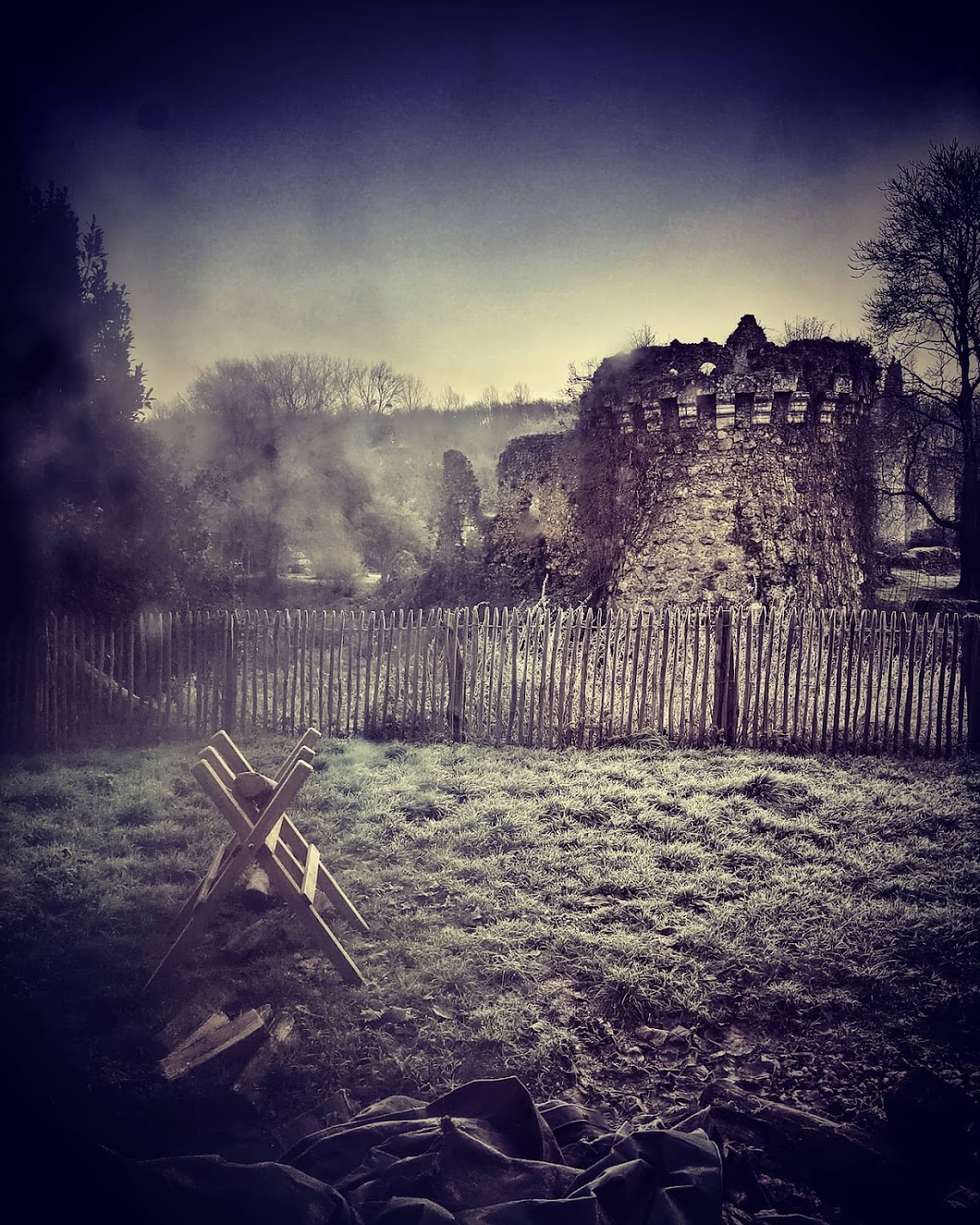
The ruins stand about 3 kilometres south of Château-la-Vallière, near the hamlet of Vaujours, in the valley of the Fare and close to the Château du Vivier des Landes. The castle occupied a mound in the middle of a lake. Water from the lake fed the surrounding water-filled moats, creating a water-fortress arrangement. The moats are now dry and covered by vegetation.
Fortified Layout
The Bailey and Outer Defenses
The complex is divided into two fortified areas, with a bailey, an enclosed area within a castle’s outer defenses, to the west and the principal castle to the east. The entrance through the double enceinte, or enclosing defensive circuit, was protected by two cylindrical towers and a drawbridge. A bastion on the north side added another defensive position.
The Main Entrance and Tower of Honor
A second drawbridge and a postern, a smaller secondary gate, led toward the tower of honor. The postern was flanked on the north by a cylindrical tower. The residential building stood to the south, while the chapel ruins occupied the northern side of this part of the fortress.
Surviving Castle Structures
Walls, Towers, and Walkway
On the eastern side, towers gave access to a covered wall-walk, a protected passage behind the fortifications used by defenders to patrol the walls and reach defensive positions. The enceinte contains several towers, some incorporating projecting masonry blocks as defensive features. The walls were covered with plaster or render, and some towers retained painted surface coatings.
Keep and Lower Courtyard
The keep and the lower courtyard survive within the former castle. To the south, the bastion connected with the fortress and with an advanced defensive work. Together, these surviving elements preserve the relationship between the castle’s inner spaces, its outer defenses, and the works that extended its protection.
The ruins have been cleared of vegetation and are surrounded by lawns, hedges, shrubs, and planted beds.
Nearby sites