Schloss Frankenberg: A Renaissance Castle Estate in Germany


Site at a Glance
- Rating
- 4.2
- Popularity
- Low
- Country
- Germany
- Primary era
- Early Modern
- External website
- Open
- Eras represented
- Medieval, Early Modern
- Civilizations
- Holy Roman Empire
- Site type
- Domestic
- Remains
- Castle
On this page11 sections
History
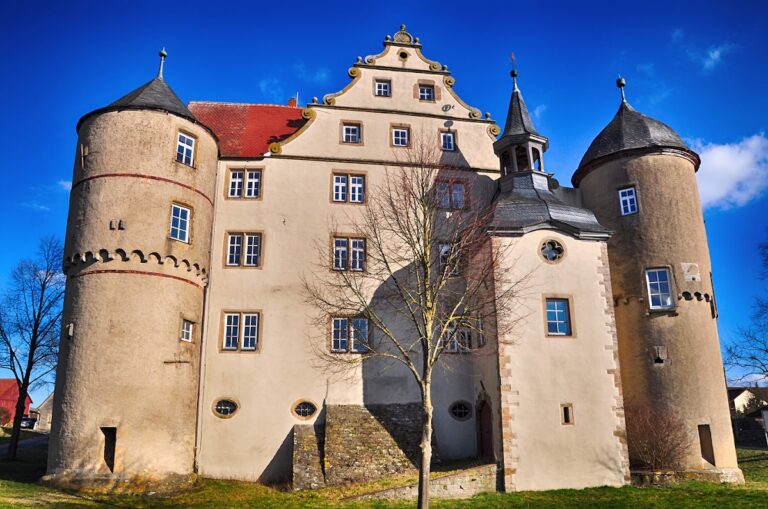
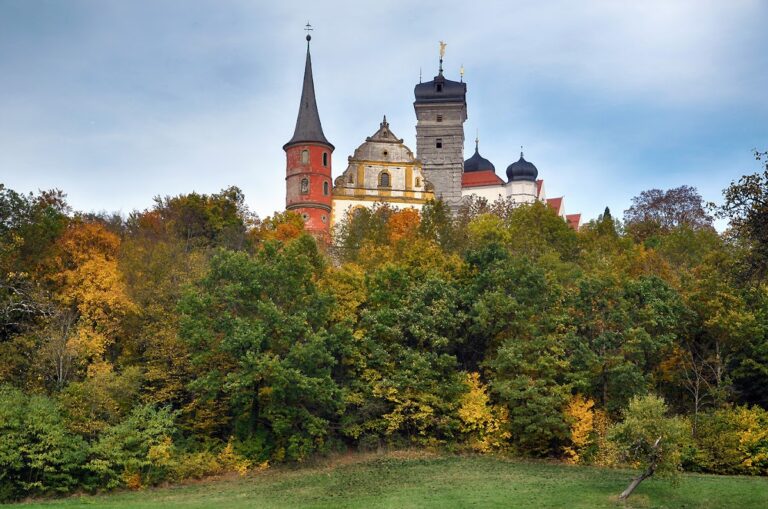
Schloss Frankenberg is a castle estate in Germany, located in the municipality of Weigenheim in the southern Steigerwald. Its principal complex was created as a Renaissance castle between about 1525 and 1555, replacing much of an earlier medieval fortress. The site occupies a wooded, vineyard-covered mountain spur and developed alongside a second castle, Hinterfrankenberg, whose ruins remain nearby.
Medieval Rival Castles
Hinterfrankenberg was the older of the two fortifications and initially belonged to the prince-bishops of Würzburg. In 1256, territorial conflicts prompted the burgraves of Nuremberg to build another castle close by. This second stronghold was also called Frankenberg, creating a complicated history of ownership and political relationships between the two sites.
Vorderfrankenberg was held by the lords of Hohenlohe around 1280. During the fourteenth century, the Hohenlohe controlled the Uffenheim region and the southern Steigerwald. From about 1365, the castle and the villages of Reusch and Ippesheim were repeatedly pledged. Around 1380, Vorderfrankenberg passed to Burkard von Seckendorff.
Hinterfrankenberg was destroyed in 1462 by Sigmund von Schwarzenberg but was later rebuilt. It suffered a second devastation in 1554 during the Margrave War, a conflict in which Margrave Albrecht Alcibiades fought the Catholic prince-bishoprics of Würzburg and Bamberg. After this destruction, the older castle remained a ruin.
The Hutten Renaissance Rebuilding
Vorderfrankenberg continued as an autonomous knightly lordship until the end of the Holy Roman Empire in 1806. This was the decentralized political framework that encompassed much of Central Europe. The lordship belonged to the Odenwald canton of the Imperial Knighthood, a regional association of noble families whose territories were held directly from the emperor rather than from a territorial prince.
The property changed hands among several noble families. The Seckendorffs held it until about 1430, the Absbergs until about 1465, and the Huttens from 1520 to 1783. In 1515, Duke Ulrich of Württemberg murdered his master of the horse, Hans von Hutten. Württemberg paid the Hutten family substantial compensation, and the family probably used part of this wealth to obtain the Vorderfrankenberg lordship.
Knight Ludwig von Hutten, who lived from 1483 to 1548, largely demolished the older Absberg castle. Between about 1525 and 1555, he commissioned a regular complex incorporating very early Renaissance elements that were considered highly modern at the time. The resulting castle became the seat of the Hutten family, which remained there until 1783, when its line ended with Johann Philipp Friedrich von Hutten. The family burial place is in the church at Reusch.
Later Noble Ownership and Restoration
After the last Hutten died, Ansbach Margrave Christian Friedrich Karl Alexander granted the fief to Ludwig Karl Wilhelm von Poellnitz. A fief was land or jurisdiction granted by a higher lord to a vassal in return for service and allegiance. The Poellnitz family lived at Schloss Frankenberg until 1971.
After the death of the last Baroness von Poellnitz in 1971, the estate passed to the Barons von Lerchenfeld of Heinersreuth near Kulmbach. It covered more than 500 hectares, with the castle and approximately 100 hectares remaining in the von Lerchenfeld family’s possession until 2006. Following Carl von Lerchenfeld’s insolvency, entrepreneur Roland Belz acquired the castle in 2008. After Belz died in 2011, the castle and associated property passed in 2014 to LIVIA Group and Peter Löw’s private investment company. The dairy buildings were acquired in 2016.
The outer bailey and chapel were renovated during the 1990s. From 2014, restoration extended to the castle, the dairy buildings, and the vineyard areas. The estate contains 29 hectares of vineyards, and wine production resumed there in 2016 after many years, using grapes grown and processed at the estate as well as some grapes brought in from elsewhere. A hotel occupies the castle and outer bailey, while the former administrative building contains a restaurant. Schloss Frankenberg is designated as a listed architectural monument in Bavaria.
Remains
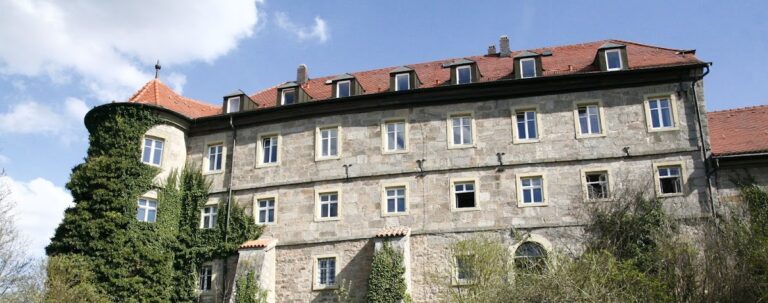
The two castle sites occupy a long spur formed by reed sandstone. The main Schloss Frankenberg complex was probably planned as a four-winged structure. The surviving buildings include the east wing, the south wing, and about half of the west wing. The medieval north wing and part of the west wing are traditionally said to have burned around 1700, although that destruction is not documented. The buildings form a landmark visible across the Ochsenfurt and Uffenheim plains.
Castle Complexes
Schloss Frankenberg
The principal castle is a regular Renaissance complex created during the rebuilding commissioned by Ludwig von Hutten. Much of the earlier Absberg castle was removed to make way for the new arrangement, which incorporated early Renaissance features. The surviving east, south, and partial west wings form the principal architectural remains, while later restoration has preserved and renewed parts of the castle and its associated buildings.
Hinterfrankenberg Ruins
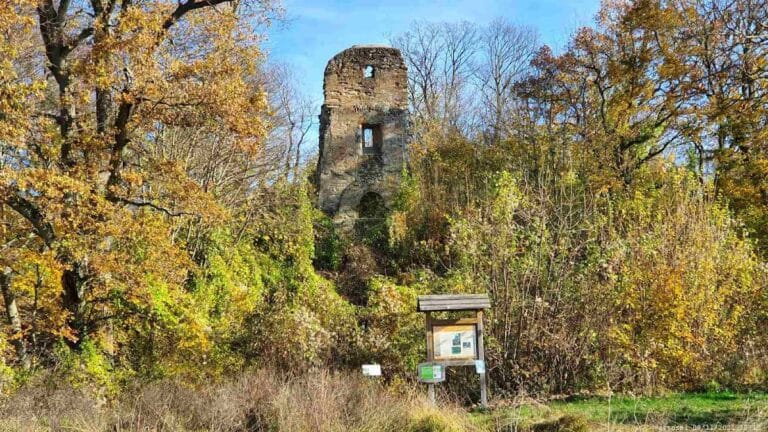
The older Hinterfrankenberg fortification survives in a fragmentary state. Its remains include a double tower, ditches, limited sections of wall, and a well that is almost completely filled in. A publicly accessible park lies beside the ruins. The private cemetery associated with Schloss Frankenberg occupies a terrace several metres northwest and below the former castle.
Castle Cemetery and Woodland Grave
Poellnitz Family Cemetery
The castle cemetery contains members of the von Poellnitz family and servants of the estate. It is arranged on a terrace, with the graves placed in a circle around a central round temple. This structure is a Monopteros, an open-sided classical pavilion surrounded by columns. The deteriorating temple became structurally unsafe, and wooden supports came to obscure much of its form.
Grave of Karl Friedrich von Poellnitz Frankenberg
The grave of Karl Friedrich von Poellnitz Frankenberg, who lived from 1758 to 1826, lies near the summit plateau of the Scheinberg, the highest elevation in the Steigerwald at 498.4 metres. Its gravestone stands on an island in a small woodland lake known as a Rousseau Island. The name refers to Jean-Jacques Rousseau, the eighteenth-century French philosopher associated with ideas emphasizing a close relationship between people and nature.