Dzērbene Castle: A Medieval Archbishopric Fortress in Latvia

Site at a Glance
- Rating
- 4.7
- Popularity
- Low
- Country
- Latvia
- Primary era
- Early Modern
- External website
- Open
- Eras represented
- Medieval, Early Modern
- Civilizations
- Livonian Order
- Site type
- Domestic
- Remains
- Manor House
On this page10 sections
History
Dzērbene Castle is a medieval bishop’s castle in Latvia, located at Dzērbene in present-day Cēsis Municipality. It belonged to the Archbishopric of Riga, a medieval ecclesiastical principality ruled by the archbishop of Riga, and served as both a road-blocking stronghold and an economic centre within the Rauna castle district.
Origins and the Archbishopric of Riga
The castle stood near Augstais kalns, a Latgalian hillfort where a wooden castle existed during the thirteenth and fourteenth centuries. The name Serben, another name for Dzērbene Castle, is derived from Simon Serben, who was identified as the first administrator of the castle district and a vassal of the archbishop.
The castle’s foundation is traditionally placed in 1357, or sometimes in 1360, and has been attributed to Archbishop Fromhold of Riga. Both the dates and the attribution remain unsubstantiated. In 1361, Fromhold pledged the Dzērbene and Piebalga districts to his vassal Bartholomew von Tiesenhausen for 2,800 Riga marks.
A church stood at Dzērbene in 1439. That year, Archbishop Henning Sharpenberg granted the Taurene estate in the Dzērbene district to his vassal Ansis Renne, illustrating the castle’s place within the archbishopric’s network of estates and dependent territories.
Livonian Order occupation
Conflict between the archbishops and the Livonian Order, a military religious order that contested political and territorial power in Livonia, brought Dzērbene under Order control in 1479. Troops captured the castle together with twelve other archiepiscopal castles, reportedly without a battle.
The Order appears to have strengthened the position and begun constructing a stone castle there. This work may indicate that no substantial earlier stone predecessor existed. Dzērbene returned to the Archbishopric of Riga in 1485.
In 1530, Dzērbene was one of seven table estates assigned to the archbishop’s coadjutor, an ecclesiastical assistant expected normally to succeed the archbishop, Wilhelm of Brandenburg-Ansbach-Kulmbach. In 1555, the archbishop granted the castle estate to his chancellor Christoph Sturz. The Livonian Order seized it from him the next year, and after Archbishop Silvester Stodewescher was arrested and imprisoned at Smiltene in 1556, the Order occupied Dzērbene again.
Destruction during the Livonian War
Russian forces attacked Dzērbene in February 1559 during the Livonian War, the conflict of 1558 to 1583 in which Russia, Poland-Lithuania, Sweden, and Denmark fought for control of Livonia. The advancing troops looted and burned settlements across the region. Dzērbene was apparently captured and extensively damaged or destroyed during this attack. Its final destruction occurred during the Livonian War, although the precise date is uncertain.
By the end of the war, Dzērbene had become part of the Polish-Lithuanian-controlled Duchy of Livonia and its Cēsis voivodeship. The medieval fortress was not rebuilt. Its owners instead occupied manor buildings, and later records referred chiefly to the estate. A chapel or small sanctuary associated with Dzērbene was mentioned in 1599, while the 1582 Treaty of Jam Zapolski referred to the site as the citadel of Dzērbene.
Estate ownership and later transformation
Around 1580, King Stephen Bathory granted the Serben estate to his officer Johann Drobisch, also known as Jan Drobysz. Drobisch served as the local starost, an administrative official, until 1612. In 1596, King Sigismund III confirmed ownership of the estate to Christoph Sturz the Younger, the son of the former chancellor. The decision produced a prolonged dispute between the two claimants.
During the Swedish conquest of Livonia in the Polish-Swedish War, King Gustav II Adolf granted Dzērbene and Drusti to General Svante Gustafsson Banér in 1625. The estates later reverted to the Swedish state during the reduction, after their previous owners had left with the Polish forces.
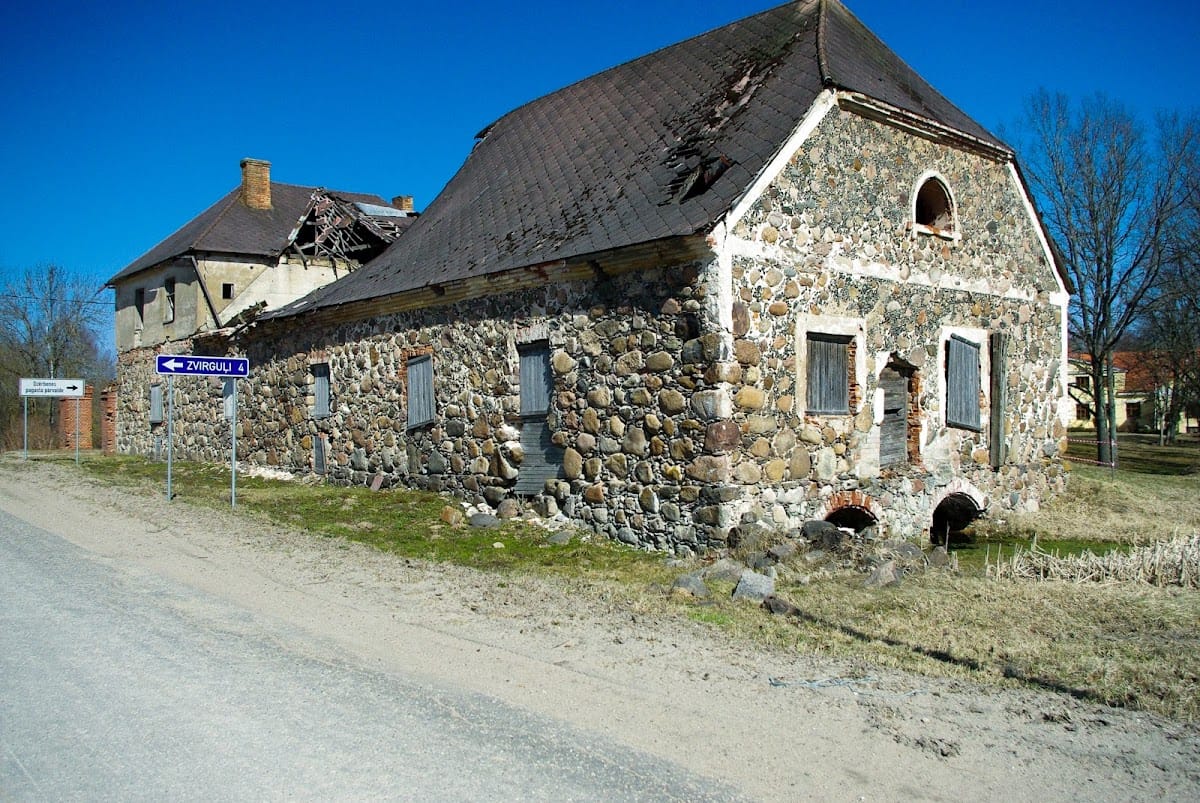
From the late seventeenth century, manor houses were built over the castle remains. One of these buildings survives as the present Dzērbene manor house. Russian forces devastated the district four times between 1700 and 1711 during the Great Northern War.
The Russian Empire granted Dzērbene to Prince Vyazemsky in 1764, later bought the property back, and enfeoffed it in 1771 to Major General Baron Otto Weissmann von Weissenstein. The Weissmann von Weissenstein family held the Serben estate from 1771 to 1891. An account from 1776 stated that the bishop’s castle no longer existed, while a geographical work of 1786 described Dzērbene as a ruined castle. A manor house with a small rectangular tower was built over the ruins in the late eighteenth century.
Modern destruction and conservation
The manor was burned during the 1905 Revolution and rebuilt afterwards. It burned again during the First World War and was restored in 1929. A survey and plan of the castle and manor complex were prepared in 1997, and the manor’s facades and interiors were restored in 2010.
The former castle site lies within the historic Dzērbene manor centre, between Lake Āraisi and the road from Dzērbene to Rauna. In earlier periods it belonged to the southern part of Tālava, near the northern boundary of the Autine castle district, and later to Dzērbene and Drusti parishes in the Cēsis district of the Livland Governorate.
Remains
Castle enclosure and setting
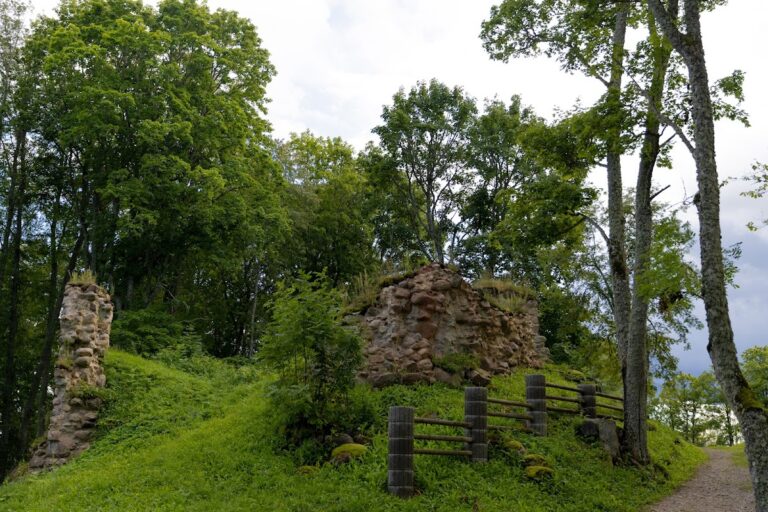
Dzērbene Castle occupied a low elevation or hillock enclosed naturally by slopes to the north, east, and west. Two ravines formed a semicircular boundary on those sides. Depressions at the foot of the slopes were later flooded to create ponds, while a shallow depression marks the artificial ditch on the southern side.
The castle grounds formed a regular square of approximately 70 by 70 metres, with its corners directed toward the cardinal points. Water-filled moats surrounded the enclosure, and sections remain visible on three sides. Their arrangement indicates a perimeter wall around a relatively open internal layout, perhaps a Lagerkastell, meaning a regular fortress enclosure with an open-plan interior.
Eastern defensive works
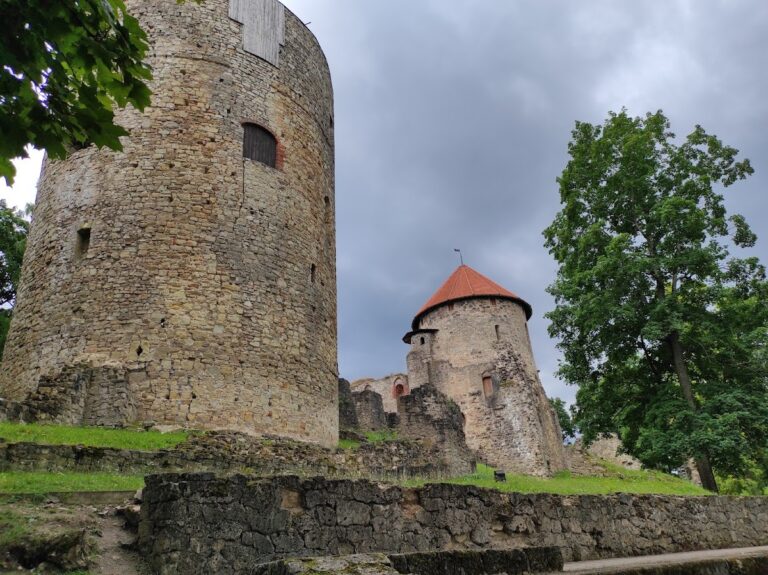
A projecting round tower stood at the eastern corner of the enclosure. It measured approximately eight metres in diameter, and its construction or strengthening probably belongs to the fifteenth century, when the growing use of firearms began to influence fortress design. Foundations of the eastern round tower remain visible near the eastern corner of the manor house.
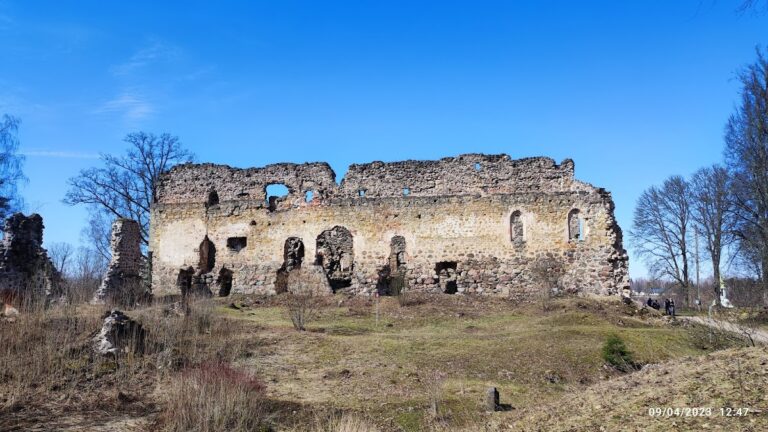
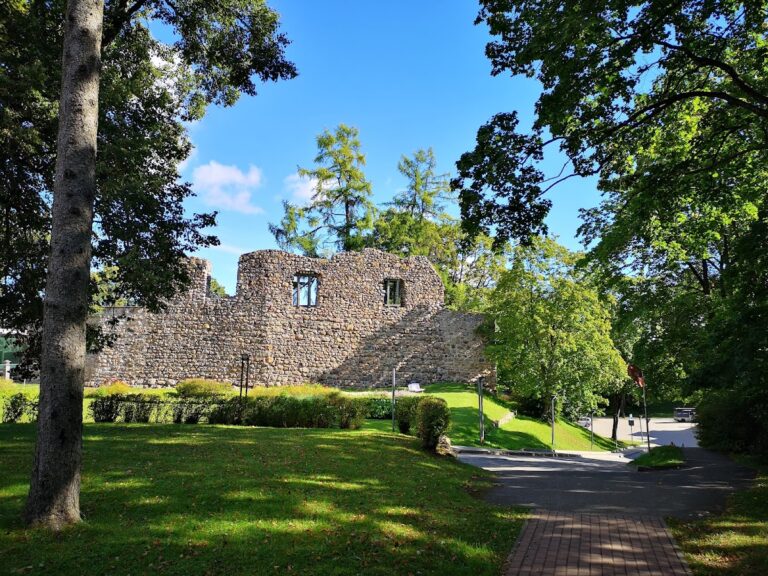
A rebuilt round tower can also be discerned on the northeastern side of the manor house. The surviving water-defence system in the manor park preserves part of the castle’s defensive arrangement, while the extent of medieval walls incorporated into the later buildings remains uncertain.
Manor over the medieval site
The present Dzērbene manor house occupies the northeastern side of the former castle grounds and is thought to stand directly over the medieval principal building. Its late-eighteenth-century rectangular tower formed part of the manor’s later architectural history, rather than a reconstruction of the medieval fortress. The manor house now accommodates the municipal council, a community centre, a music school, and a café.
Nearby sites