Château of Vauvenargues: A Fortified Bastide and Picasso Residence in France

Site at a Glance
- Rating
- 4.1
- Popularity
- Low
- Country
- France
- Primary era
- Early Modern
- Eras represented
- Classical, Medieval, Early Modern, Modern
- Civilizations
- County of Provence, French, Roman
- Site type
- Domestic
- Remains
- Castle
On this page13 sections
History
The Château of Vauvenargues is a fortified bastide in France, in the village of Vauvenargues north of Montagne Sainte-Victoire, whose present castle began in the thirteenth century over an earlier Roman military position. The site later became a medieval stronghold, a Provençal manor, and the home and burial place of Pablo Picasso, giving it a history that connects Roman, medieval, aristocratic, religious, and modern artistic traditions.
Roman and medieval foundations
The area was known in Roman times as “Vallis Veranica” and was occupied by a Roman fort. A medieval castle was later constructed over the Roman site. The complex first belonged to the Counts of Provence before passing to the Archbishops of Aix in 1257, when Isnard II of Agoult and Entrevennes ceded his wife Beatrix of Rians’s property to Vicedomino de Vicedominis, Archbishop of Aix.
Ownership changed hands several times during the late fifteenth and early sixteenth centuries. In 1473 Oliver of Pennart, Archbishop of Aix, transferred the castle to René of Anjou, the prince who ruled Anjou and Provence and was also a major patron of the arts. René gave the château and its lands to his physician Pierre Robin of Angers in 1475. The estate then passed to Pierre de Cabanis in 1477, Thomas de Jarente in 1485, and Melchior de Séguiran in 1504.
The de Clapiers family and the marquisate
After Melchior de Séguiran died at Vauvenargues in 1509, the estate went first to his son Boniface and then to his daughter Marguerite. Her marriage to François de Clapiers in 1548 transferred the property to the de Clapiers family, which retained it for about two and a half centuries.
Between 1643 and 1667, Henri de Clapiers, a cavalry officer, transformed the medieval fortress into a residential manor while keeping its outer defensive walls. The apartments were spacious and included sixteenth-century fireplaces. Henri later became first consul of Aix and prosecutor for Provence in 1674. The building was completed in its château-bastide form during the eighteenth century.
Joseph de Clapiers was recognized for his conduct during the Great Plague of Marseille in 1720, the epidemic that severely affected the city and surrounding region. Around 1722, Louis XV raised the lordship of Vauvenargues to a marquisate. Joseph’s son Luc de Clapiers, Marquis of Vauvenargues, became an Enlightenment moralist and essayist associated with Voltaire and Marmontel.
The Isoard period
The third marquis of Vauvenargues sold the château in 1790, after the French Revolution, to the Isoard family. Their social rise during the First French Empire was connected to the friendship between Lucien Bonaparte and Joachim-Jean-Xavier d’Isoard. Joachim-Jean-Xavier became a cardinal in 1827, Archbishop of Auch in 1828, and Archbishop of Lyon shortly before his death in 1839.
Cardinal d’Isoard installed a small oratory, or private prayer room, containing relics of Saint Severin. Pope Pius VII had presented the relics. The Isoard family retained the château for about 150 years. Gonzague d’Isoard, a later member of the family, became known as a chess player through his participation in the 1858 Opera Game and helped organize the Paris chess tournament of 1867.
The château was listed as a historic monument in 1929, including its interior decoration. This legal protection preserved the status of the building at a time when its historic furnishings and decorative fabric later faced substantial removal.
From estate to Picasso residence
Simone Marguerite d’Isoard Vauvenargues sold the château in 1943 to three Marseille industrialists. They removed its furnishings and much of its interior decoration. In 1947 the building became a vacation centre operated by a maritime welfare organization. It subsequently changed ownership, including a transfer to the Société agricole du domaine de Vauvenargues in 1954.
Pablo Picasso acquired the property in September 1958 after the art collector and critic Douglas Cooper showed it to him. Picasso, a Spanish-born artist and a principal founder of Cubism with Georges Braque, wanted a more isolated place to work than his former residence, La Californie, in Cannes. The purchase also included 1,110 hectares on the northern side of Montagne Sainte-Victoire.
Picasso moved into the château in January 1959 and occupied and remodeled it, with interruptions, until his permanent move to Mougins in 1961. He returned intermittently until a serious operation prevented further visits after 1965. At Vauvenargues he installed a studio and kept his personal art collection. His work there included portraits, bacchanalian subjects, linocuts, and paintings and drawings that reworked Édouard Manet’s Déjeuner sur l’herbe.
The setting beneath Montagne Sainte-Victoire connected Picasso in his mind with Paul Cézanne, the French post-Impressionist painter whose work strongly influenced later modern art. The mountain inspired Picasso, although the few landscapes he made at Vauvenargues depict the village opposite the château.
Picasso’s burial and later history
Picasso died at Mougins on 8 April 1973, aged 91. When local authorities did not permit his burial at Mougins, Jacqueline Picasso chose the grounds of Vauvenargues. His body was temporarily placed in the vaulted guardroom before burial on 16 April beneath a mound on the terrace in front of the main entrance.
Jacqueline transformed the guardroom into a shrine after her husband’s burial. She died in 1986 and was buried beside Picasso. Ownership passed to her daughter from her first marriage, Catherine Hutin-Blay, and the château remains private property belonging to Picasso’s heirs. Public visits began again in 2009, for the first time since 1973, and resumed in 2010 with additional rooms used for an exhibition of about 60 photographs by Jacqueline Picasso. Earlier plans to turn the property into a museum had been rejected by the village of Vauvenargues.
Remains
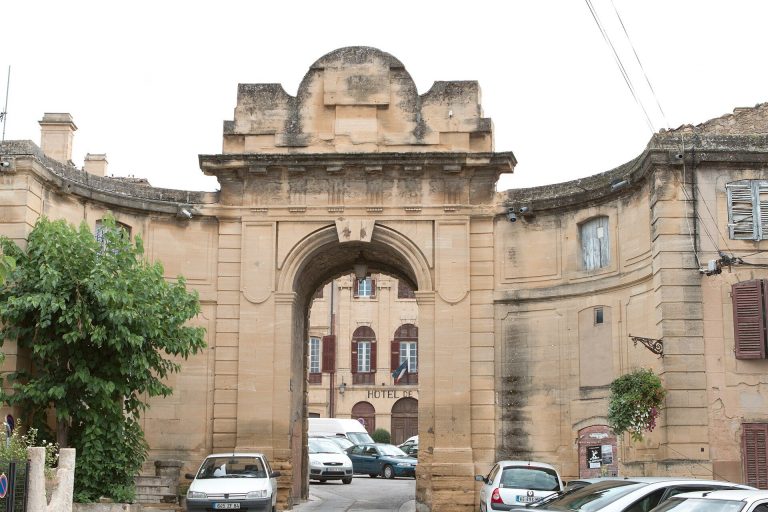
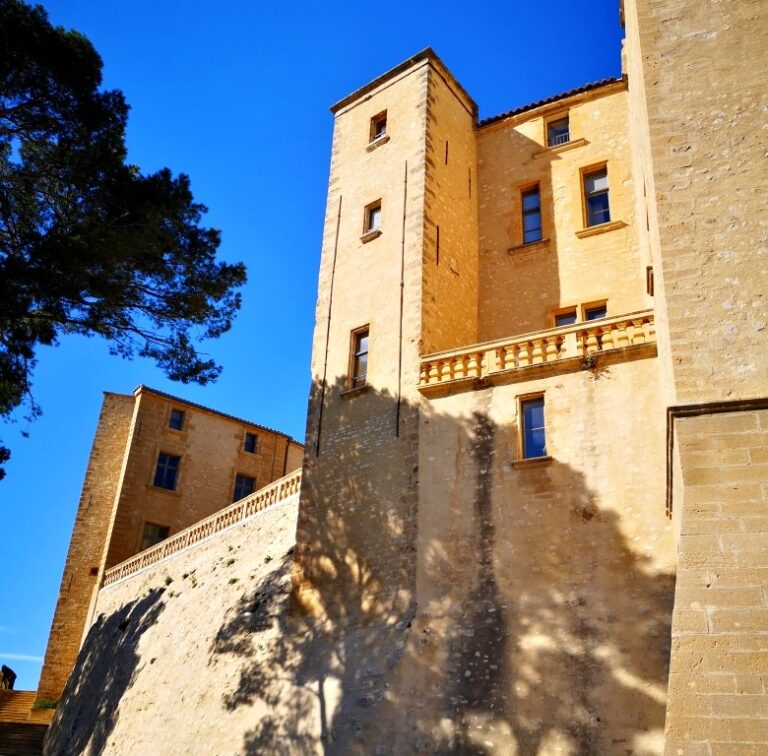
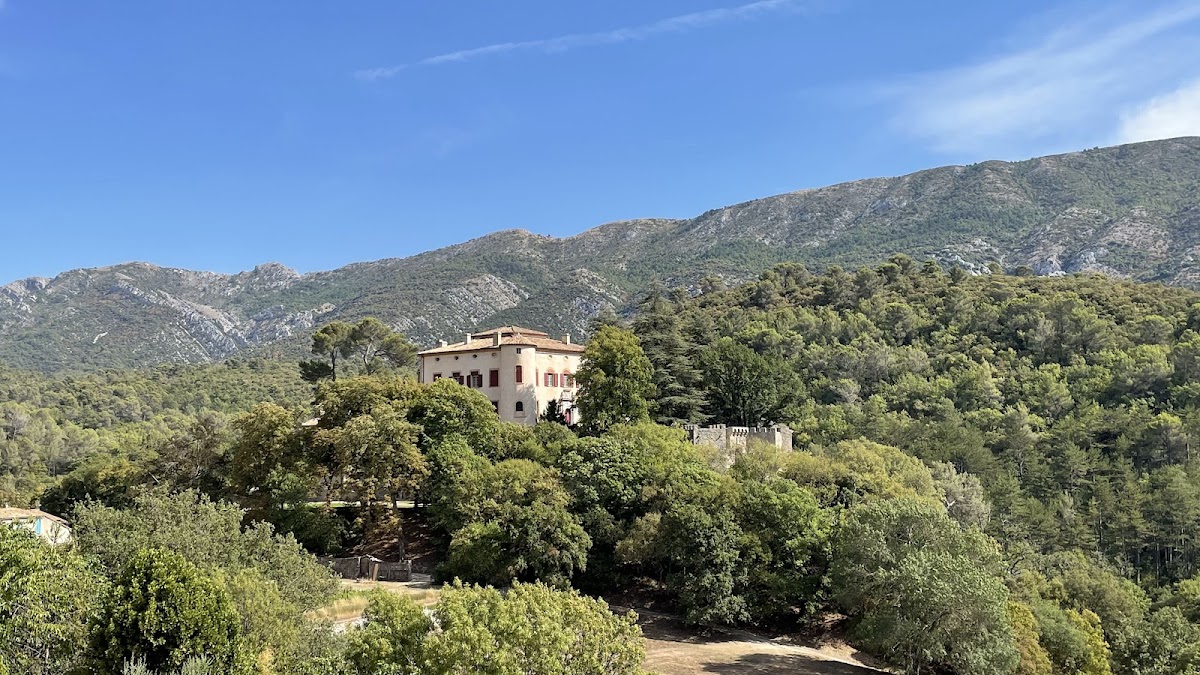
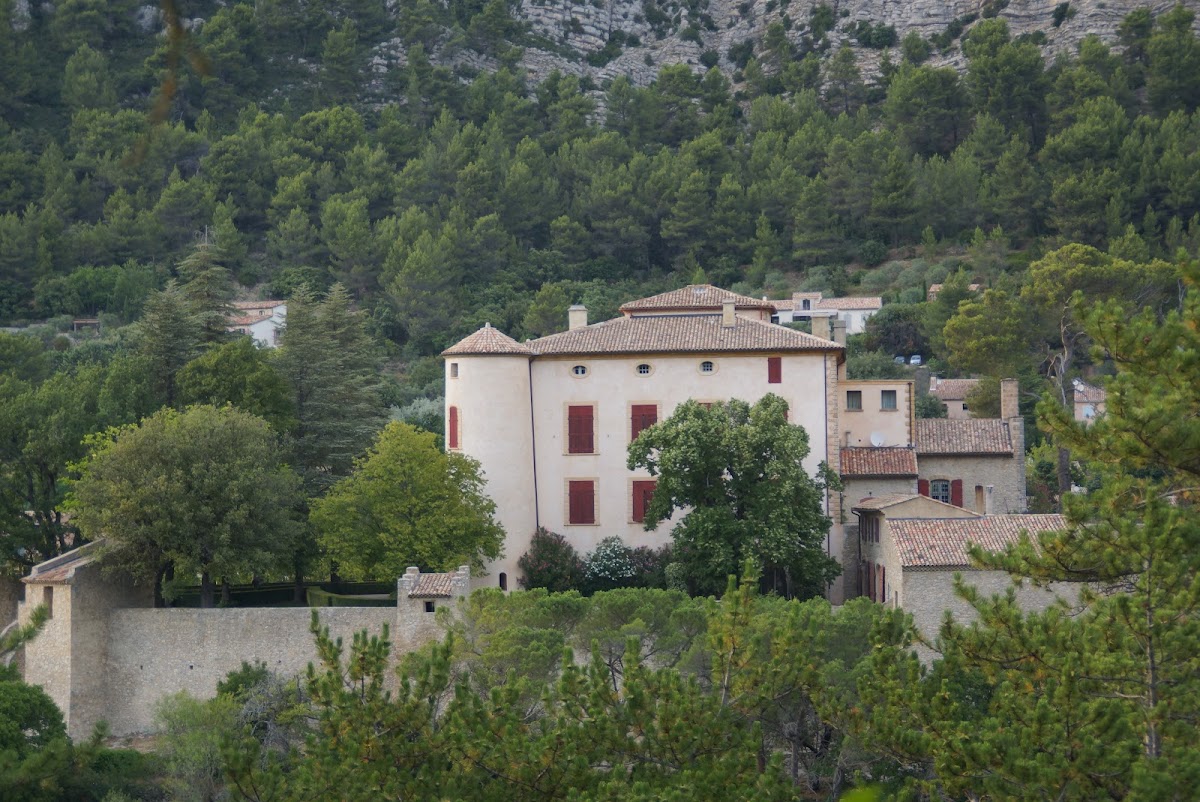
The château stands on a rocky knoll about 440 metres above a narrow gorge of the Cose River, at the foot of the northern slope of Montagne Sainte-Victoire. Its surviving form combines a medieval fortified enclosure and corner towers with later residential interiors. The building preserves evidence of the transition from a Roman military position to a medieval fortress, then to a manor house and an artist’s residence.
Fortress and residential fabric
The medieval complex was built over the remains of a Roman castrum, a fortified settlement or military position, or over a fortified Roman mound. A very large room known as the Réduit is traditionally said to have formed part of the Roman fort. Another medieval room has walls between two and three metres thick. The present castle began in the thirteenth century, while its corner towers and fortified enclosure date from the fourteenth century. Alterations in the sixteenth and seventeenth centuries produced the château-bastide form completed in the eighteenth century.
Henri de Clapiers’s conversion of the fortress into a manor retained the outer defensive walls while creating spacious apartments. The building also preserves sixteenth-century fireplaces and highly ornate seventeenth-century carved plasterwork and mouldings in the studio and library. During Picasso’s occupation, these surfaces were rendered bright white, and the studio received two industrial lamps.
Picasso-era rooms and furnishings
The studio
Picasso’s west-facing studio has three spacious windows and is described as the largest, grandest, and best-lit room in the château. It contained his painting materials, large wooden skittles given by Marc Chagall, and two chairs painted by Picasso in yellow, red, and green. The colours referred to Spain, the surrounding forests, and Montagne Sainte-Victoire. Picasso installed central heating, while the château otherwise retained relatively rudimentary standards of comfort.
In April 1959 Picasso moved his personal art collection from bank vaults in Paris to Vauvenargues and supervised the unpacking and hanging of the works. The collection included paintings by Cézanne, Matisse, Degas, Miró, Modigliani, Vuillard, Le Nain, Chardin, Corot, Courbet, Renoir, Gauguin, Braque, and Henri Rousseau.
Principal rooms
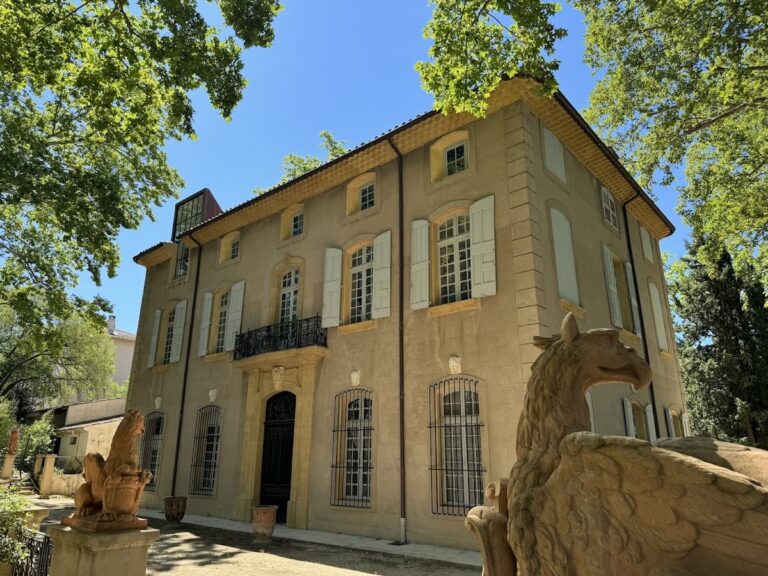
Picasso brought bronze sculptures from the garden of La Californie and placed them on the terrace before the principal façade and in the entrance hall. Beside the balustraded stairs to the front doors, fountains spout water from grotesque sculpted heads from Portugal. The Provençal dining room contains a traditional farmhouse table with wooden benches, octagonal brick-red floor tiles, and a marble fireplace. A life-size photograph of Picasso was placed on the mantelpiece after his death. The room also holds a mandolin acquired in Arles and a large black dresser in the style of Henri II.
Picasso installed a medallion cabinet given to him by Henri Matisse in the nineteenth-century room of Cardinal d’Isoard. Matisse had used the cabinet to store prints and drawings. Jacqueline’s bedroom contains a simple yellow and red bed, a swirling red-and-black carpet designed by Picasso, and partially painted walls. In the adjacent bathroom, Picasso painted a large bucolic frieze directly into the plaster, showing a faun playing pipes amid greenery.
Library, reception room, and removed decoration
The former library and ceremonial reception room were lined with Provençal embossed, polychrome, gilded leather panels from Córdoba. The panels, along with much of the château’s furniture and interior decoration, were removed after the 1943 sale. Some of this material survives at the Château of La Barben.
Guardroom and burial mound
The vaulted guardroom is the oldest part of the château. Picasso’s body was first placed there in a mahogany casket, after which Jacqueline furnished the room as a shrine with flowers. Picasso and Jacqueline are buried in the grounds beneath a grassy mound in front of the main entrance. The mound is surmounted by Woman with a Vase, a monumental sculpture originally created in 1933 and previously placed at the entrance of the Spanish Pavilion at the 1937 International Exhibition in Paris.