Palais de l’Archevêché d’Aix-en-Provence: Former Archiepiscopal Residence


Site at a Glance
- Rating
- 4
- Popularity
- Low
- Country
- France
- Primary era
- Early Modern
- External website
- Open
- Eras represented
- Classical, Medieval, Early Modern, Modern
- Civilizations
- County of Provence, French, Roman
- Site type
- Religious
- Remains
- Palace
On this page14 sections
History
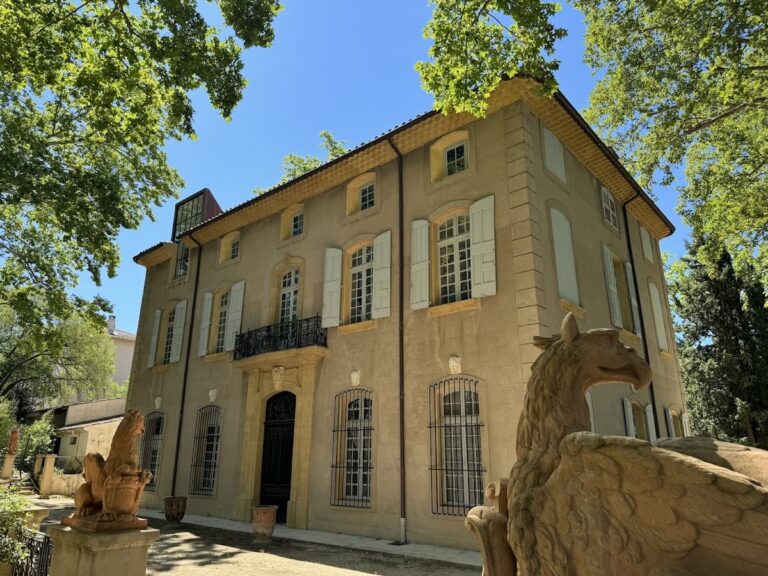
The Palais de l’Archevêché in France is the former residence and administrative seat of the archbishops of Aix, developed in its present Régence-style form between 1650 and 1730. It stands beside Saint-Sauveur Cathedral and was one of 19 archiepiscopal palaces in France. Before the Revolution of 1789, the ancien régime was the country’s established political and social order, and this palace housed the highest institution of the Roman Catholic Church in Provence.
Roman and medieval origins
The site had been occupied for at least two millennia. Excavations beneath the palace and cathedral identified remains of the Roman forum of Aquae Sextiae, the principal civic square of the Roman city that became Aix-en-Provence. Work in the palace courtyard also uncovered walls from two Roman insulae, urban building blocks that commonly contained apartments or other structures.
After the new Saint-Sauveur Cathedral was built in the eleventh century, the bishops of Aix initially continued to use a palace near the older cathedral of La Seds. Construction of an episcopal palace at the present site began in 1338 under Arnaud de Barchesio. Successive bishops enlarged the complex, and Robert Damiani added the east wing in 1447.
Royal visitors and seventeenth-century rebuilding
From the sixteenth century onward, the palace received a succession of royal visitors. Charles IX came in October 1564, Catherine de Medici in June 1579, Louis XIII in November 1622 and again later that month, and Anne of Austria, the young Louis XIV, and the court arrived in 1660. During Louis XIII’s second visit, tradition attributes to him the remark that he had been received at Arles like a gentleman, at Marseille like a king, and at Aix like a god.
The major rebuilding campaign responded to the archbishops’ desire for a residence suited to their ecclesiastical and political rank. Cardinal Richelieu arranged a gallery in 1624, and Cardinal de Grimaldi founded the north wing in 1648. The principal plans and walls of the present palace also date from 1648. Further work was entrusted to Laurent Vallon, and the west façade was completed in 1715. The resulting complex took its Régence character from the transitional French style associated with the Regency between the reigns of Louis XIV and Louis XV.
Revolutionary era and later use
Raymond de Boisgelin became archbishop of Aix in 1770. During the famine affecting Aix-en-Provence in 1772, he obtained permission from Terray, the controller general of finances, to import grain. During the Revolution, Boisgelin represented the clergy of the Aix seneschalship at the Estates-General. He voted for the abolition of privileges and equal taxation, defended the property rights of the clergy, presided over the assembly from 23 November to 4 December 1789, and proposed a clergy donation of 400 million livres to the public treasury.
The arms above the portal belong to Monseigneur de Bausset-Roquefort, who became archbishop of Aix in 1817. The palace was classified as a Monument historique in 1942. Owned by the city of Aix-en-Provence, it now serves as a museum as well as a former archiepiscopal residence. The former Tapestry Museum, created in 1909 and now designated a Musée de France, occupies the first floor and the ceremonial apartments.
The courtyard has hosted the Aix Festival of Lyric Art and Music since the festival was founded in 1948. Conceived as a French counterpart to the festivals at Bayreuth and Salzburg, the festival led to the courtyard’s remodelling in 1997 and 1998. The work provided a larger stage and orchestra pit, and the courtyard accommodates approximately 1,300 spectators.
Remains
The palace stands north of Aix-en-Provence’s historic centre, directly east of Saint-Sauveur Cathedral. Its buildings enclose a spacious interior courtyard, and the visible structures are built from Bibémus stone, whose characteristic colour is associated with Aix-en-Provence architecture of the seventeenth and eighteenth centuries. Beneath this later complex lie Roman remains connected with the ancient urban centre.
Roman archaeological remains
Archaeological work in the courtyard found walls belonging to two Roman insulae approximately 0.8 to 2 metres below ground. These urban blocks may have had military functions if a section of the ancient defensive wall ran along the adjacent Pierre-et-Marie-Curie street, although that interpretation remains uncertain. The remains form part of the archaeological evidence for Aquae Sextiae and its Roman forum beneath the palace and cathedral.
Seventeenth- and eighteenth-century architecture
Grand staircase
In the north-east part of the palace, the grand double-revolution staircase dates from 1670. Its unusual diagonal composition distinguishes it within the building’s interior arrangement.
West portal
The west façade carries a monumental portal completed in 1715. Its door decoration is attributed to Toro, a sculptor from Toulon. The arms placed above the portal relate to the later episcopate of Bausset-Roquefort.
Tapestry collections
The Grotesques
The Grotesques consists of six pieces made around 1680. Their orange tones derive from cartoons by the painter Jean-Baptiste Monnoyer, and the pieces were used as theatrical scenery.
The Story of Don Quixote
The Story of Don Quixote was made between 1735 and 1745 from cartoons by Charles-Joseph Natoire. The series presents episodes involving the Princess of Micomicon, Dulcinea, the Knight of the Mirrors, the Cave of Montesinos, and Don Quixote’s encounters with the duchess. Other scenes show Sancho Panza’s departure for the island of Barataria, his meeting with the hazelnut seller, and his meal at Barataria. Pierre Griniod d’Orsay commissioned the tapestries for one of his Parisian town houses, and they remained at the former Orsay castle until the Revolution. The series is described as unique, as the only known example to exist.
The Russian Games
The Russian Games, dated 1770, was made from cartoons by Jean-Baptiste Le Prince. Its pastoral scenes depict dancing and dining Romani people, together with bird-catchers.
Modern museum holdings
The museum’s collections include seventeenth- and eighteenth-century tapestries, theatrical scenery, contemporary textile art, antique furniture, and material connected with the history of the Aix Festival. From the 1970s onward, the holdings expanded to include textile art, contemporary works by Cane, Buraglio, Bioulès, Surian, and Garanjoud, and performing-arts material such as models, costumes, stage sets, and documents. The museum’s principal orientation is now the performing arts, with plans for an opera-house museum bringing together heritage collections from the Aix Festival and the Jeu de Paume theatre.