Château de Montmuran: Medieval Fortress and Breton Residence


Site at a Glance
- Rating
- 4.4
- Popularity
- Low
- Country
- France
- Primary era
- Medieval
- External website
- Open
- Eras represented
- Medieval, Early Modern
- Civilizations
- Duchy of Brittany, French
- Site type
- Domestic
- Remains
- Castle
On this page13 sections
History
Château de Montmuran is a historic castle in Les Iffs, France, whose origins reach back to the medieval Breton period and an earlier Gallic political center. The site developed from a wooden fortress built by the Tinténiac family in 1036 into a stone stronghold, and later became a residence combining medieval defenses with classical architecture.
From Gallic center to medieval fortress
During the Gallic period, Montmuran was probably an early political center of the Coriosolites, a Gallic people whose territory lay in what is now Brittany. That center was later moved to Corseul, ancient Fanum Martis. The medieval history of the castle began in 1032, when Alain III, Duke of Brittany, founded Saint George’s Abbey in Rennes for his sister Adèle and endowed it with the lordship of Tinténiac and high-justice rights, meaning authority over the most serious criminal cases.
Abbess Adèle converted the lordship into a fief for the knight Donoual and charged him with constructing a fortified castle to protect the lands. Donoual subsequently adopted the name Donoual de Tinténiac, and the Tinténiac family built the first castle at Montmuran in 1036. Made of wood, it was destroyed by the Plantagenets, the royal dynasty that ruled England and held extensive territories in France, in 1168.
During the twelfth century, the abbess ordered the construction of a more defensible stone fortress. The lord of Tinténiac built this new castle in 1170, establishing the medieval stronghold that shaped the later development of Montmuran.
Laval ownership and the Breton succession
By the fourteenth century, Montmuran was regarded as the most powerful fortress in the region. In 1352, during the War of the Breton Succession, a conflict over the ducal succession of Brittany that lasted from 1341 to 1364, ownership passed to the Laval family through Jean de Laval-Châtillon.
The castle is closely associated with Bertrand du Guesclin, the French military commander who later held the kingdom’s senior military office as Constable of France. On Holy Thursday in 1354, the Norman knight Alacres de Marès, also known as Elaste du Marais, knighted Du Guesclin in the castle chapel. Du Guesclin had helped save Montmuran from an English attack launched from Bécherel. Anticipating the assault, he placed about thirty archers along a route that became known as the “Bloody Way.”
In 1374, Du Guesclin married Jeanne de Laval in the castle chapel. He was then Constable of France and the widower of Tiphaine Raguenel. The marriage made him lord of the estate until his death before Châteauneuf-de-Randon in Lozère in 1380. Jeanne de Laval married her cousin Guy XII de Laval in 1384, keeping Montmuran within the Laval family.
From the Colignys to the Revolution
In 1547, Charlotte de Laval, the last Laval descendant, married Admiral Gaspard de Châtillon, Lord of Coligny, in the chapel. Henry II appointed Coligny Admiral of France in 1552. He was later killed during the St. Bartholomew’s Day Massacre. The Coligny family occupied Montmuran until 1643 and contributed substantially to the economic development of the surrounding region.
A Scottish family bearing the French form of the name Hamilton lived at Montmuran from 1643 to 1662. Gilles Huchet de la Bédoyère purchased the castle in 1662, but Henri Pélage de Coëtquen, Lord of Combourg, annulled the transaction in 1664 by invoking a right of lineage retraction. This legal right allowed a relative to reclaim family property sold outside the lineage, and Coëtquen claimed it through his distant kinship with Charlotte de Laval. He owned Montmuran until 1693.
The Mornay family occupied the castle from 1693 to 1750. In that year, Count Joseph Marie de la Motte, of the La Motte Rouge branch of the House of Dinan, a Breton noble lineage, purchased Montmuran. He emigrated to the Channel Islands in 1789, at the beginning of the French Revolution. The castle was then seized as national property, meaning property confiscated by the revolutionary state, and resold in 1794 to the Bizien du Lézard family.
Later ownership and conservation
The Bizien du Lézard family retained Montmuran until 1888, when Monsieur de La Villéon, a descendant of Jean Baptiste François de La Villéon, purchased it. The estate has remained in the La Villéon family. The Revolution caused serious damage, and part of the castle was deliberately burned in 1889. The painter Emmanuel de La Villéon later produced paintings depicting the château.
The dependencies were listed as historic monuments in 2000, and the château itself was classified in 2003. Montmuran was also selected in 2023 by a national mission concerned with endangered built heritage. A ceiling beam collapsed in 2020, and the discovery of dry rot, a wood-destroying fungal decay, in the roof framework led to a major restoration project launched in 2022. The works were completed in July 2024.
Remains
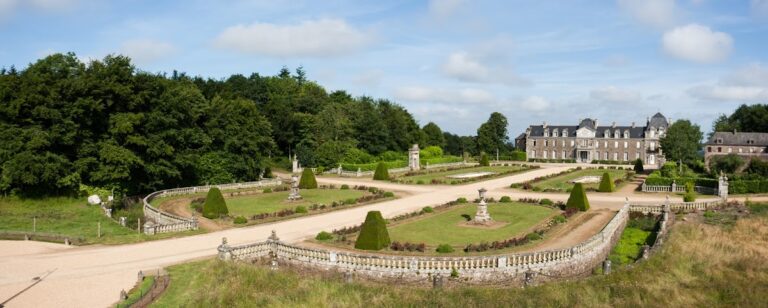
The present château is approached by a wooded avenue and combines surviving medieval defenses with later classical and residential elements. It occupies a dominant position, while terraced parterres, formal ornamental garden beds, extend around the complex and provide panoramic views over the surrounding countryside.
Medieval fortifications
North-side towers and keep
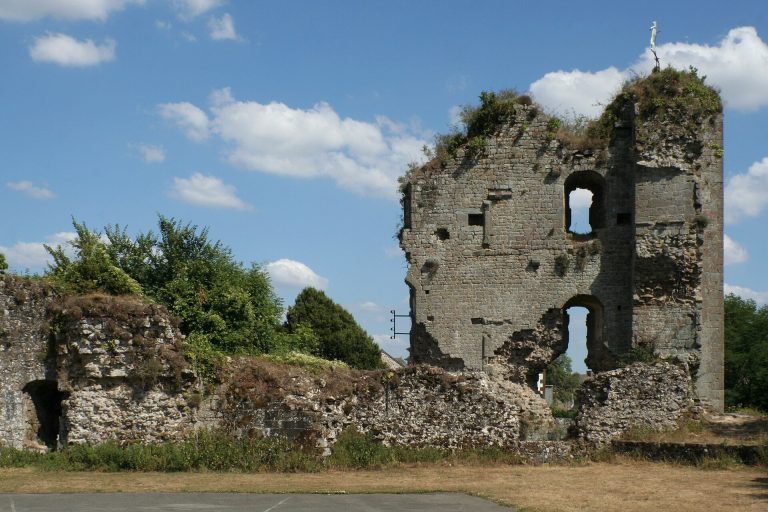
At least two towers from the twelfth century survive within the present castle on the north side, including the keep. These stone elements belong to the fortified rebuilding undertaken in 1170, after the earlier wooden castle had been destroyed.
Fourteenth-century gatehouse
The entrance is formed by a fourteenth-century châtelet, or fortified entrance building, with two towers and machicolations. These projecting openings allowed defenders to attack people below the walls. A portcullis, moat, and two drawbridges protect the approach, and both drawbridges remain functional.
Residential and ceremonial buildings
Central residential block
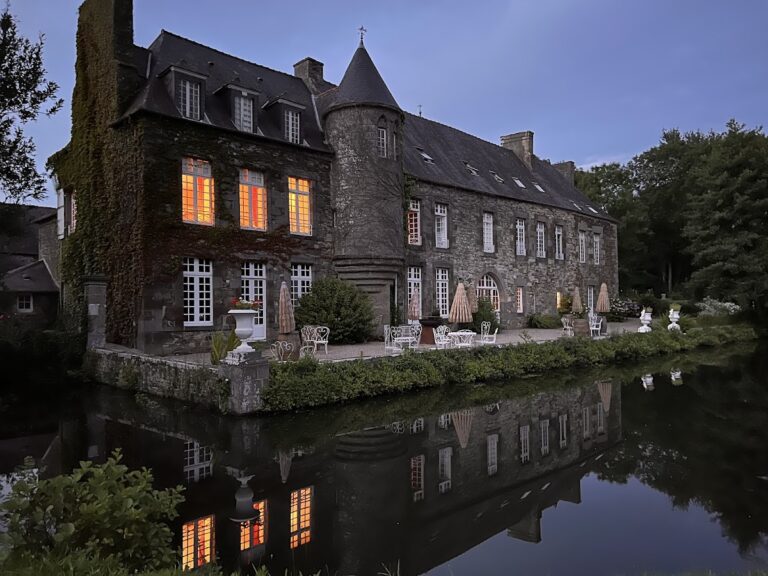
The central part of the château is a seventeenth-century corps de logis, the principal residential block of a château, remodeled in the eighteenth century. It contains a sequence of salons and other connected rooms, reflecting the transformation of Montmuran from a primarily defensive stronghold into an aristocratic residence.
Orangery and dependencies
An orangery and several dependencies belong to the eighteenth-century phase of the complex. They form part of the later architectural setting alongside the remodeled residential block.
Chapel
The chapel remains part of the château complex. Its stained-glass windows bear the coats of arms of France and the Montmorency-Laval family, linking the building’s surviving decoration to the noble families associated with Montmuran.