Herzberg Castle: A Welf Residence and Courthouse in Germany


Site at a Glance
- Rating
- 4
- Popularity
- Low
- Country
- Germany
- Primary era
- Early Modern
- Eras represented
- Medieval, Early Modern, Modern
- Civilizations
- German, Holy Roman Empire
- Site type
- Domestic
- Remains
- Palace
On this page14 sections
History
Herzberg Castle is a medieval and Renaissance castle in Germany, built and repeatedly used by members of the House of Welf. It stands above Herzberg am Harz on the Schlossberg and developed from a hunting lodge and hill castle into a long-standing dynastic residence, courthouse, museum, and cultural venue.
Medieval origins and Welf possession
The site probably began as a hunting lodge between 1024 and 1029. Its construction has traditionally been attributed to Lothair III of Süpplingenburg, a German king who became Holy Roman Emperor in 1133. An earlier tradition that Werner of Lutterberg built a hunting lodge there in 1029 is considered probably incorrect. The castle is indirectly known through Luipold of Herzberg, who witnessed a document in 1050. The oldest direct evidence consists of documents issued there by Henry the Lion in 1156 and 1158.
After Count Hermann of Lutterberge died without an heir in 1143, the Welfs took possession of the castle and its surrounding administrative district in 1144 as a reverted fief. In 1157, Henry the Lion acquired the then-imperial castle as an allod, meaning property held directly as hereditary possession, from Frederick Barbarossa. The exchange involved estates in Swabia inherited by Henry’s first wife, Clementia of Zähringen. Herzberg Castle then remained in Welf possession for 708 years, until the end of the Kingdom of Hanover in 1866.
The castle became the residence of the Brunswick-Grubenhagen branch of the Welf dynasty in 1290. From 1486, the dukes of the Principality of Grubenhagen, a Welf territory in the southern Harz, lived there until that line became extinct in 1596. The estate then passed to the Brunswick-Lüneburg branch.
Dynastic residence
Herzberg also served as a residence for Welf widows and other members of the dynasty. After the death of Emperor Otto IV, his widow Maria of Brabant lived there and issued a document at the castle in 1218. For a short time, this made Herzberg an imperial residence. From 1279, the castle housed the widow of Duke Albert the Great of Brunswick. Between 1337 and 1714, it was almost continuously a ducal residence and served as a widow’s residence on several later occasions.
A major fire in 1510 trapped Duke Philip I, his wife Catharine, and their son Philip inside the castle. They escaped at the last moment, although the duke’s shield bearer and the duchess’s chambermaid died. Afterward, Philip I allowed the citizens of Herzberg to hold shooting festivals and gave them a silver chain with a silver stag in recognition of their help during the fire and reconstruction.
The present palace complex was rebuilt after the fire, with the work completed in 1528. Its continuing connection with the Welf dynasty led to the alternative name Welf Castle of Herzberg. Duke George of Brunswick-Lüneburg lived in the rebuilt castle with his wife, Anne Eleanor of Hesse-Darmstadt, until 1636. Their son Ernest Augustus, later the first Elector of Hanover, was born there in 1629. From 1665, George’s widowed sister-in-law Dorothea Sophie of Celle lived at Herzberg for three years before marrying Frederick William, the Great Elector of Brandenburg, and moving to Berlin.
From residence to public institutions
Herzberg ceased to function as a residence in 1714, the year George I, the son of Ernest Augustus, became king of Great Britain and Ireland in personal union. Agricultural tithes had already been stored in the complex. In 1798, the former residence was converted into a granary, while additional rooms were used for storing tithes.
The castle has housed the Herzberg district court since 1852. Judicial proceedings had taken place there before the introduction of a uniform court system in the Kingdom of Hanover. A museum was established in 1900. A prison once stood beside the gatehouse, and the gatehouse itself housed a juvenile detention facility until the beginning of the 2000s.
War damage, restoration, and continuing use
On the night of 4 April 1945, an explosion at a nearby explosives factory severely damaged the castle. The factory contained 40,000 kilograms of explosives and 8,000 mines. The blast tore away the castle roof and destroyed the museum, and probable looting followed. Further damage occurred in 1947 when nearby military bunkers were demolished. The war damage has since been repaired.
Parts of the castle were renovated in 2006. A ten-year general restoration campaign began in 2017 and included the gatehouse and barbican, the Clock Tower, the Stables Wing, the Grey Wing, and the Sieber Wing. The work also added lifts, fire-detection systems, emergency exits, and measures required by current accessibility and fire-safety standards. Temporary archaeological excavations during the restoration uncovered numerous foundation walls belonging to the former castle.
The Clock Tower was completed in December 2021 as the first restoration phase, followed by the Stables Wing in 2022. The Stables Wing now accommodates the Herzberg district court. The restoration was supported by the State of Lower Saxony and, from 2021, by the German federal government. Herzberg Castle is a landmark of the UNESCO Global Geopark Harz–Brunswick Land–Eastphalia. Its courthouse, museum, and cultural functions continue alongside one another.
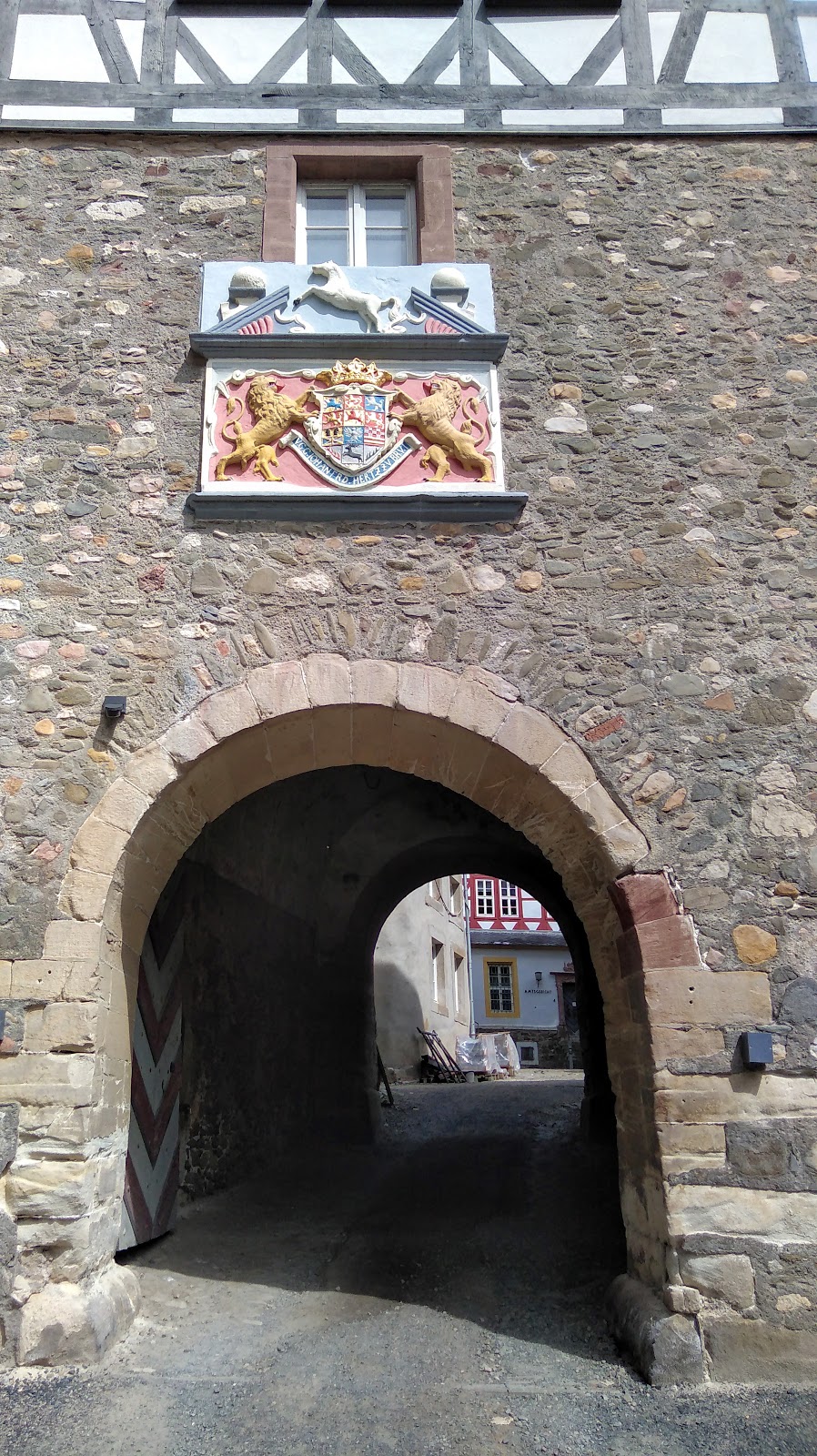
The museum presents the history of the castle and the Welfs, Harz forestry, Herzberg’s arms manufacture, the organ builder Johann Andreas Engelhardt, and Esperanto. The Knights’ Hall hosts concerts, lectures, conferences, exhibitions, civic meetings, and civil weddings. The Friends of Herzberg Castle association, founded in 2004, supports the preservation of the complex and its artistic and cultural activities. Its projects have included rebuilding the Engelhardt organ, acquiring paintings and other exhibits, restoring heraldic emblems on the second gatehouse, improving lighting, expanding a 32-generation Brunswick genealogy panel, and supporting museum and concert programs. Four original portraits from Leineschloss in Hanover entered the castle as a permanent loan in summer 2023. The annual Herzberg Castle Concerts were established in 1986, and six to eight concerts have generally been held each year in the Knights’ Hall.
Remains
Hilltop setting and earlier defenses
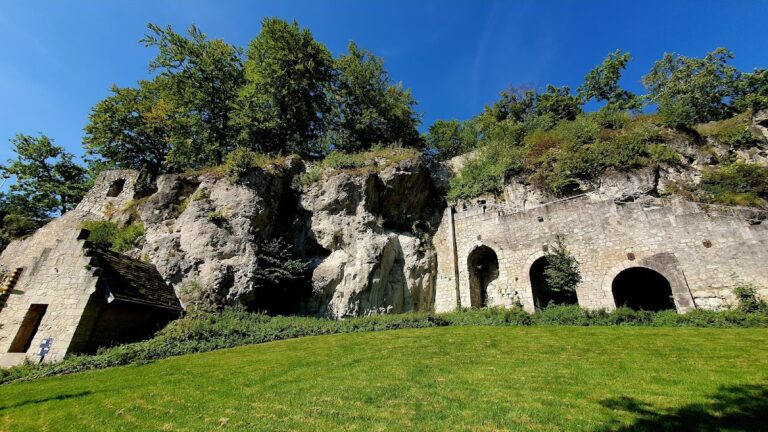
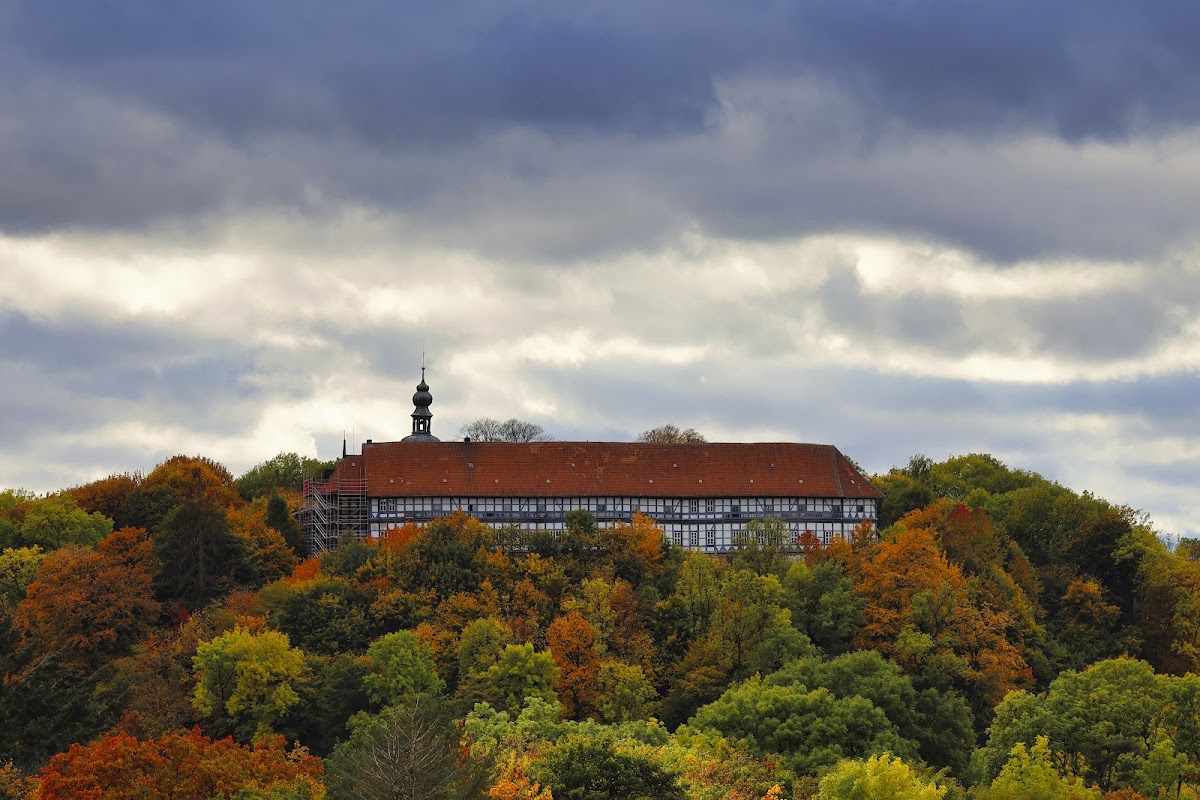
The castle occupies the northeastern spur of the wooded Schlossberg, a ridge rising to about 275 metres above sea level immediately west and above the centre of Herzberg am Harz. The River Sieber passes north of the site. The spur is geologically unstable. Steep slopes expose Hauptdolomite from the southern Harz Zechstein belt, while Werra anhydrite forms the base of the Schlossberg. Underground dissolution and movement of these soluble rocks have destabilized the spur. Fissures encourage peripheral rock to tip and slide downslope, while a rock plate about 40 metres thick and roughly 100 metres wide at the surface is slowly spreading toward the steep slopes. A clay layer up to 1 metre thick promotes this movement, and reddish-brown salt clay separates the anhydrite from the dolomite.
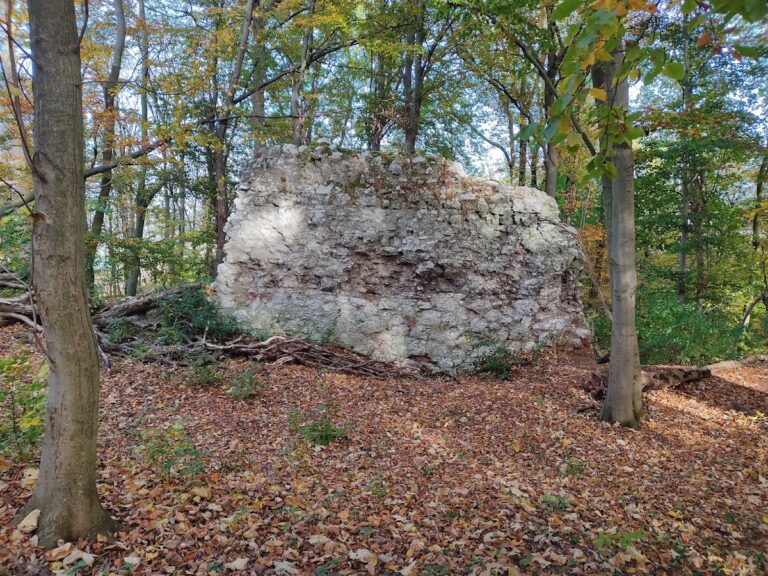
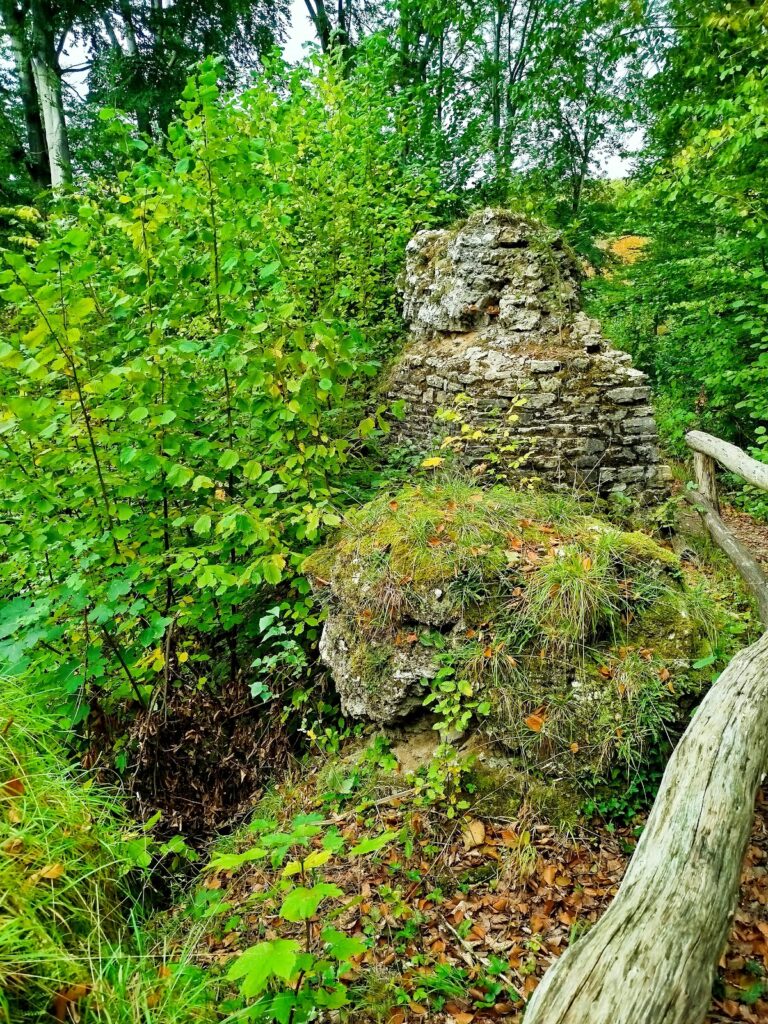
Remains of the original castle include a ditch on the south side, preserved to a maximum depth of 5 metres. A southeastern outer rampart protected the approach from the ridge behind the castle. It extends for about 80 metres, reaches up to 2.5 metres in height, and measures up to 5 metres across at its base.
The Renaissance palace complex
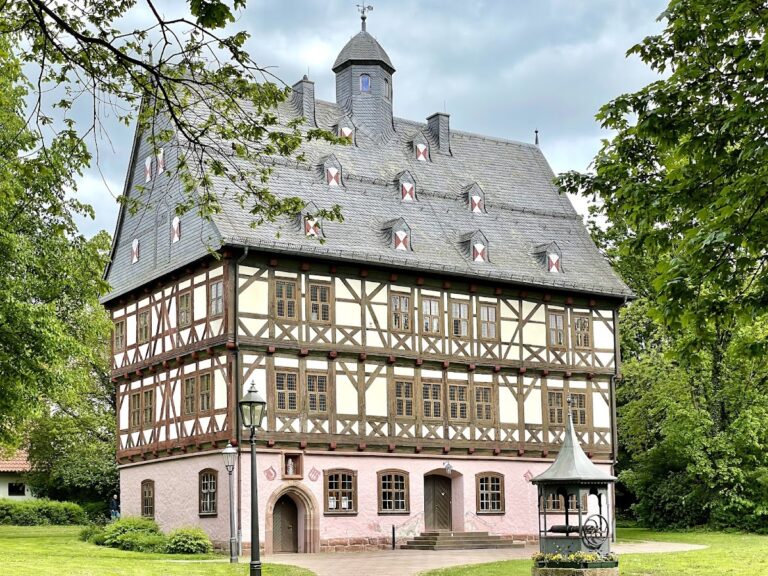
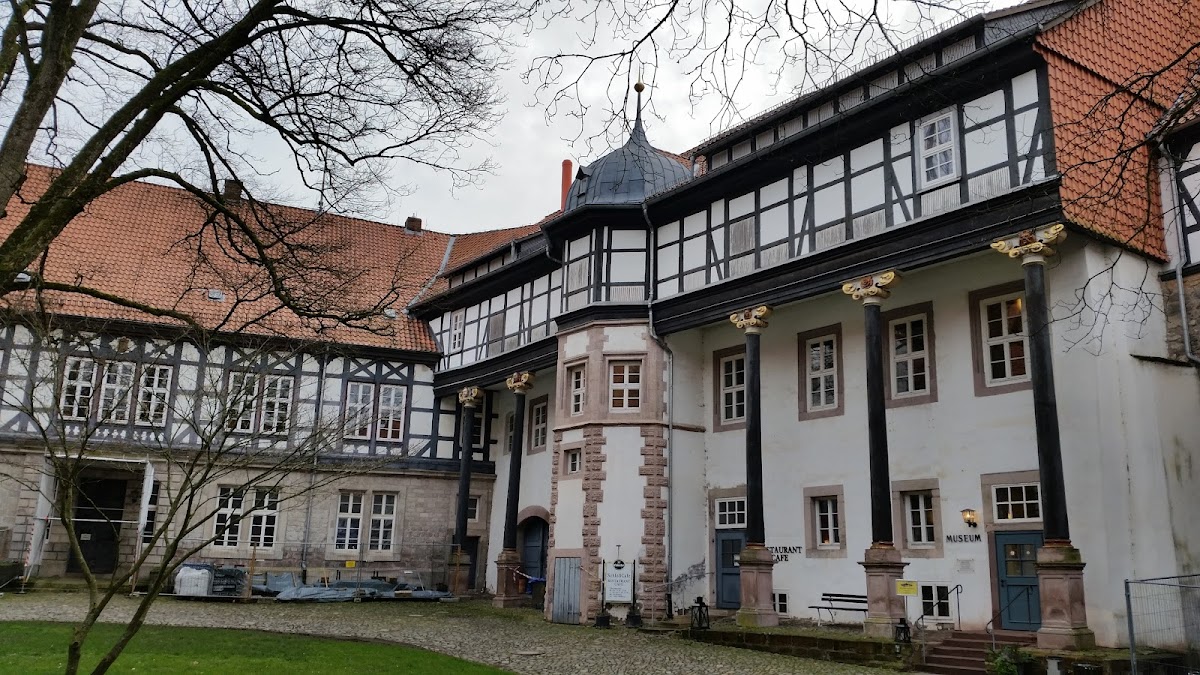
The present palace is a closed four-wing Renaissance complex arranged around a rectangular inner courtyard measuring 40 by 58 metres. It was built predominantly with timber framing, a method using a structural wooden framework filled with materials such as clay, and contains 180 rooms. The roofs are covered with red hollow tiles. The original entrance arrangement through a gate tower and barbican, a fortified passage protecting a gate, remains in place.
Gatehouses and Main House Wing
Entry passes through a gatehouse and adjoining barbican before reaching a second, two-storey gatehouse at the southwestern corner. The southern Main House Wing adjoins the eastern side of the second gatehouse, and remains of the original castle are suspected within it. Its second upper storey was built or renewed in 1722. The wing also contains a chapel room now used as the café-restaurant.
Grey Wing
The Grey Wing has a ground floor constructed from sandstone blocks and an upper storey of timber framing. Its predecessor was demolished around 1860. The wing was rebuilt on the old cellar in a late-classical form in 1861.
Sieber Wing
The northern Sieber Wing has a stone ground floor and two timber-framed upper storeys. It originally housed the ducal court and now contains the Herzberg district court. Six copper water spouts project toward the courtyard from this wing.
Clock Tower
A square palace tower stands at the junction of the Main House and Sieber wings. Known as the Clock Tower because of the clock installed in it, it has three timber-framed upper storeys and a lead lantern roof. During the 2021 restoration, its timber framing was repaired using the original clay-building technique. The beams were painted historical ochre rather than the earlier brown-red colour.
Stables Wing
The massive, two-storey Stables Wing occupies the northwestern side of the courtyard. It was built in the same general period as the Clock Tower and now includes facilities for the district court.
Interior rooms and collections
The Knights’ Hall is located in the Main House Wing and has 130 seats. Its furnishings include a motorized projection screen, projector, wireless internet, a concert grand piano made by the Brunswick manufacturer Grotrian-Steinweg, paintings including a portrait of George II, a historical suit of armour, and a Renaissance dress. Adjustable lighting was installed in 2021 for different events.
The museum displays a facsimile of the Gospel Book of Henry the Lion, a twelfth-century Romanesque illuminated manuscript containing the four Gospels, along with a model of Herzberg Castle and Scharzfels Castle. Since 2017, the collection has included a restored sixteenth-century Welf cradle. It also contains an Engelhardt organ restored and reassembled through the Friends of Herzberg Castle association, as well as coins from the Scharzfeld coin hoard, including a commemorative thaler marking the death of Duke Christian Louis.
Paintings and other objects acquired or loaned for the interpretation of Welf and castle history form part of the permanent and temporary exhibitions. The four portraits loaned in 2023 depict Duchess Sophie and Dukes Ernest Augustus, John Frederick, and Christian Louis, and are displayed in the Knights’ Hall.
Nearby sites