Burg Seebenstein: A Medieval Hilltop Castle in Austria
Site at a Glance
- Rating
- 4.6
- Popularity
- Low
- Country
- Austria
- Primary era
- Early Modern
- External website
- Open
- Eras represented
- Medieval, Early Modern, Modern
- Civilizations
- Duchy of Austria, Habsburg, Holy Roman Empire
- Site type
- Military
- Remains
- Castle
On this page13 sections
History
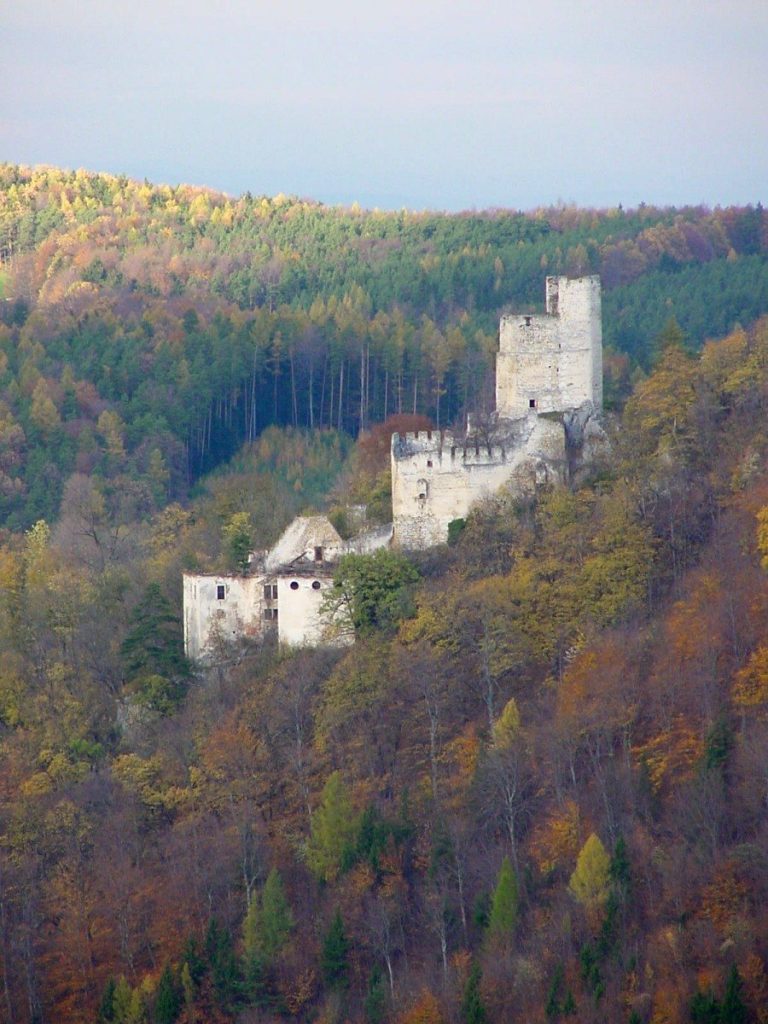
Burg Seebenstein is a medieval hilltop castle in Austria, built on the eastern frontier of the Duchy of Austria in the Pitten Valley. It guarded routes toward Wiener Neustadt and the Duchy of Styria, including a valley route first established by Roman legionaries. Its foundation is traditionally dated to 1045 and attributed to Gottfried von Wels-Lambach, while another tradition assigns its construction to Eckbert von Formbach-Neuburg in 1092. More recent research places the construction of Sewenstein between about 1180 and 1230.
Medieval Frontier Castle
Around 1049, the castle passed to the Formbach counts or one of their retainers. After the Formbach line became extinct in the twelfth century, ownership passed to the Wildenstein counts. The name Seebenstein appears in a document from 1159–1164, and people using the Seebenstein name are recorded in 1170. The castle’s position exposed it to Hungarian incursions toward Styria.
The Stubenberg family held Seebenstein by 1316, when it was temporarily pledged as security for a land purchase. Niklas von Seebeck acquired the castle in 1403, and his heirs sold it to the Königsberg family in 1432. The Königsbergs were influential local nobles, with members holding senior offices in the territories of the bishops of Salzburg and Gurk.
Renaissance Expansion and Ottoman Threats
The Königsbergs carried out a major Renaissance reconstruction. They enlarged the medieval fortress into a palace-and-castle complex while retaining and modernizing its outer defenses. Wolf Matthäus von Königsberger substantially expanded the buildings, and much of the surviving upper castle dates from his period. His expenditure left him deeply indebted. After his death in 1653, his principal creditor, Carl von Pergen, acquired much of the estate and later purchased the castle from the Königsberg heirs.
In 1488, during the Habsburg conflict with Matthias Corvinus, the fifteenth-century king of Hungary who fought the Habsburgs for control of territories in the region, a Hungarian army besieged Seebenstein but failed to capture it. Ottoman raiders also besieged the castle in 1683, during the Habsburg–Ottoman wars and the Ottoman advance toward Vienna, but they were unable to take it.
Decline, Romantic Transformation, and Restoration
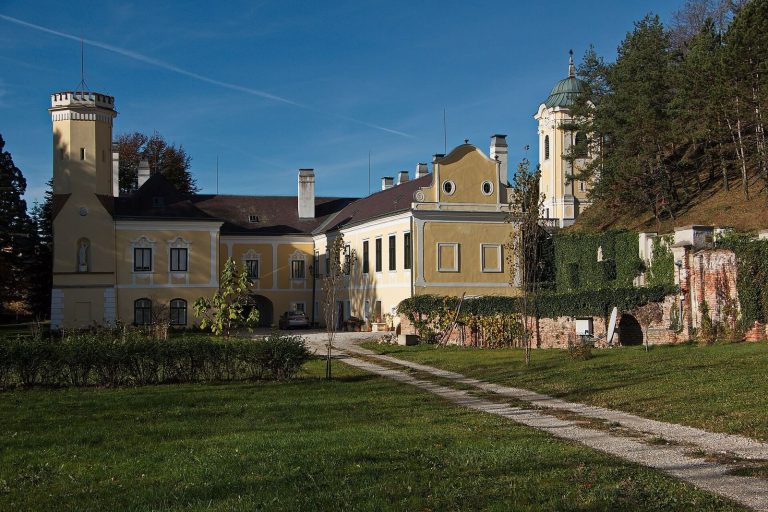
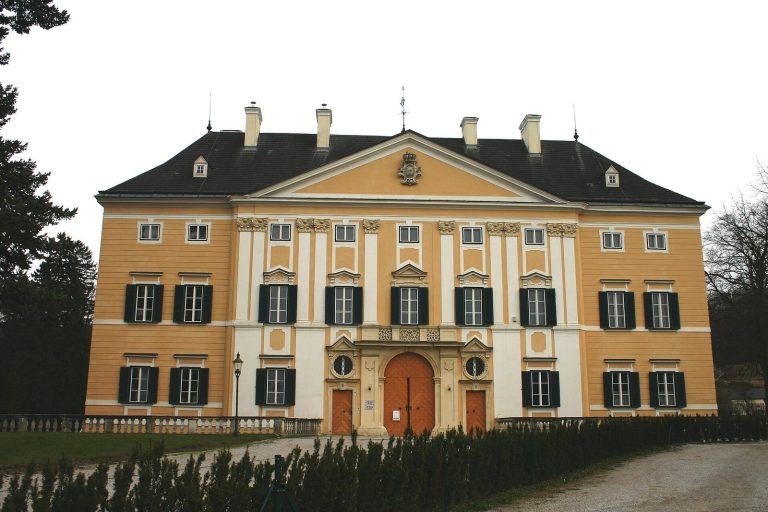
During the seventeenth century, the Pergen family moved its residence from the exposed hilltop to a new palace in the valley. Johann Baptist von Pergen had built this lower residence by 1694. The older castle was then neglected and progressively deteriorated. Anton David Steiger rented it in 1788 and undertook substantial repairs. In 1790 he founded the Wildensteiner Knights on Blue Earth, a romantic chivalric association that attracted high-ranking members. The association was dissolved in 1824.
The Pergen family owned Seebenstein until 1824, when Johann Karl von Pergen sold it to Prince Johann I of Liechtenstein. The Liechtensteins remodelled the castle in the romantic historicist manner, a nineteenth-century approach that revived and reinterpreted historical architectural styles, especially medieval ones. Parts of the buildings were deliberately removed to create a more visibly ruinous appearance. Johann I also commissioned the artificial Türkensturz castle ruin near Gleißenfeld, south of Seebenstein, for picturesque effect.
In 1848, Seebenstein became an allodial estate, meaning land held as private property rather than as a feudal fief, administered from Schottwien. The Liechtenstein family retained ownership until the period of Austria’s annexation and the beginning of the Second World War. By the early twentieth century, the castle was neglected and steadily deteriorating. The Nehammer family acquired the ruins in 1942, and Lilly Nehammer-Prinz financed partial restoration, particularly of the former residential buildings, where she housed a collection of medieval art. The castle remains privately owned by Christine Vopara, a grandniece of Lilly Nehammer-Prinz and a member of the Nehammer family. It is protected as an Austrian cultural heritage monument under number 33618.
Remains
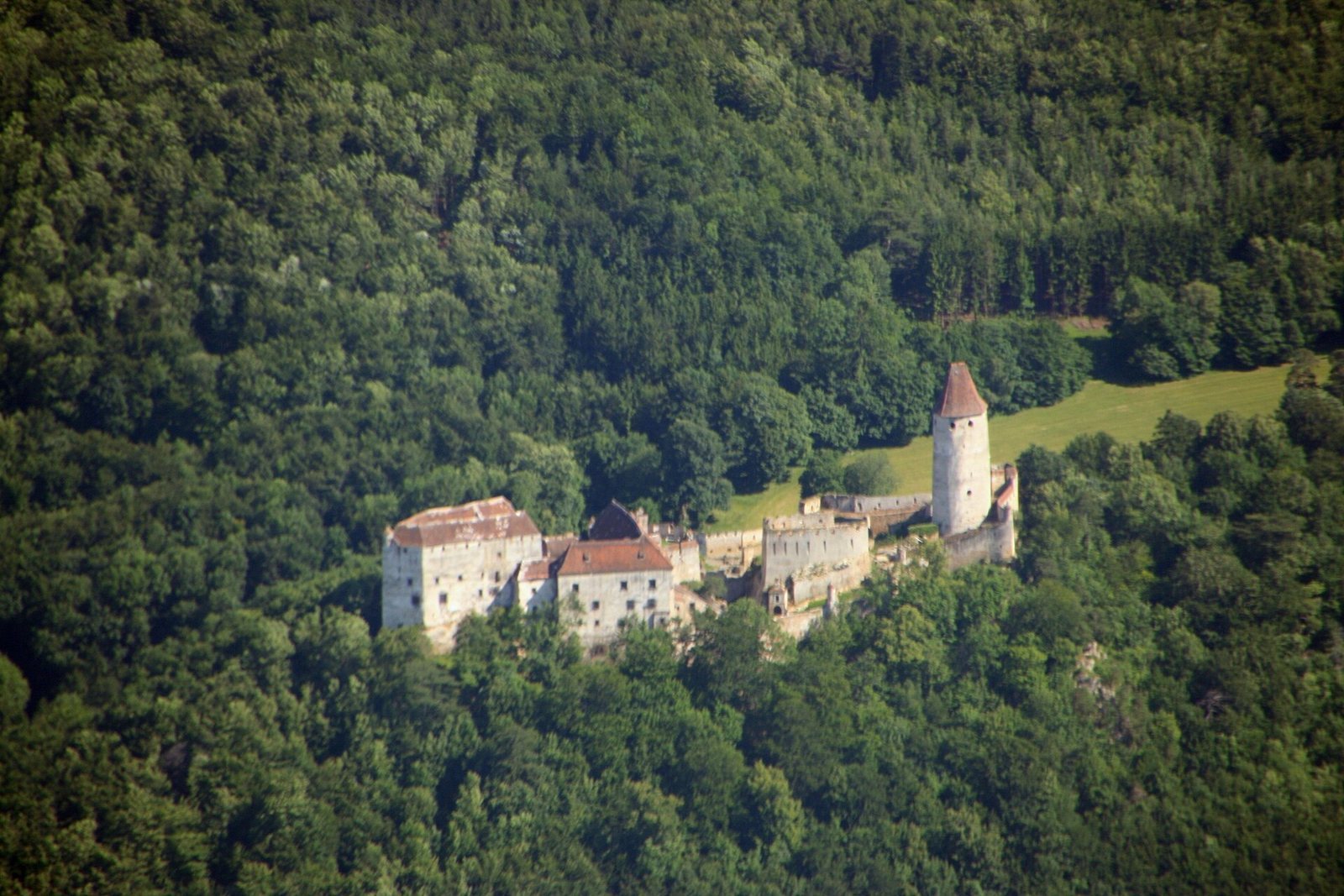
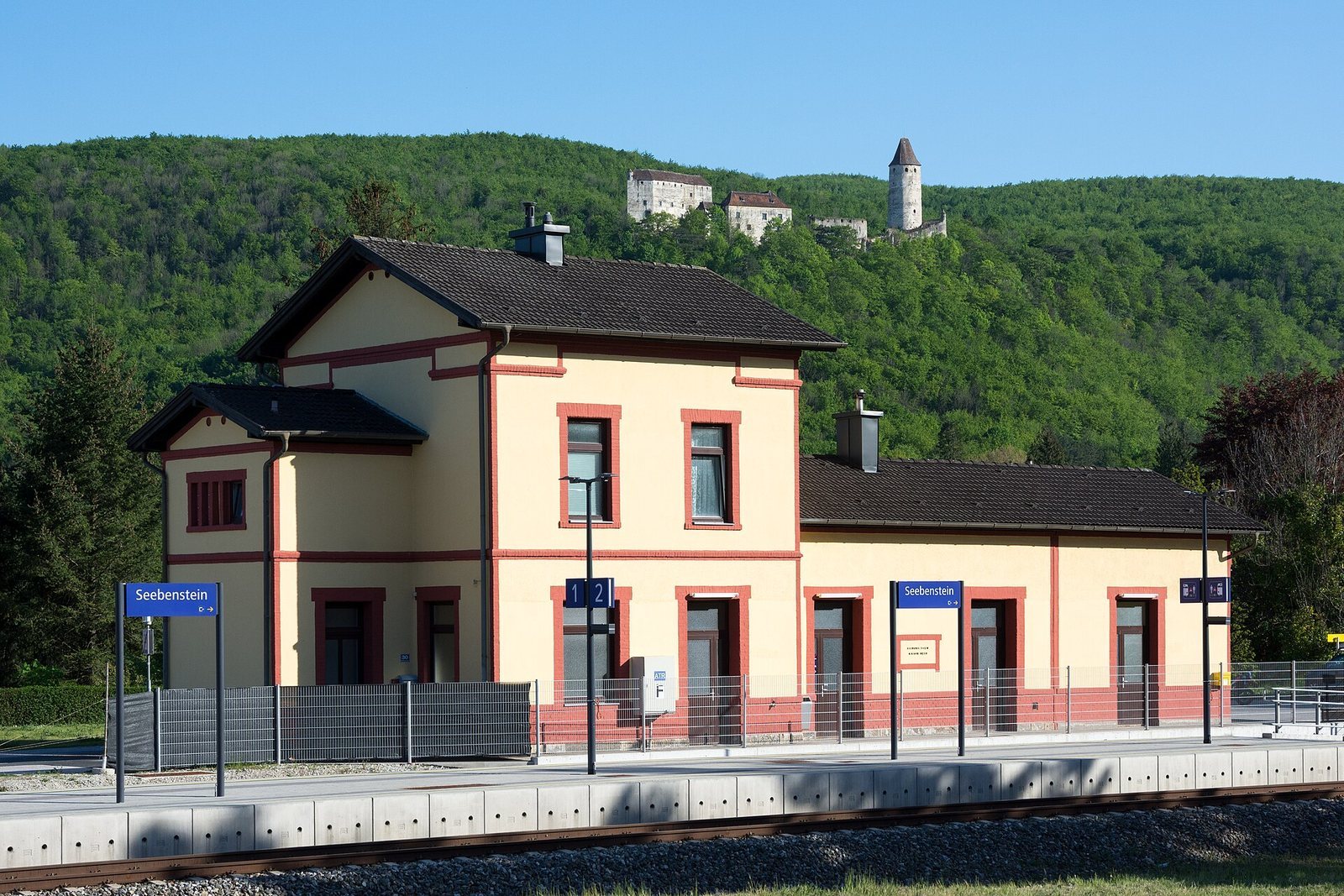
Burg Seebenstein stands on a high hill at about 453 metres above sea level, in the Pitten Valley near the western edge of the Rosalia Mountains. Dense woodland surrounds the complex, which forms the centre of a large nature park. The site consists of an older castle and a newer inner castle built on the higher part of the hill. Its surviving layout includes the medieval fortress, the expanded upper castle, an outer wall, a service wing, and the historic southern entrance.
Castle Buildings and Defences
Old Castle
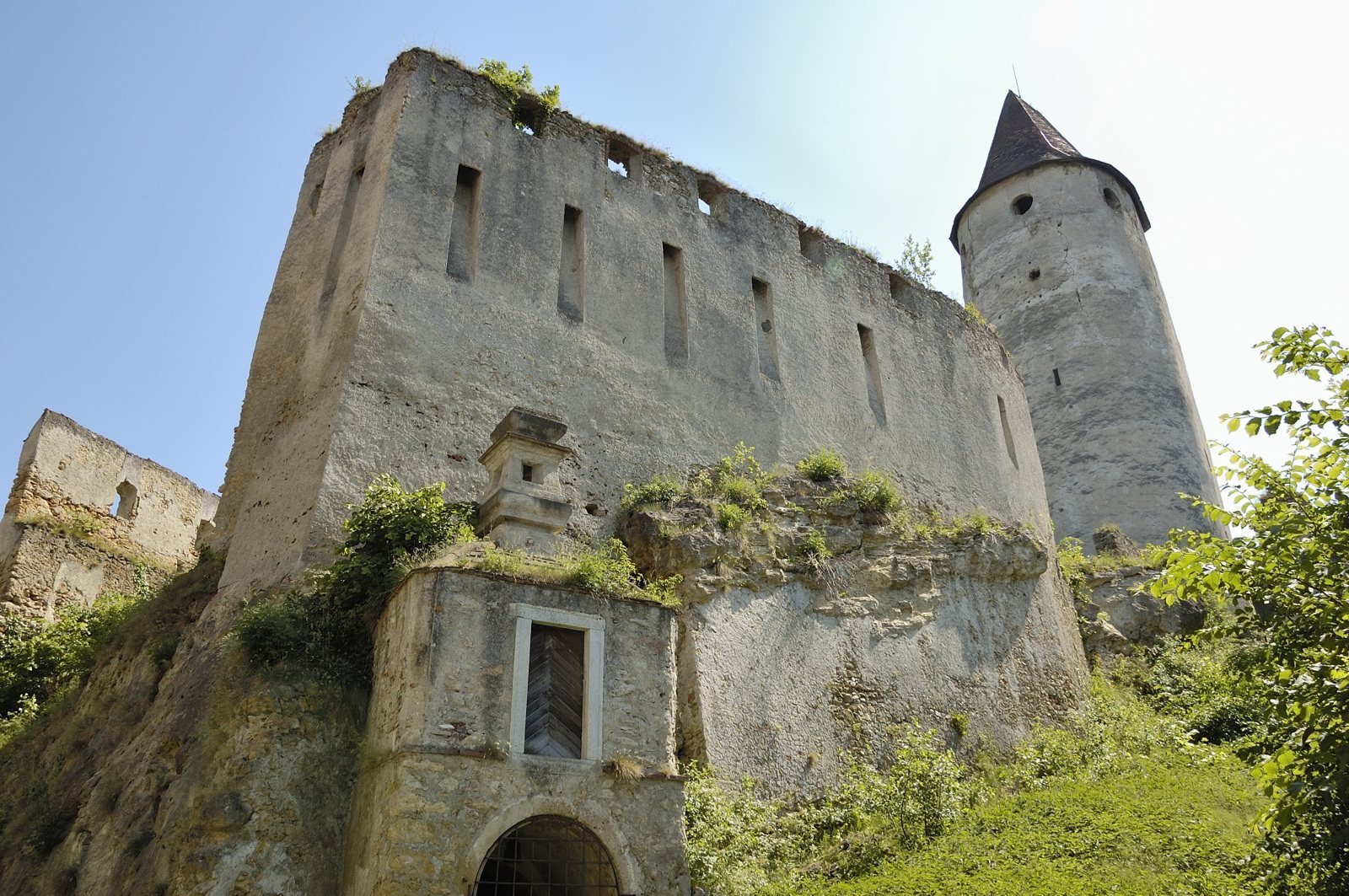
The Old Castle contains a medieval round bergfried, the principal tower of a medieval German-speaking castle, used mainly for defence and refuge, together with a ruined residential palace dating from the thirteenth and fourteenth centuries. During the Renaissance, this part of the complex served as the foreburg, the outer or lower fortified section protecting the principal castle.
New Castle
The New Castle, or upper castle, was built and enlarged between the fifteenth and seventeenth centuries. It contains about forty rooms and is in comparatively good condition, with partial restoration. Some rooms are arranged as museum spaces. Residential buildings were constructed in the sixteenth century and repeatedly rebuilt. In 1734, the second floor of the northwestern wing became a Baroque ballroom. During the nineteenth century, this room was used as a knights’ hall by the Wildensteiner Knights on Blue Earth.
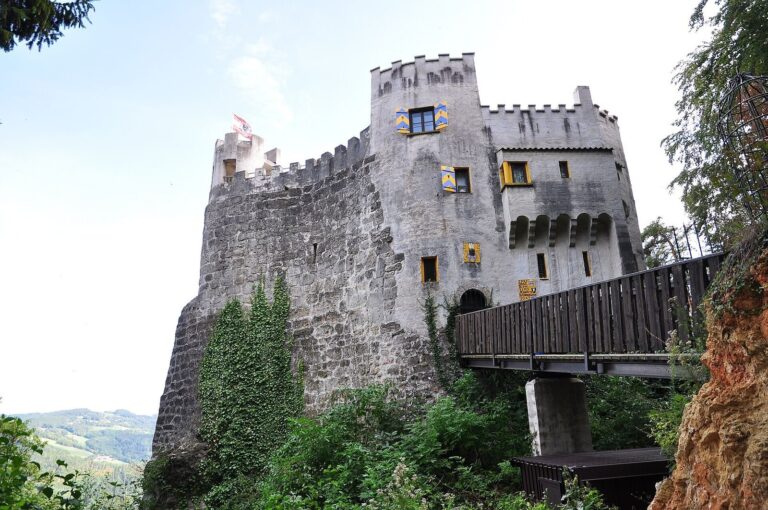
Bergfried
The round bergfried is built mainly of rubble stone and rises about 23 metres. Wooden floors divide it into seven storeys. Its former entrance was high above the present round-arched portal, and that entrance was blocked in the seventeenth century. The original roof was steeper and approximately twice as high as the roof visible today.
Entrance and Chapel
The historical entrance lay on the south side. A drawbridge formerly led to two gates, connecting the approach with the fortified complex. A chapel occupies a corner of the New Castle. Its triangular ground plan contains an Alpine winged altarpiece dating to about 1550 and marble sculptures of Saints Peter and Paul attributed to Nikolaus Gerhaert, a fifteenth-century sculptor active in the German-speaking lands.
Museum Collections and Interior Features
Weapons and Medieval Art
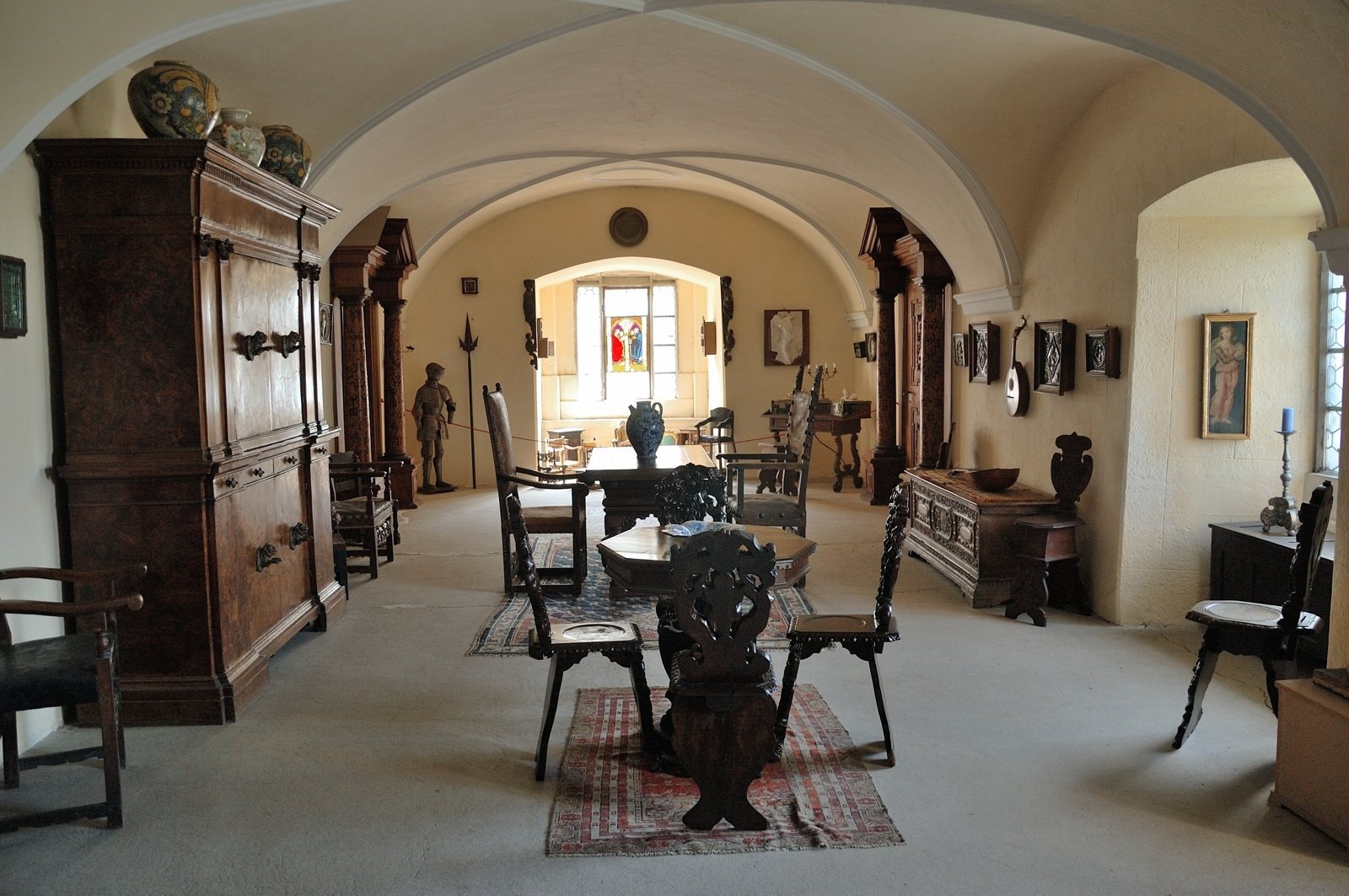
The castle museum contains historic weapons and armour, including original and reproduced pieces, as well as medieval paintings, tapestries, and other medieval artworks. Three rooms are devoted to the armoury. A Madonna statue by Veit Stoß, a major late-medieval sculptor, is displayed in the castle. A Madonna sculpture by Tilman Riemenschneider, a leading German sculptor of the late Gothic period, formerly stood there but was sold by the owners in 2004. Other works once kept at the castle were also sold abroad.
Library and Decorative Rooms
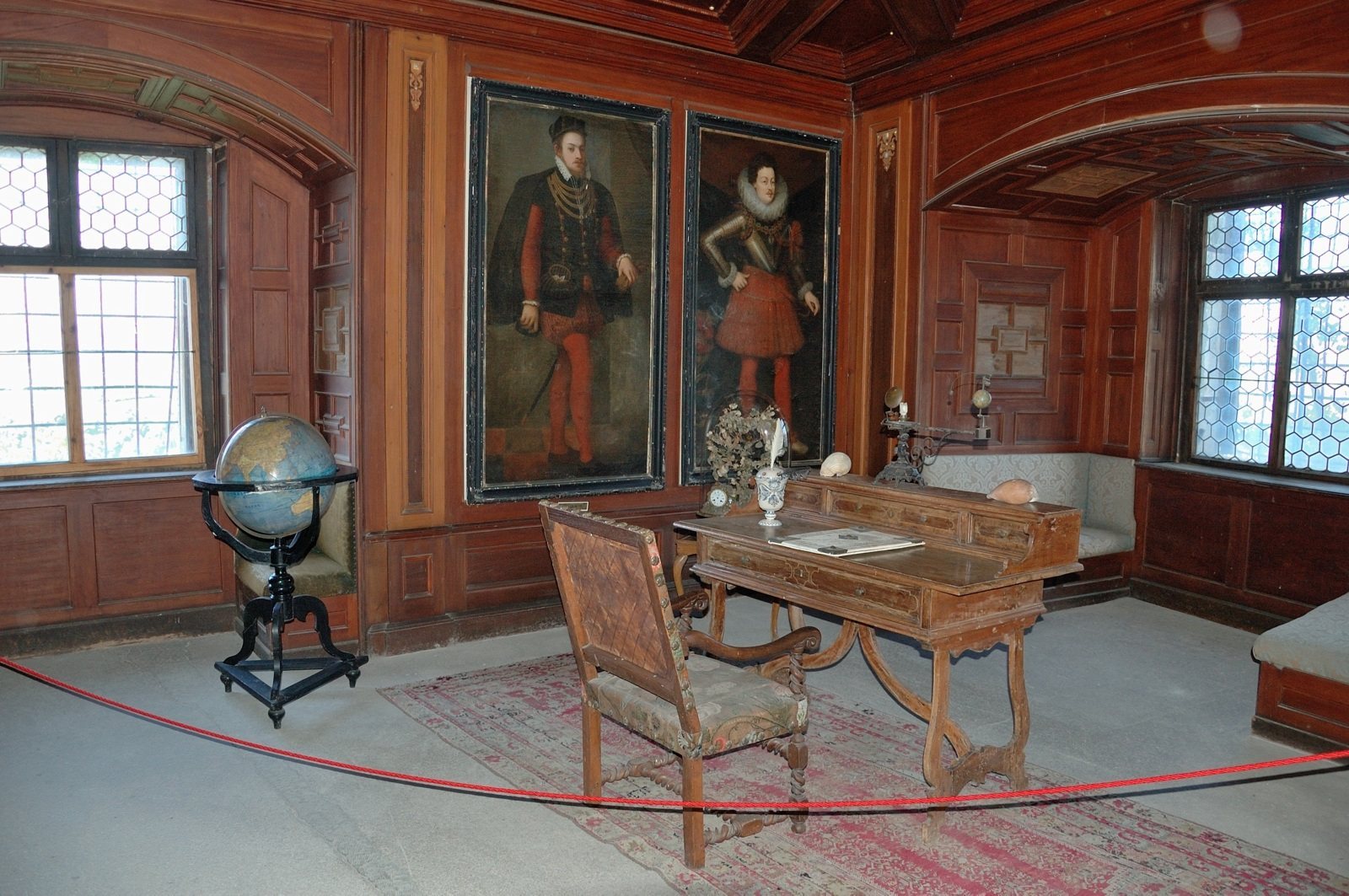
The library contains one of Peter Anich’s celestial globes. The Maria Hall, formerly used as a court, contains two Gothic Madonna statues. Other interior features include richly worked wooden doors, historic musical instruments in the Haydn Hall, and porcelain formerly belonging to Katharina Schratt.