Riberhus: A Medieval Royal Castle in Ribe, Denmark
Site at a Glance
- Rating
- 4.3
- Popularity
- Low
- Country
- Denmark
- Primary era
- Medieval
- External website
- Open
- Eras represented
- Medieval, Early Modern
- Civilizations
- Danish
- Site type
- Military
- Remains
- Castle
On this page16 sections
History
Riberhus is a Danish royal castle in Ribe, Denmark, probably built in the 1260s under King Eric V. During the Middle Ages, it was one of Denmark’s important royal castles, serving first as the seat of the king’s vassal in southwestern Jutland and as a center of local government. Until the fourteenth century, the itinerant Danish court also used Riberhus regularly as a royal residence.
Royal rule and medieval transformations
The castle first appears under the name Riberhus around 1320. A document connected with Christopher III’s accession that year ordered the demolition of all his castles in Jutland except Skanderborg Castle, Koldinghus, and Riberhus. This exemption reflects the castle’s continuing value within the royal network.
In 1330, Christopher II pawned Riberhus to Gerhard III, Count of Holstein. King Valdemar Atterdag reacquired it in 1383, as he re-established royal control over much of Denmark after a period of political fragmentation. Riberhus therefore passed through both royal and aristocratic control during a period when the Danish monarchy was consolidating its authority.
King Eric of Pomerania attempted to strengthen the castle’s defenses in 1428. Further extensions and additions followed, with the last major works carried out in the sixteenth century under Christian III, king of Denmark and Norway from 1534 to 1559.
Sixteenth-century administration and persecution
By the beginning of the sixteenth century, Riberhus had fallen into neglect. Christian III began its renovation in 1537, in a campaign dated more broadly to 1537–1543. Bricks from St John’s Priory were used in the work, linking the renewed royal complex to materials taken from a former religious institution.
The castle was administered by lensmen, royal officials who governed crown fiefs and often combined local governmental, financial, and military duties. Predbjørn Podebusk held the office from 1499 to 1537, followed by Johan Rantzau from 1537 to 1539 and Henrik Rantzau from 1540 to 1542. Claus Sehested served from 1543 to 1550, Jesper Krasze or Krasse from 1550 to 1554, Peder Bild from 1554 to 1558, Erik Rud from 1558 to 1559, and Niels Lange from 1559 to 1565.
Later lensmen included Axel Tønnesen Weffart, who served from 1565 to 1570, Erik Lykke from 1570 to 1580, Albert Friis from 1550 to 1594 and again from 1597 to 1601, Valdemar Parsberg from 1594 to 1597, Albert Scheel from 1601 to 1639, Gregers Krabbe from 1639 to 1651, Mogens Sehested from 1651 to 1655, and Otte Krag from 1655 to 1658. Otte Krag was the last lensman, after which Count Schack took over.
Witch burnings began at Riberhus during the period of Erik Lykke from 1572. During Gregers Krabbe’s tenure, Maren Splids was burned at the stake after being convicted of witchcraft during the period of the European witch trials.
War, decline, and later memory
Riberhus was damaged during the war with Sweden in 1659, one of the seventeenth-century conflicts between Denmark-Norway and Sweden. The castle was shelled from the town tower. After the Swedish Wars, it no longer had major military importance and fell into disrepair.
From 1685, Riberhus was used as a source of building materials and was subsequently demolished. During the eighteenth century, its stones and other materials were reused for church repairs and road construction in Ribe. The name survived in the administrative designation Riberhus Amt, which was used from 1662 to 1793.
Danish folk songs say that Queen Dagmar died at Riberhus on 24 May 1212. This tradition predates the probable construction of the castle, but it became part of Riberhus’s later historical and cultural identity. The National Museum of Denmark investigated and restored the castle bank in 1940–1941, including the re-excavation of the northern moat.
Remains
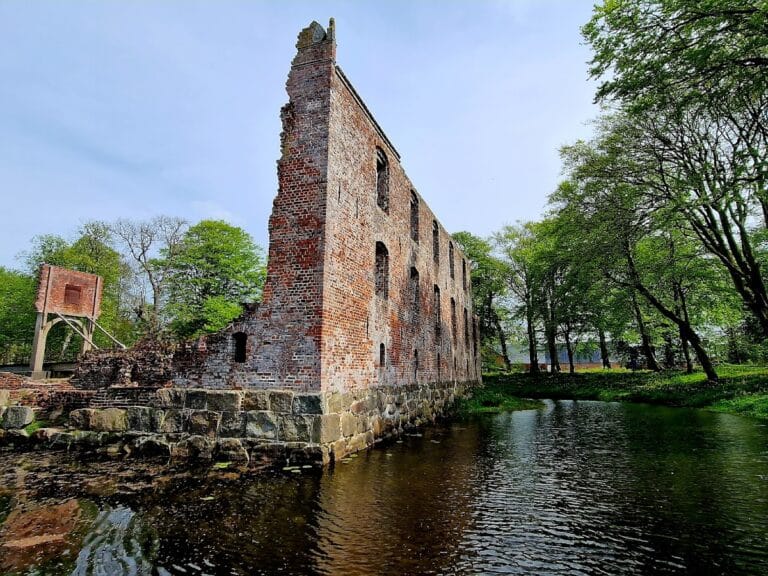
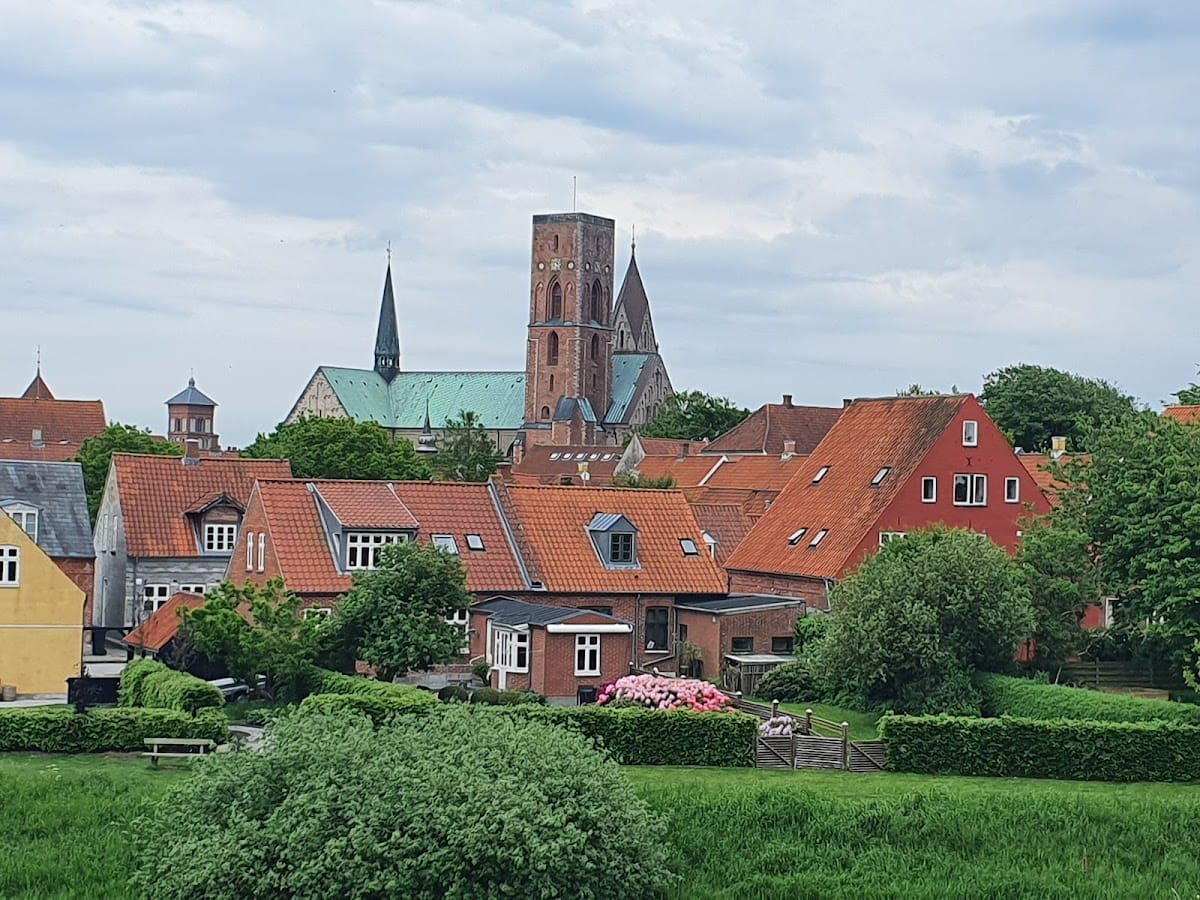
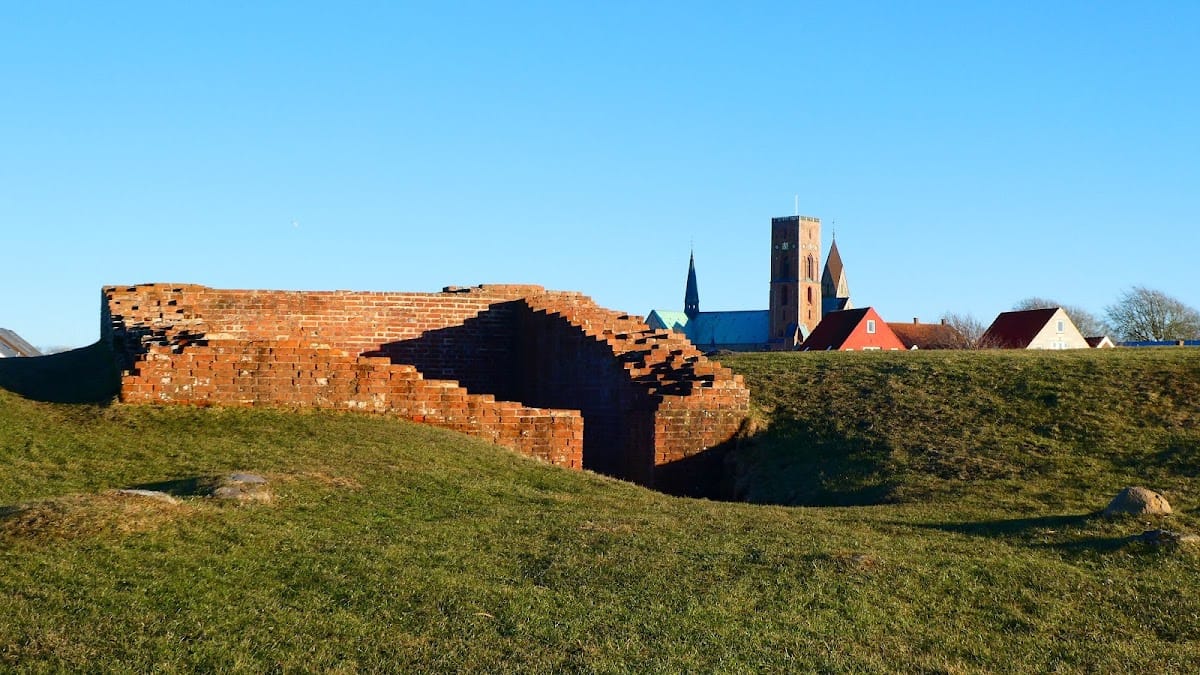
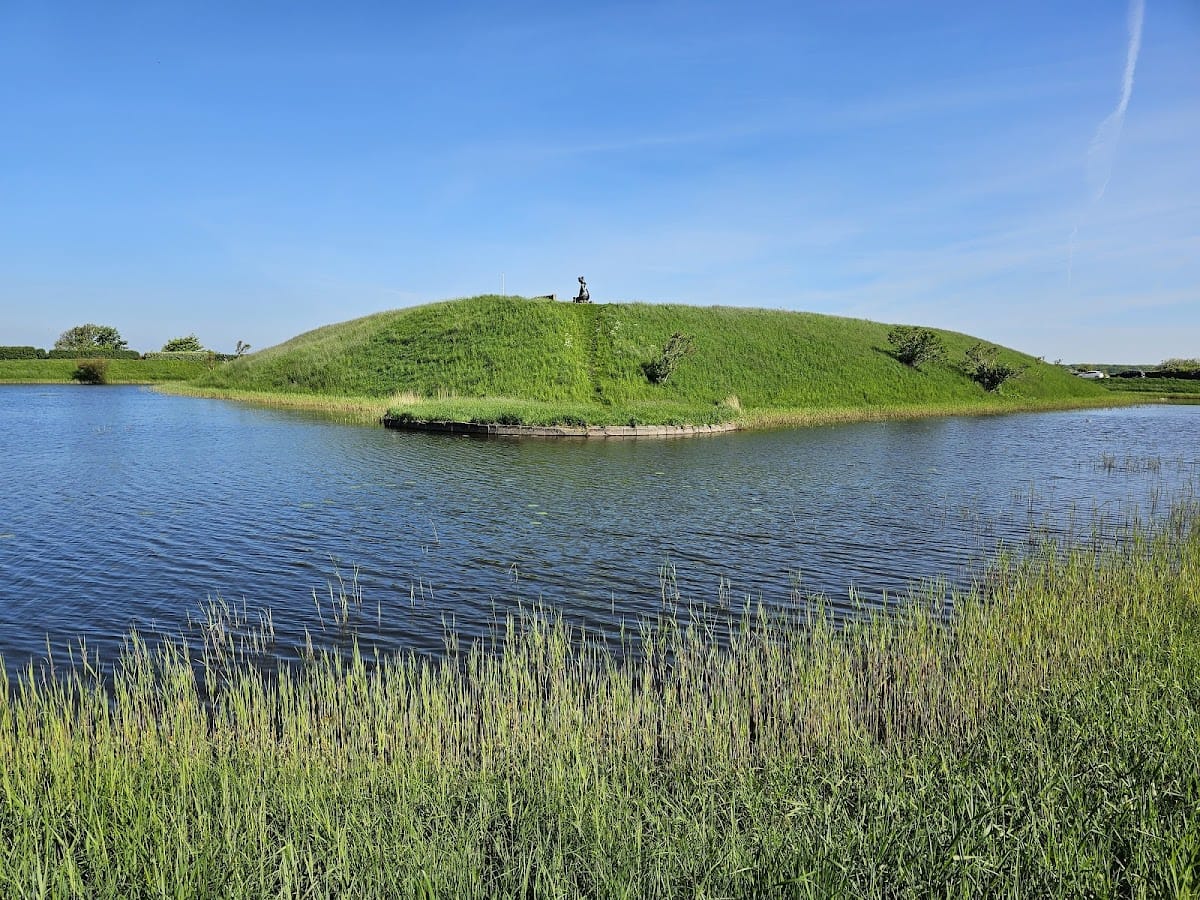
Riberhus survives as an approximately square castle bank measuring about 90 by 90 metres and rising roughly 8 metres above the surrounding marshland. Moats about 30 metres wide surround the earthwork. The site lies immediately northwest of Ribe, in marshland west of the town, and its visible remains include the moat, earthworks, limited wall fragments, a masonry sewer, the cellar of the Scribe’s House, and part of a corner tower.
Enclosure and access
Castle bank and moat
The square bank formed the raised enclosure of the castle, while the broad moat provided a surrounding water obstacle. A channel ran toward Stampemølleåen. Together, the earthworks, water defenses, and surviving masonry convey the basic arrangement of the medieval stronghold, even though much of its original construction material was later removed.
Causeway and bridge
Access to the castle bank was provided by a causeway crossing the moat from the north. The causeway is believed to have occupied approximately the same position as the present access route. In 1903, Ribe Tourist Association built a bridge across the moat at that location.
Buildings and defensive structures
Main building
The principal building stood inside the southwestern side of the enclosure. Its surviving remains were used in 1803 to construct the road to Ribe Plantage. A smaller building opposite the main building was used for the same road, leaving the castle bank with only limited traces of these structures.
Gate and southern tower
Excavations in the eastern corner in 1792 revealed two substantial parallel walls, believed to mark the position of a gate. A tower stood at the southern corner and could defend the entrance from the canal into the moat. The remains of a corner tower are still among the visible features of the site.
Steward’s house
A larger building opposite the causeway is thought to have been a castle steward’s house. Its position formed part of the arrangement around the approach to the enclosure, although the surviving evidence is limited.
Scribe’s House
The cellar of Skriverstuehuset, or the Scribe’s House, dates from the fourteenth century and survives at the eastern corner of the castle bank. This masonry remains is one of the clearest surviving building traces within the earthwork.
Memorial and survey feature
Queen Dagmar statue
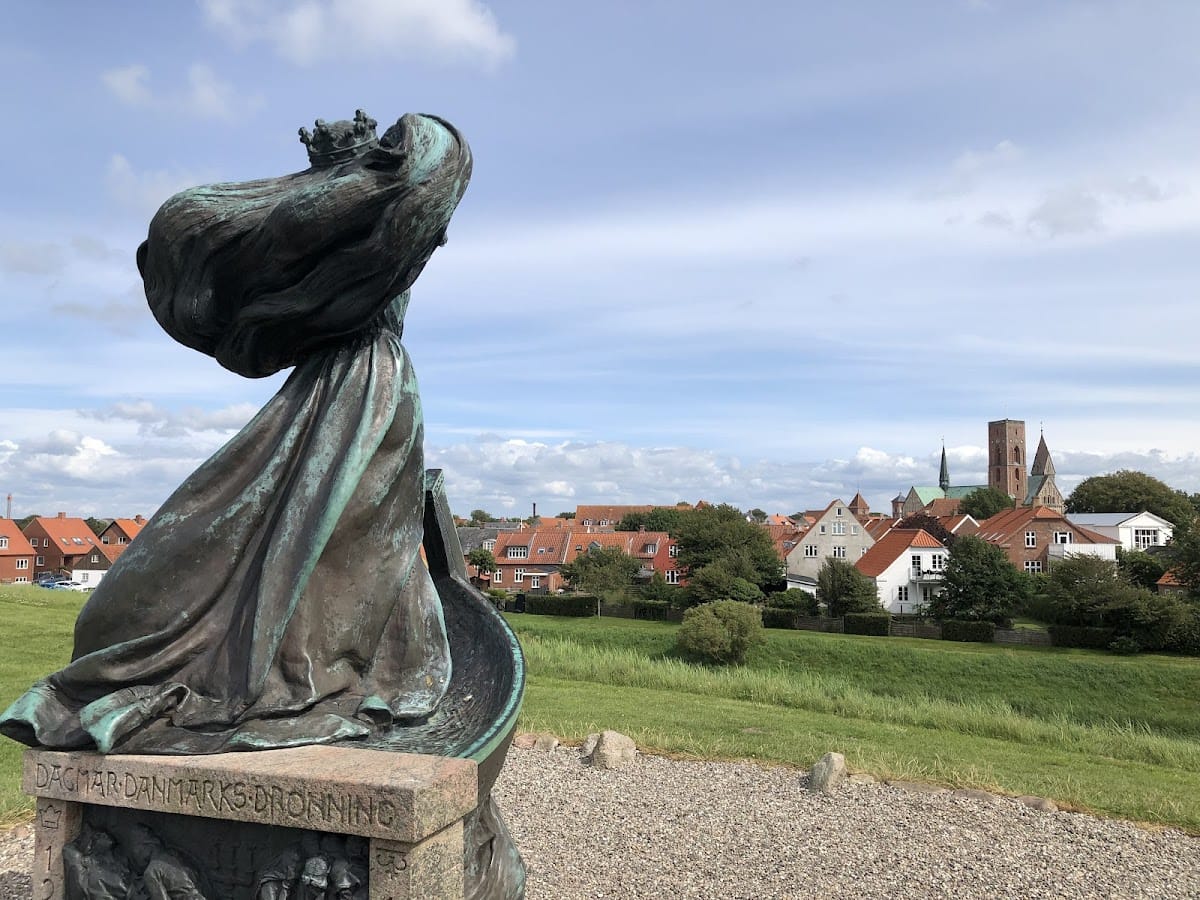
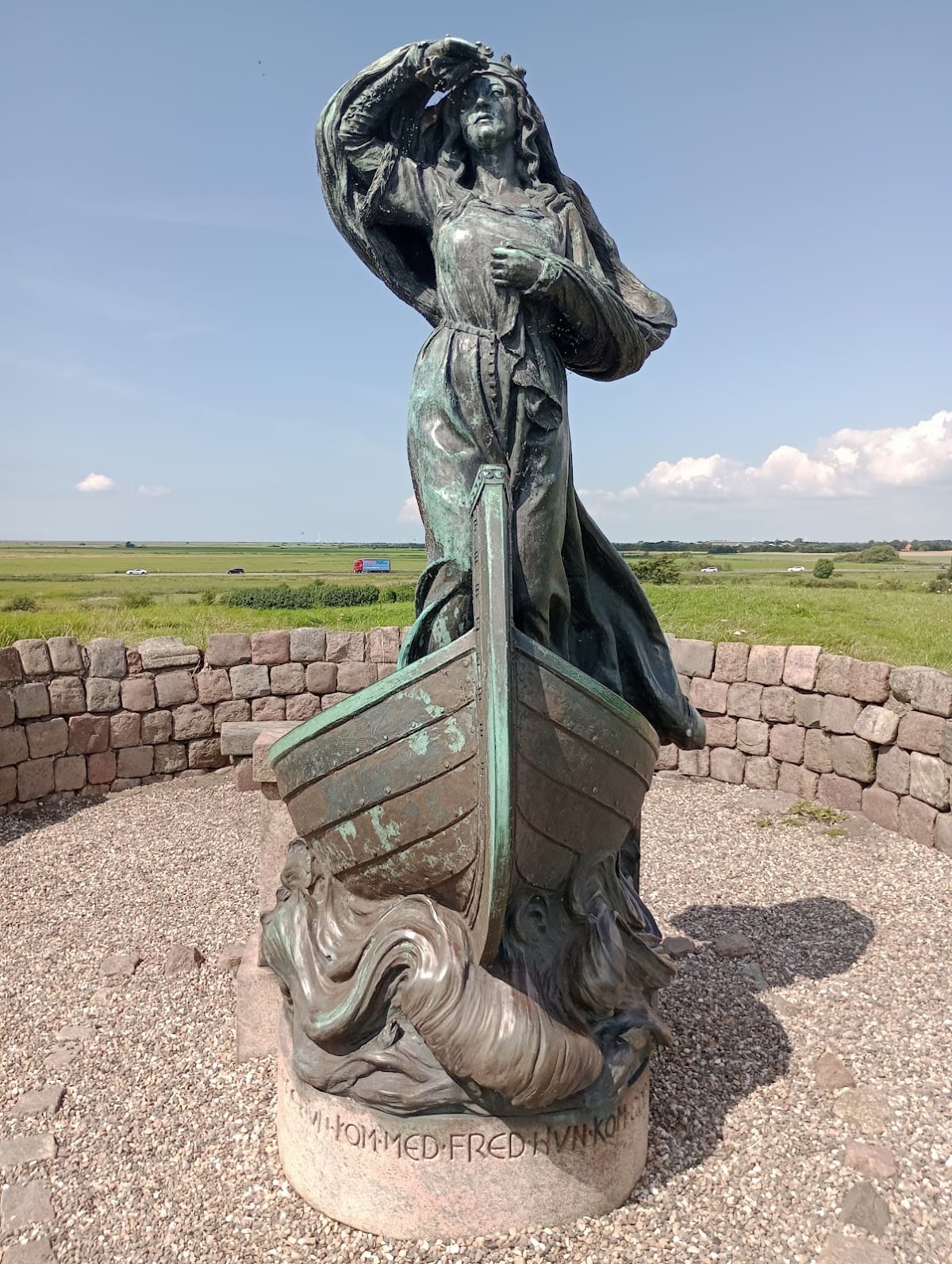
A bronze statue of Queen Dagmar stands at the southern corner of the castle bank. Made by the Danish sculptor Anne Marie Carl-Nielsen, it was inaugurated on 24 August 1913 and gives physical form to the later tradition linking the queen with Riberhus.
Triangulation station
A triangulation station, also described as a pedestal, is located at the northern corner of the bank. It forms a later survey feature within the surviving layout of the castle site.