Athenry Castle: A Medieval Anglo-Norman Tower House in Ireland


Site at a Glance
- Rating
- 4.4
- Popularity
- Low
- Country
- Ireland
- Primary era
- Medieval
- External website
- Open
- Eras represented
- Medieval
- Civilizations
- English, Norman
- Site type
- Military
- Remains
- Castle
On this page6 sections
History
Athenry Castle is a medieval Anglo-Norman tower house in Athenry, Ireland, built in the thirteenth century by the Anglo-Normans, the descendants and institutions of the Normans who conquered and settled in England and parts of Ireland. It is also known locally as King John’s Castle, King John’s Court, or Bermingham’s Court, although its construction began about twenty years after John, king of England from 1199 to 1216 and Lord of Ireland from 1177 to 1216, had ended his reign.
Foundation and expansion
In 1235, Richard de Burgh, the Anglo-Norman Lord of Connacht, granted Meyler de Bermingham, the second Baron of Athenry, permission to build a castle on his lands. Work on the first stone castle began around 1235 and was completed by about 1240. Meyler de Bermingham substantially enlarged the castle around 1250, creating the principal form associated with the site.
A settlement developed around the castle by about 1240. It included a market square and a parish church, and the castle and its owners remained associated with the Barons of Athenry.
Conflict and later occupation
In 1316, during conflict between Irish clans and Anglo-Norman settlers, Athenry Castle was attacked. The assault led to the construction of additional defensive walls around the castle and town.
During the fifteenth century, the Berminghams moved from the castle to a town house near the market cross in the main square. In 1596, during the Nine Years’ War, a late-sixteenth-century conflict in Ireland between forces aligned with the English crown and a coalition of Gaelic Irish leaders, the castle came into the hands of the O’Donnells, a prominent Gaelic Irish ruling dynasty from Ulster.
Athenry Castle was restored in 2005. It is a National Monument of Ireland and remains in state ownership.
Remains
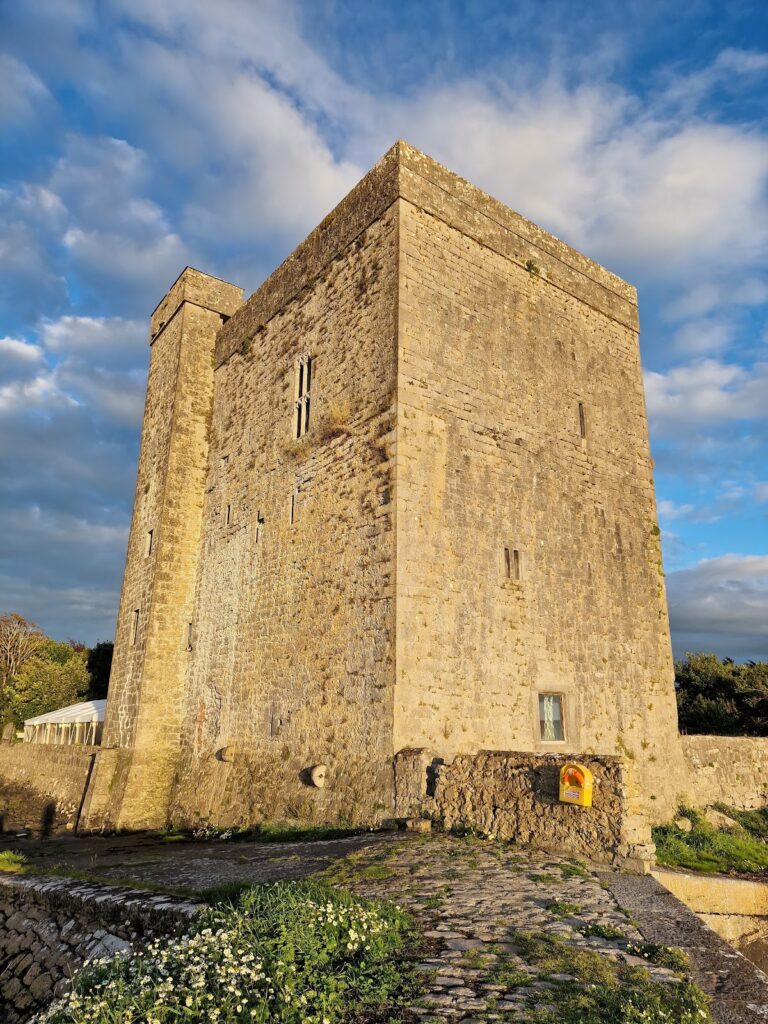
Athenry Castle stands off Court Lane in the eastern part of Athenry, on the west bank of the River Clarin. It occupies a natural rise positioned to defend a ford across the river. The surviving complex centres on a large rectangular tower house of rubble stone, with walls that slope outward at the base, together with parts of its original enclosure wall and corner defenses.
The tower house
The original tower, built around 1235 to 1240, was low and squat, with its roof approximately at the level of the present second floor. The building was extended around 1250. Its first arrangement placed a hall on the upper level and storerooms on the ground floor, combining domestic accommodation with the defensive purpose of a tower house, a fortified stone residence organized around a tall tower.
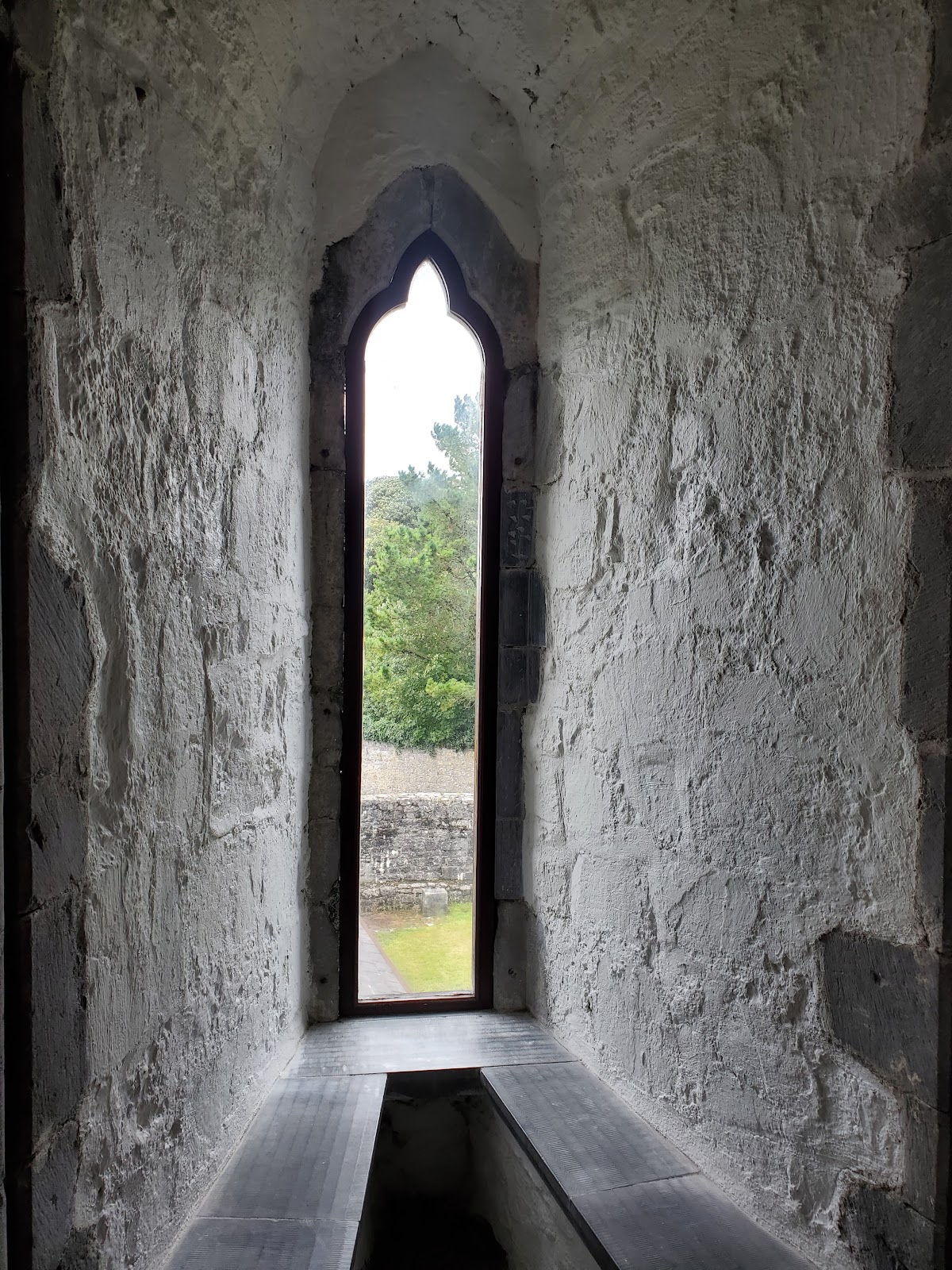
The thirteenth-century battlements contain tall arrowslits set in the raised sections between their openings. When a new roof was installed in the fifteenth century, the protective upper walls were incorporated into the north and south gables. The original entrance was at first-floor level and was reached by an external wooden staircase, while a stairway within the thickness of the wall led to the top floor.
The hall was probably heated by a brazier placed at its centre, with smoke escaping through a louver or roof opening directly above it. Diagonally opposite the main entrance is a garderobe, a medieval latrine built into a castle wall. Fine stone carving survives on the exterior of the doorway and on the inner sides of two window openings. Their capitals carry floral decoration in the local School of the West style, a regional form that combines Romanesque and Late Gothic elements.
Enclosure and defenses
Parts of the original enclosure wall survive around the tower. Wall towers stood at the northeast and southeast corners, while the southwest corner was defended by the gate. Additional defensive walls were built around the castle and town after the attack of 1316, adding to the fortified setting of the earlier structure.
Nearby sites