Castello di Uviglie: A Medieval Fortress and Noble Residence in Italy


Site at a Glance
- Rating
- 4.4
- Popularity
- Low
- Country
- Italy
- Primary era
- Medieval
- External website
- Open
- Eras represented
- Medieval, Early Modern, Modern
- Civilizations
- Holy Roman Empire, Italian, Kingdom of Sardinia
- Site type
- Domestic
- Remains
- Castle
On this page9 sections
History
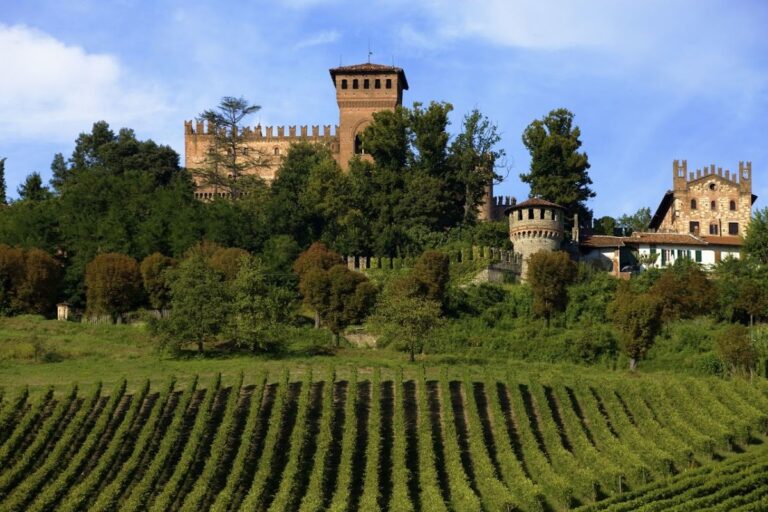
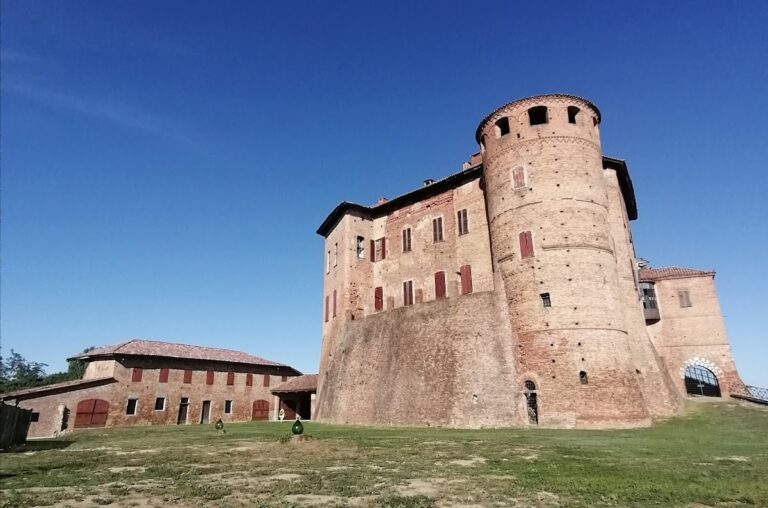
Castello di Uviglie is a medieval fortress in Italy, located at Uviglie, a hamlet of Rosignano Monferrato. Its construction belongs broadly to the thirteenth and fourteenth centuries, with the first fortification dated to the fourteenth century. The castle formed part of the historical territory of Monferrat, ruled by marquises, and later became a noble residence, religious institution, cultural meeting place, and wine-making property.
The Pocaparte foundation
The original fortification incorporated an earlier parish church dedicated to Saint Eusebius of Vercelli, a fourth-century Christian bishop and the patron saint of Vercelli. On 14 June 1322, Marquis Theodore I of Monferrat authorized the Pocaparte family, also known as Parvapart, to build a fortified residence at Uviglie. The family had left the communal consortium of Rosignano after the settlement became a free commune.
The fourteenth-century building campaign established the castle’s round tower, keep, and retaining wall. The fortress continued to serve a defensive purpose until the beginning of the eighteenth century. At the end of the fifteenth century, Antonio Pocaparte surrendered his feudal possessions to Maria of Serbia, regent for the young Marquis William IX, after Marquis John II Palaeologus imposed new taxes to recover places and castles pledged by his father, Theodore.
The Pico Gonzaga county
In 1499, Marquis Gian Giacomo Palaeologus granted Giovanni Antonio Pico jurisdiction over the castle and its fief. The Pico family later joined its name to that of the Gonzaga family, creating the Pico Gonzaga branch. In 1680, Ferdinand Charles Gonzaga-Nevers, Duke of Mantua and Monferrat, made the Pico Gonzaga family Counts of Uviglie and raised the fief to a county.
The Pico Gonzaga family lived at Uviglie for at least three centuries. They practiced alchemy and other sciences, and their interests contributed to the extensive esoteric symbolism of the interiors. During the period when Ferrante Gonzaga governed Monferrat, the castle also hosted his young son Luigi Gonzaga. Luigi later became a Jesuit and a saint associated with congregations caring for sick and needy people.
From fortified residence to country estate
At the beginning of the nineteenth century, the death of the last Pico Gonzaga descendant, Giovanni Antonio IV, transferred the county and castle to his daughter Felicita as a marriage dowry. Her marriage to Count Ignazio Callori of Vignale produced Luigia and Armodio. Armodio Callori commissioned alterations by the Vercelli architect Count Arborio Mella. The southern defensive walls were demolished, and the cleared ground became the park that survives today.
After Armodio’s death in 1879, ownership passed through his sister Luigia Callori, her marriage connection to the Massel family of Caresana, and the Bricherasio family. The Bricherasios used Uviglie for extended stays in the countryside and for hunting. They also connected the castle with the wider cultural life of Piedmont.
The Bricherasio circle and twentieth-century changes
Sofia Cacherano di Bricherasio, a painter and patron who had studied under Lorenzo Delleani, helped establish Uviglie as a cultural salon. The circle included Delleani, the sculptor Leonardo Bistolfi, the writer Edmondo De Amicis, and the cavalry captain Federico Caprilli. Sofia’s brother Emanuele Cacherano di Bricherasio was a founder and principal shareholder of the F.I.A.T. automobile company, whose founding deed was signed at Palazzo Bricherasio in Turin in 1899.
After Emanuele died at the Castle of Agliè in 1904, his inheritance passed to Sofia. In 1928, as the last unmarried descendant without heirs, she gave the entire castle to the Missionaries of the Consolata, a Catholic missionary institute, for use as a novitiate, an institution for the initial training of members of a religious order.
Following the Italo-Ethiopian War, the castle sheltered the daughter and young male grandchildren of Haile Selassie, emperor of Ethiopia from 1930 to 1974. Their refuge resulted from the direct intervention of Queen Elena of Savoy and the involvement of the Consolata Missions Institute in the Italian colonies of East Africa. During the Second World War, the remains of Giuseppe Allamano, founder of the Consolata missionary institute, were temporarily moved into the castle’s underground spaces for protection from heavy bombing in Turin.
In 1946, four years before her death, Sofia Cacherano di Bricherasio transferred the castle to the Salesian Institute for the Missions. At the beginning of the 1970s, benefactor families enabled its acquisition from the Consolata Missions Institute. The property was then restored and opened to public use, with a modern wine-making cellar added beside the historic cellars. The former defensive role had by then given way to residential, religious, cultural, and wine-making functions. The Piedmont Region has designated the park as a historic garden of botanical interest.
Remains
Medieval fortification
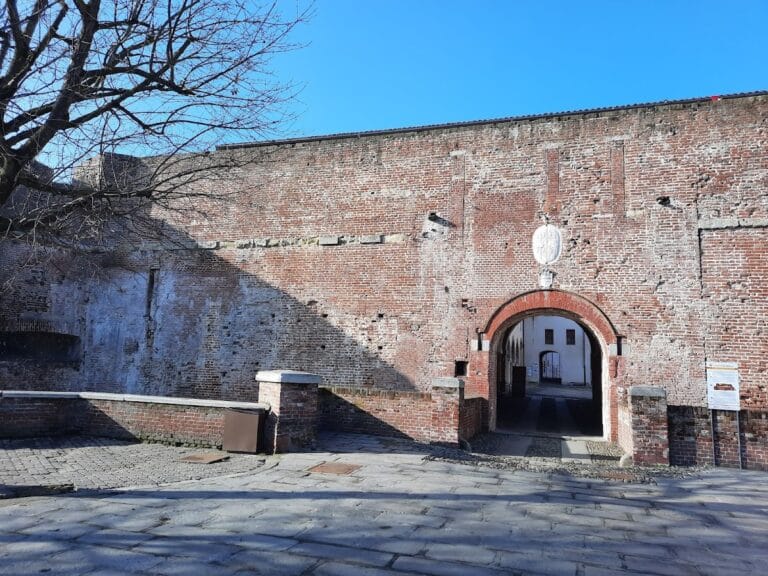
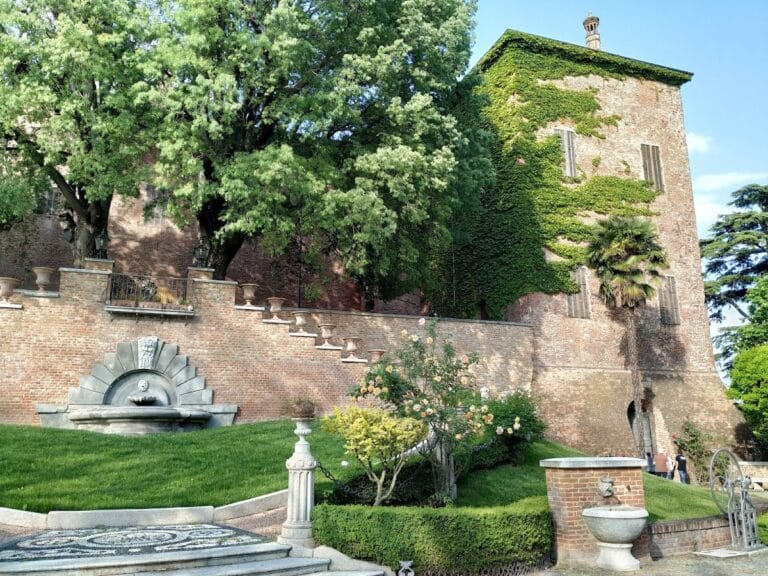
Castello di Uviglie stands on the hill of Uviglie along the road toward San Martino di Rosignano. Its medieval fabric incorporates the earlier parish church of Saint Eusebius of Vercelli. The original fortified complex included a round tower, a keep, and a substantial retaining wall that supports the later hanging garden, a garden arranged on a raised terrace.
Noble residence and wine cellars
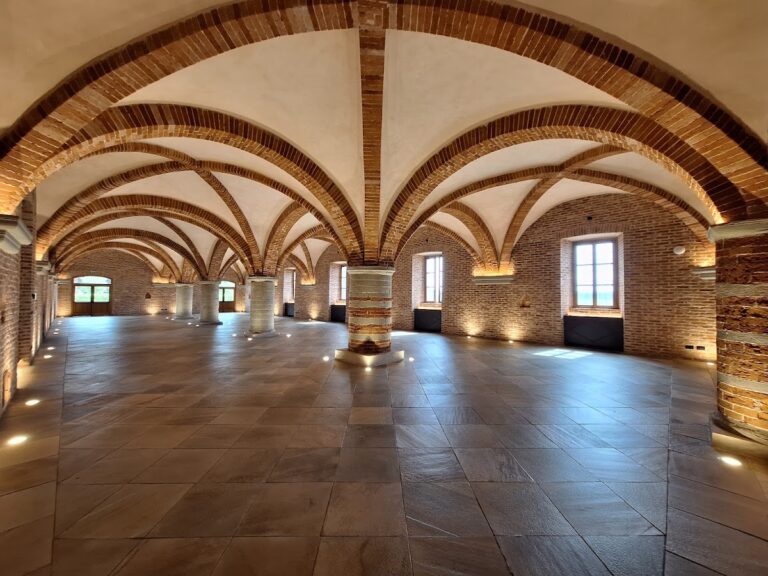
The castle was reshaped as a noble holiday residence, with large frescoed salons opening onto the hanging portion of a formal Italian garden. Beneath the salons of the noble wing are grand wine cellars containing ancient barrels, cooperage tools, and a private bottle collection. They preserve a wine-making tradition extending back to the Renaissance. A modern wine-making cellar stands beside these historic monumental cellars.
Park, chapel, and burial features
The predominantly Romantic-style park occupies the area created when the southern defensive walls were removed. Its plantings include trees suited to the local climate as well as species from Asia and the Americas. The grounds contain broad views over the surrounding territory and include a Cedrus libani.
The park also contains the Chapel of Saint Eusebius and the crypt of the Pico Gonzaga counts. A stone sarcophagus records the initial burial of Count Armodio. His remains and those of his wife, Lidia Thaon de Revel, were later transferred to the main cemetery of Casale Monferrato.