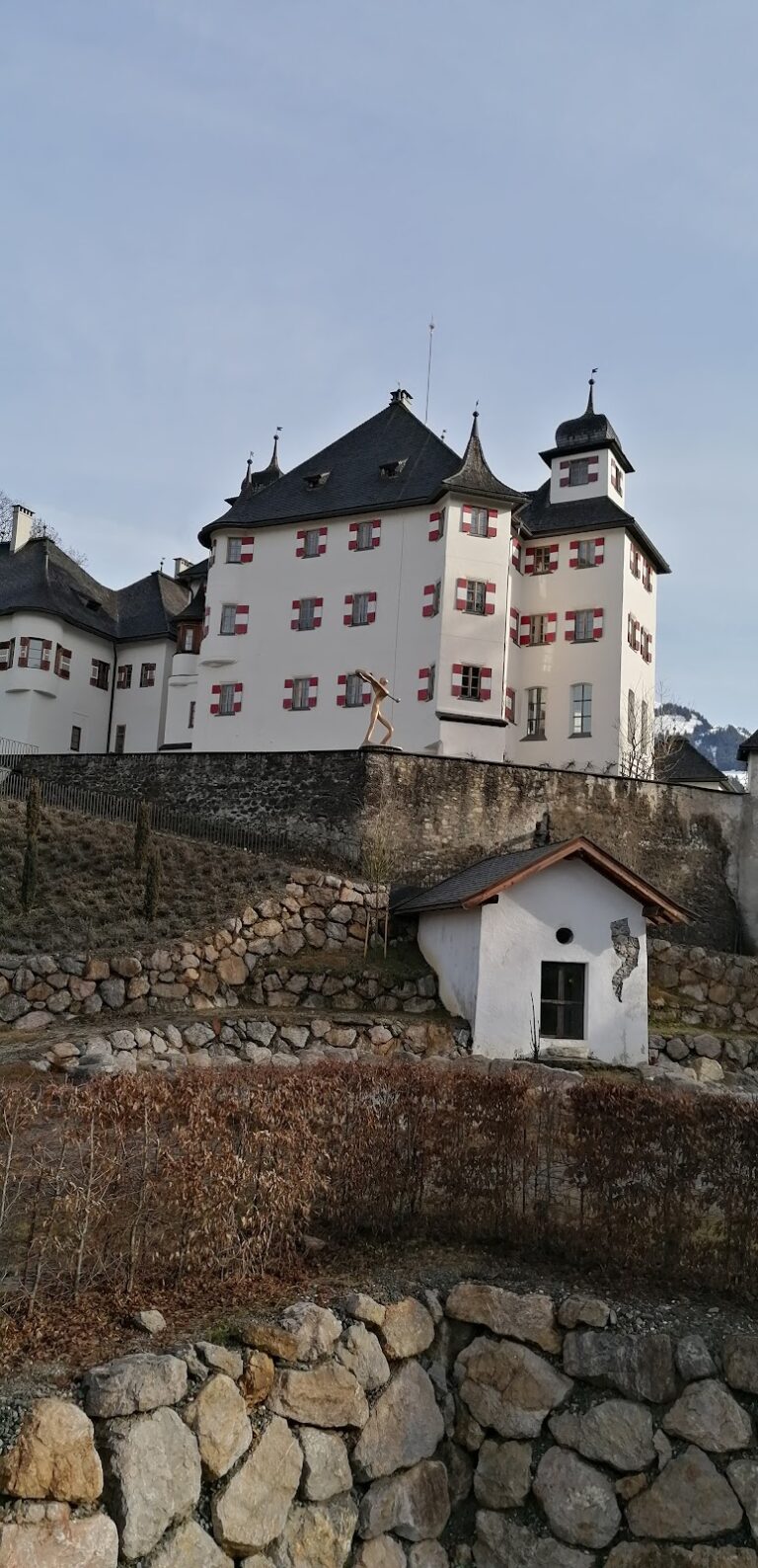
Mittersill Castle: A Medieval Administrative and Residential Fortress in Austria


Site at a Glance
- Rating
- 4.7
- Popularity
- Low
- Country
- Austria
- Primary era
- Early Modern
- External website
- Open
- Eras represented
- Medieval, Early Modern
- Civilizations
- Duchy of Bavaria, Holy Roman Empire
- Site type
- Military
- Remains
- Castle
On this page14 sections
History
Mittersill Castle in Austria is a medieval fortress on a spur above the Salzach Valley, with a castle on the site by about 1150. It controlled the Oberpinzgau valley road and routes toward Tyrol through the Pass Thurn and Felber Tauern, an area important to transalpine traffic between the tenth and fourteenth centuries. The castle also served as the seat of the Oberpinzgau district court.
Medieval foundations and Salzburg rule
The counts of Lechsgemünd, who held Oberpinzgau as a fief from the dukes of Bavaria, are regarded as the castle’s founders. They also used the titles counts of Sulzau and Pinzgau, and from 1180 the designation Mitersele. Around 1000, the area belonged to the counts of Matrei. About two centuries later it was held by the dukes of Bavaria, before passing by exchange to the Archbishopric of Salzburg in the twelfth century.
In 1228, Oberpinzgau became part of the Prince-Archbishopric of Salzburg. This was an ecclesiastical principality in which the archbishop exercised both religious and territorial authority. Mittersill Castle then became the seat of the archbishop’s administrative custodians for the region. Members of the Lords of Felben frequently held this office. Gebhart von Velben appears in 1292, Heinrich in 1344, Conrad and Hans in 1347, and another Heinrich between 1360 and 1363. Archbishop Pilgrim II of Puchheim used the castle as a residence for an extended period in 1388.
Rebuilding after revolt and fire
During the Peasants’ Revolt of 1526, a widespread uprising against social, economic, and religious grievances, the castle was captured, plundered, and burned. Archbishop Matthäus Lang von Wellenburg suppressed the rebellion with a mercenary army. He then compelled the rural population of Oberpinzgau to rebuild the castle and contribute 2,500 florins to the work.
The rebuilding gave the castle a more palace-like character while strengthening its defenses. A well was dug in the courtyard for use during sieges. The date 1528 was carved above the entrance arch, and the gate building was completed in 1537. The castle chapel followed in 1533, when the archbishop’s date and coat of arms were placed on its ceiling. A roof turret for a bell was added in 1562, followed in 1563 and 1564 by horse and cattle stables, baths, a defensive enclosure, and tiled stoves.
Fire struck the castle again in 1555, destroying the palas, the principal residential and representative building of a medieval castle, and the gatehouse beneath it. Local craftsmen rebuilt the damaged structures, including master builder Leopold Winckler and carpenter Gabriel Sayler. Another fire damaged the palas and gate room in 1597. Repairs were completed in 1606, when a fish tank was made in the castle ditch.
Later archiepiscopal and state administration
The chapel was described as unconsecrated in 1617, while its dedication to the Holy Trinity is recorded from 1673. A new shingle roof was installed in 1773, and a seven-foot stove was supplied for the princely chamber in 1774. The drawbridge was removed around 1800 or at the beginning of the nineteenth century.
Secularization of the Salzburg archbishopric in 1803 ended its political authority and brought major changes to the castle’s ownership and administration. A district court was established at Mittersill in 1816. Salzburg’s custodians nevertheless continued to live in and administer the castle until 1850. The closure of the castle chapel was ordered in 1845.
The Austrian state transferred the property in 1880 and 1881 to the Wels merchant Anton Hahn, who sold it in 1882 to Countess Marie Larisch-Moenich, born Baroness von Wallsee. She commissioned the Viennese architect Carl Gangolf Kayser to undertake a major renovation. The expense apparently exceeded her means, and in 1885 the property passed to Kayser’s son, Karl Georg Kaiser.
Further changes of ownership followed. Theodor Pöller acquired the castle in 1894, Michael Wahl, an Augsburg brewery director, in 1896, and Leopold and Marianne Philippi in 1903. Countess Eugenie Clary-Aldringen bought it in 1910, and Margareta Jernberg of Stockholm in 1919. The Munich academic painter Hugo von Grundherr zu Altentann acquired it in the same year, remodelled it romantically, and installed an art collection. Financial difficulties later led to its transfer to the Lammer Bank of Zell am See.
Sporting club, Nazi occupation, and forced labour
Baron Hubert von Pantz acquired Mittersill Castle in 1935 and established the International Sport and Shooting Club there. Its membership included aristocrats, industrialists, and film stars. Queen Juliana of the Netherlands and Prince Bernhard spent their honeymoon at Mittersill in 1937. In July 1938, probably after a lightning strike, a fire severely damaged the buildings. Complete repairs were not carried out until after the Second World War.
Following the German annexation of Austria in 1938, the castle was confiscated. Parts of it were occupied by the Reich Institute Sven Hedin for Inner Asian Research, an associated body of the SS organisation Ahnenerbe. The Ahnenerbe pursued ideological and pseudo-scientific research under Nazi rule. At Mittersill, researchers investigated plant varieties suitable for less favourable climates, including oil plants and cereals from Tibet and the Soviet Union.
From 24 March 1944, fifteen Jehovah’s Witness women transferred from Ravensbrück concentration camp were held at the castle as agricultural forced labourers. Ravensbrück and Mauthausen were Nazi concentration camps, while a subcamp was a smaller labour site administered by a main camp. Nine women were moved a few days later to the Lannach subcamp in Styria, another plant-research site administered from Mittersill. Six remained at the castle and were liberated by American forces on 8 May 1945. Some were subsequently returned to Mauthausen and released there, while two apparently remained in Mittersill. Their work mainly involved cleaning and office duties, under the supervision of a 52-year-old SS woman.
Postwar uses and preservation
After postwar renovation, the castle received prominent guests from the 1950s, including the Shah of Persia, the Dutch royal couple, King Farouk of Egypt, the Duke of Windsor, Aristoteles Onassis, the Aga Khan, Henry Ford II, Rita Hayworth, Gina Lollobrigida, and Clark Gable.
In the mid-1960s, the International Sport and Shooting Club decided to sell the property. C. Stacey Woods, then secretary-general of the International Fellowship of Evangelical Students, helped arrange its acquisition by the organisation in 1967. The International Fellowship of Evangelical Students is a Protestant student movement whose activities include Christian education and conferences. Mittersill Castle served as a Christian conference centre under the direction of Andrzej Turkanik.
Two local families acquired the castle in December 2009, making it locally owned in the Pinzgau for the first time. Careful restoration preserved its exterior appearance, and the property opened to the public as a four-star hotel in late 2011. The Republic of Austria has protected Mittersill Castle as a monument since 1993, under registration number 35448.
Remains
Layout and defensive structures
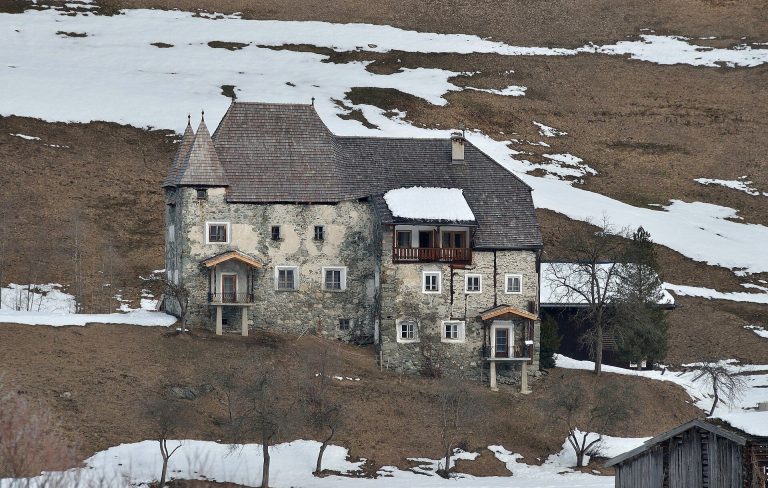
Mittersill Castle retains the architectural form of the sixteenth century despite repeated fires. Its buildings form a horseshoe or U-shaped plan linked by a continuous wall-walk, a protected walkway along or within a fortification. Two massive round towers rise above the western side. The original courtyard was open toward the valley on the south and closed there by a crenellated wall. A drawbridge once formed the approach before being removed around 1800 or in the early nineteenth century.
Entrance and court house
The main entrance is on the east. The approach to the almost level courtyard passes the building known as the Gerichtshaus, or court house. Beyond it, the courtyard is entered through a gate building projecting southward beneath the former palas. This gate building dates from 1537 and forms part of the surviving sixteenth-century arrangement.
Western towers and the former keep
The powerful round tower at the south-west corner is called the Hexenturm, or Witches’ Tower. Its upper storey contains the castle chapel. The medieval keep, a fortified central tower, was lowered during later renovation and incorporated into the surrounding buildings, so its remaining structure is integrated into the castle rather than standing visibly above the exterior.
Residential wing and chapel
Residential buildings
The east side of the courtyard is occupied by a two-storey residential wing. The palas has a north-south-oriented gabled roof with small half-hipped sections at both ends. At ground level, service buildings from the nineteenth and twentieth centuries occupy the position of a former wall-walk. The castle’s sixteenth-century form therefore survives together with later adaptations to its residential and service spaces.
Holy Trinity Chapel
The chapel in the upper storey of the Hexenturm is dedicated to the Holy Trinity. Its ceiling preserves the archbishop’s coat of arms and the date 1533, linking the room to the rebuilding phase after the Peasants’ Revolt. Inside is a Late Gothic winged altarpiece dating to about 1450, attributed to the Master of the Aussee Altarpiece.
Service and water installations
The castle originally included a courtyard well, horse and cattle stables, baths, a defensive enclosure, tiled stoves, and fish-tank installations in the castle ditch. The well belonged to the sixteenth-century strengthening of the castle and was intended to provide water during sieges. The fish tank was created in the ditch during repairs completed in 1606, while the stables, baths, enclosure, and tiled stoves were added in the 1560s.