Castello Orsini di Nerola: A Medieval Castle and Papal Residence in Italy


Site at a Glance
- Rating
- 4.3
- Popularity
- Low
- Country
- Italy
- Primary era
- Medieval
- External website
- Open
- Eras represented
- Medieval, Early Modern
- Civilizations
- Papal States
- Site type
- Military
- Remains
- Castle
On this page8 sections
History
Castello Orsini di Nerola is a medieval castle in Italy, situated above the town of Nerola and built in the Romanesque-medieval tradition between 1070 and 1085. The Orsini family began the work in 1070 while controlling the surrounding lands, and Gentil Virginio Orsini completed it in 1085. Built around an older fortification associated with the Prefetti di Vico, a medieval Roman aristocratic family linked with fortified territories near Rome, the castle became both an Orsini stronghold and an important papal residence.
Orsini foundation and papal residence
In 1085, Henry IV, the Holy Roman Emperor, stayed with the Orsini family at the newly completed castle. Henry’s imperial rule brought him into conflict with the papacy, making his presence there part of the castle’s early political history. The property was in Orsini possession by 1235, although its control had already changed in 1092, when Pope Urban II purchased it because he did not want a powerful, uncontrolled fortress close to Rome.
After the purchase, the castle became church property and an official papal residence. Popes Paschal II, Gelasius II, Callixtus II, Honorius II, and Innocent II stayed there. After the beginning of the Crusades, the popes stopped using the castle as an official residence, and funding for its repairs ceased.
Renaissance expansion and aristocratic use
After the Crusading period, the castle returned to the Orsini family. They restored it, embellished its interiors, and substantially enlarged the complex. The Renaissance expansion was designed by Francesco di Giorgio Martini, an Italian architect, engineer, painter, and sculptor known for work on military buildings and palaces. The enlarged castle included luxurious interior spaces and a richly decorated noble apartment.
During the late sixteenth century, Galileo Galilei stayed at the castle for a month. Taddeo and Federico Zuccari, prominent Renaissance painters, were commissioned to decorate the noble apartment. In 1591, the apartment accommodated Pope Gregory XIV while he sought refuge from the plague in Rome.
Later owners and cultural life
During the late seventeenth and early eighteenth centuries, ownership passed among the Odescalchi family, William III of England, and Queen Anne of England. The Odescalchi were an old family from Como. William intended to make the castle his official residence in Italy after his victory over James II, and Anne inherited it after his death.
Under Anne’s ownership, the castle became a center of intellectual and cultural life. It hosted Carlo Fontana, an artist and engineer, and Alessandro Marchetti, a mathematician, astronomer, and poet. John Lethbridge, an English inventor associated with an early diving suit, later acquired the property and conducted research there.
In 1730, the castle returned to Catholic Church ownership and again became a papal residence. Popes Clement XII, Benedict XIV, Clement XIII, Clement XIV, and Pius VI stayed there. Napoleon Bonaparte also visited while discussing his forthcoming marriage with the pope.
Decline, conflict, and twentieth-century changes
After 1819, the church ceased using the castle. It fell into neglect and remained largely uninhabited for almost a century. In 1867, during the campaign for the liberation of Rome, Garibaldian volunteers led by Menotti Garibaldi fought papal troops in and around the castle. The building also served as shelter for Garibaldini volunteers during the attack on Rome. The Garibaldini were supporters of Giuseppe Garibaldi, the nationalist leader of the Italian unification movement, while Menotti Garibaldi was his son and a military commander.
Giuseppe Meazza purchased the castle in 1930, repaired it, and expanded its gardens. After Italy won the 1934 football World Cup, the victorious national team celebrated at the castle. Meazza later refused to support the Fascist regime led by Benito Mussolini, who ordered the property’s transfer to the C.A.D.L. company. The company created a theatre for propaganda performances, and Mussolini subsequently gave the castle to Marquis Ferrari-Frey. After the marquis died in 1967, ownership returned to C.A.D.L.
From 1994, the castle was reconstructed and adapted for use as a luxury hotel. It is privately owned and operates as a five-star hotel and conference center.
Remains
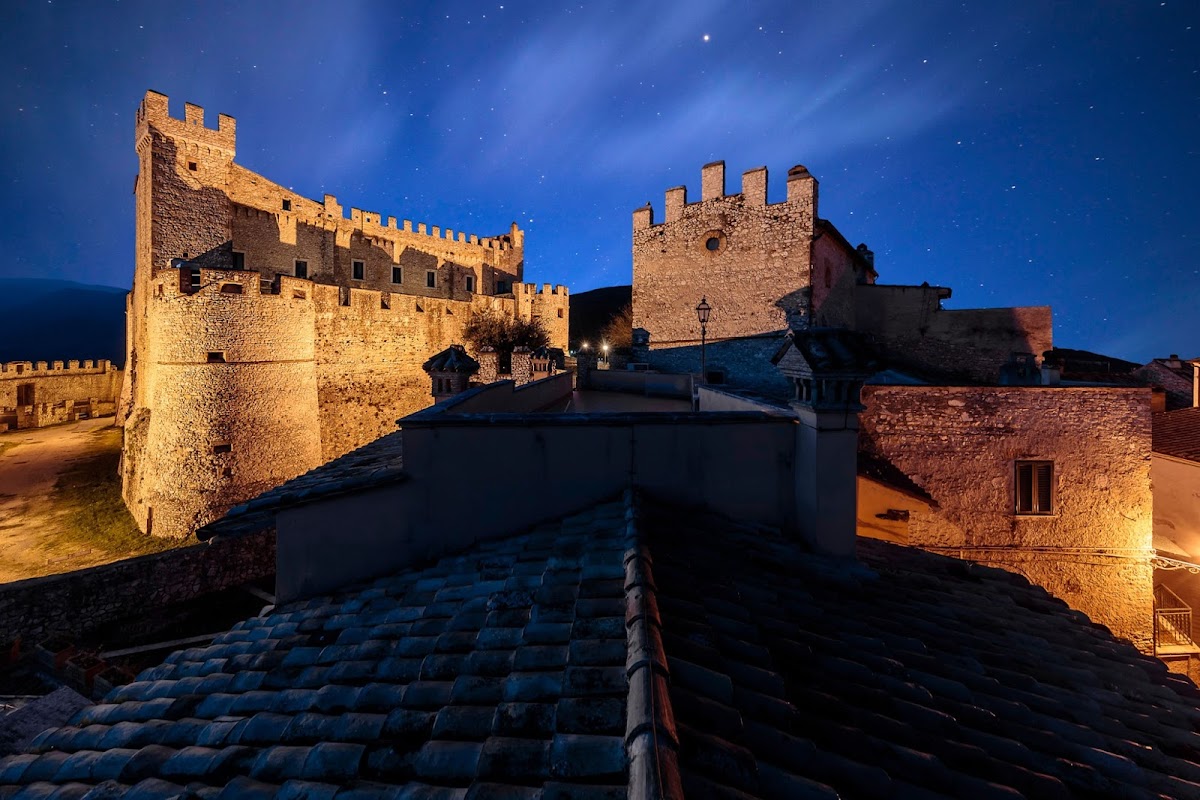
The castle occupies a hill above Nerola and has an almost regular square plan. Stone and brick form its principal materials. High walls with merlons, the raised blocks between openings in a battlement, enclose the complex, while four powerful corner towers rise above the outer defenses. Three towers are circular, and the northern tower is square.
Fortifications and entrance
A deep moat surrounds the exterior fortifications. A single bridge leads to the gate in the northwestern wall; the bridge was formerly a drawbridge. The exterior structure rises higher than the surrounding outer walls, giving the castle a strongly fortified profile. The defensive arrangement, with its enclosed square plan, towers, moat, and controlled entrance, preserves the physical character of a medieval stronghold.
Interior spaces and later adaptations
The complex contains interior buildings and a richly decorated noble apartment associated with the Renaissance enlargement. The former theatre created by C.A.D.L. was covered by a curtain or canopy and measured 13 by 13 metres, with a height of 5 metres. It could accommodate 200 spectators. The castle also retains one of Italy’s few surviving six-hour clocks.
Meazza’s work included the expansion of the surrounding gardens. The castle is now restored, and its historic buildings have been adapted for hotel and conference use.