Castle of Santa Maura: A Medieval and Ottoman Fortress in Greece
Site at a Glance
- Rating
- 4.4
- Popularity
- Low
- Country
- Greece
- Primary era
- Early Modern
- External website
- Open
- Eras represented
- Medieval, Early Modern
- Civilizations
- Ottoman, Venetian
- Site type
- Military
- Remains
- Castle
On this page13 sections
History
The Castle of Santa Maura in Greece is a fortress that began around 1300 as a small medieval stronghold controlling access to Lefkada from mainland Epirus. It was probably built by John I Orsini, the ruler of the County palatine of Cephalonia and Zakynthos, after he acquired Lefkada from his father-in-law, Nikephoros I Komnenos Doukas, Despot of Epirus, in 1295.
Orsini, Brienne, and Tocco rule
The Orsini family lost Lefkada to Walter VI of Brienne in 1331. In 1343, Walter ceded the island and the castle to the Venetian Graziano Giorgio. Leonardo I Tocco seized Lefkada in 1360 or 1362 and adopted the title of duke.
Under Carlo I Tocco, the castle became the capital of a wider domain that included the County palatine of Cephalonia and Zakynthos and much of the Epirote mainland. Carlo enlarged the fortified town, although settlement spread beyond the walls on both sides of the castle. In 1413, Centurione II Zaccaria, Prince of Achaea, attacked Lefkada with Albanian mercenaries, but Venetian assistance enabled the defenders to defeat him.
Ottoman raids in 1430 prompted the Tocci to consider transferring Lefkada to Venice. The island nevertheless remained under Tocco rule until the Ottoman conquest in 1479. Venice occupied Lefkada briefly in 1502 and 1503 during the Second Ottoman-Venetian War, then returned it to the Ottoman Empire under the peace settlement that followed.
Ottoman capital and reconstruction
Under Ottoman rule, the settlement within the fortress, known as Aya Mavra, remained the island’s capital. A register compiled between 1523 and 1536 counted 194 households and approximately 1,000 inhabitants, all Greek Christians, together with a garrison of 111 soldiers and nine artillerymen. The settlement’s lack of water led to the construction of a three-kilometre aqueduct in 1564, carrying water from the interior of the island to the castle town.
After the Ottoman defeat at the Battle of Lepanto in 1571, the Holy League, a coalition of Christian powers formed against the Ottoman Empire, unsuccessfully besieged the castle. Kapudan Pasha Kılıç Ali Pasha, the Ottoman Empire’s senior naval commander, then directed a complete rebuilding and enlargement of the fortress between 1572 and 1574. This Ottoman reconstruction gave the castle much of its later form.
By the visit of Evliya Çelebi in 1670 or 1671, approximately 200 stone houses inside the castle were occupied only by Muslims. Christians lived in two adjoining suburbs to the east and west and in another settlement elsewhere on the island. Evliya recorded a garrison of 1,085 men, while an Ottoman budget document from the same year listed 285. By the 1670s, an open settlement of approximately 700 to 800 houses had developed around the fortress.
Venetian conquest and military transformation
Venice conquered the fortress after a sixteen-day siege in 1684 during the Morean War, the Venetian-Ottoman conflict of 1684 to 1699. Under the Venetian commander Francesco Morosini, the walled town and its two adjoining suburbs were evacuated and demolished to strengthen the defensive ground around the castle. The capital moved to the remaining suburb, at the site of the present city of Lefkada, while the fortress became a strictly military installation.
Venice modernized the fortress by 1713. It was briefly abandoned and partly demolished in 1715 and 1716, when Venetian forces concentrated on defending Corfu after the Ottoman reconquest of the Morea, the historical name for the Peloponnese. Following the Venetian victory at Corfu, Lefkada was reoccupied and the fortifications were restored. They were repaired again after a local Greek rebellion in 1769.
French, Russian, British, and Greek periods
After the fall of the Venetian Republic in 1797, Lefkada passed to France. A Russo-Turkish expedition led by the Russian admiral Fyodor Ushakov captured the island in 1799, and Lefkada then became part of the Septinsular Republic, a short-lived self-governing state in the Ionian Islands under Russo-Ottoman protection. French rule returned in 1807 under the settlement associated with the Treaty of Tilsit, and Britain captured the island in 1810.
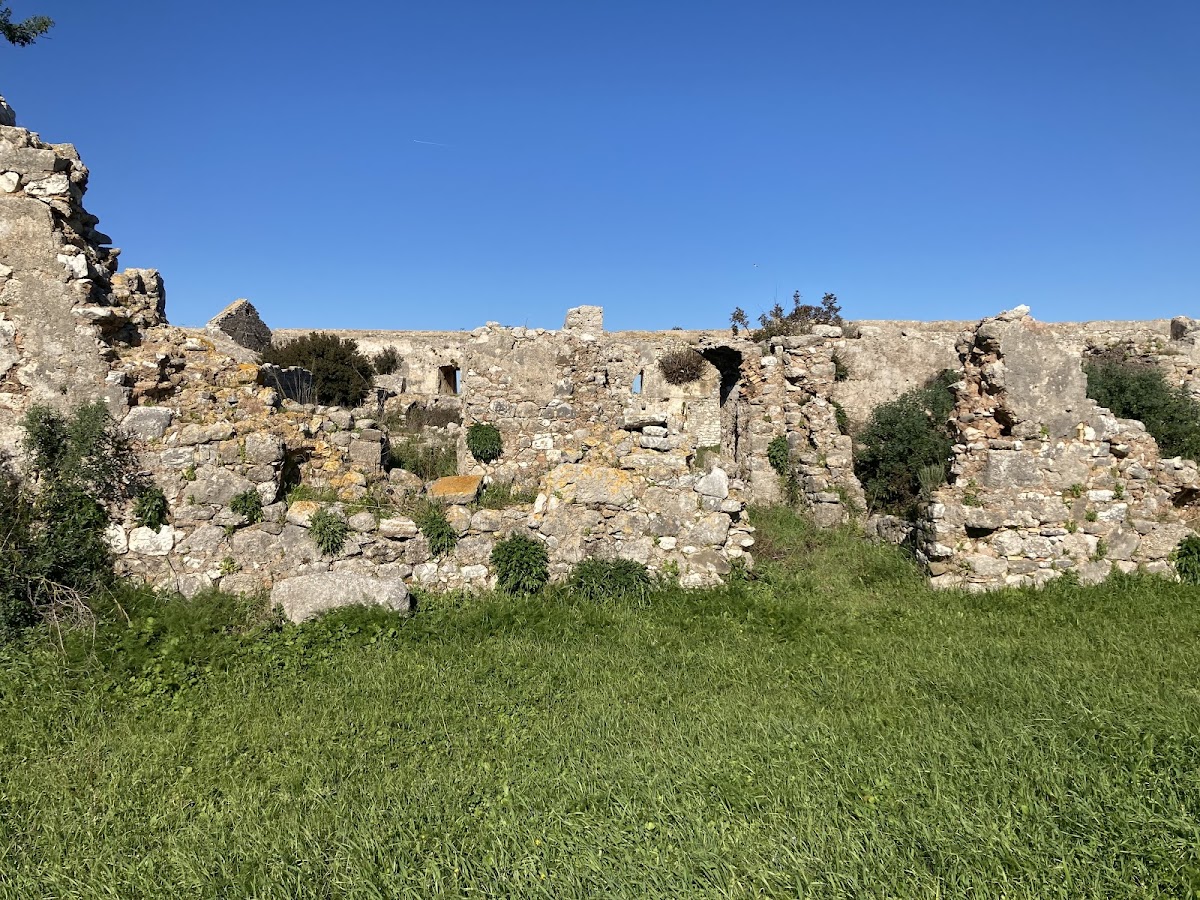
During the British protectorate, British troops garrisoned the castle and modernized some of its facilities. After the Ionian Islands were united with Greece in 1864, the Greek army continued to use the fortress as a garrison until 1922, when Asia Minor refugees were housed there. The fortress was eventually abandoned, and most buildings within its walls were demolished in 1938.
The castle and its associated archaeological site are classified in Greece as a castle and military base. Its history reflects successive periods of medieval, Ottoman, Venetian, French, Russian, British, and Greek control, while its changing role from capital to military installation shaped the survival of the site.
Remains
Setting and overall layout
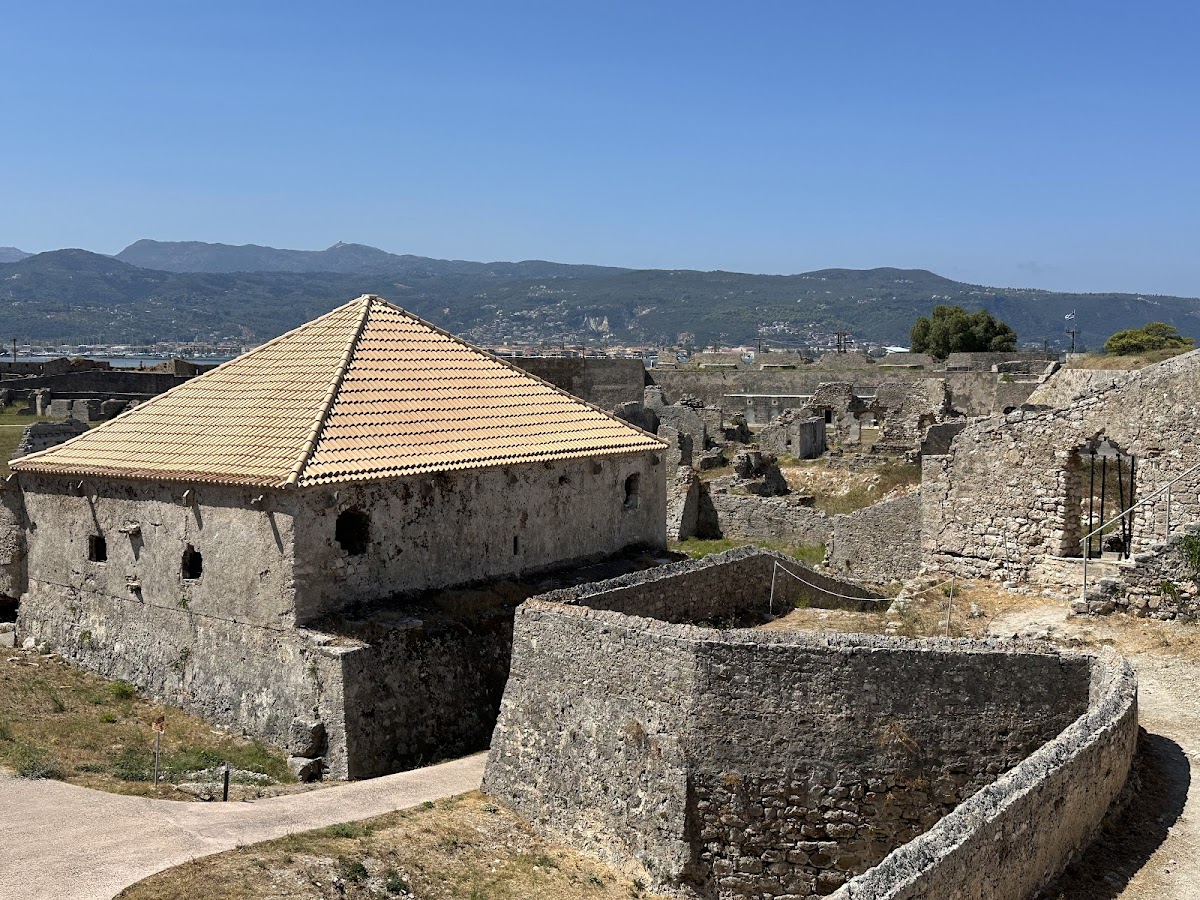
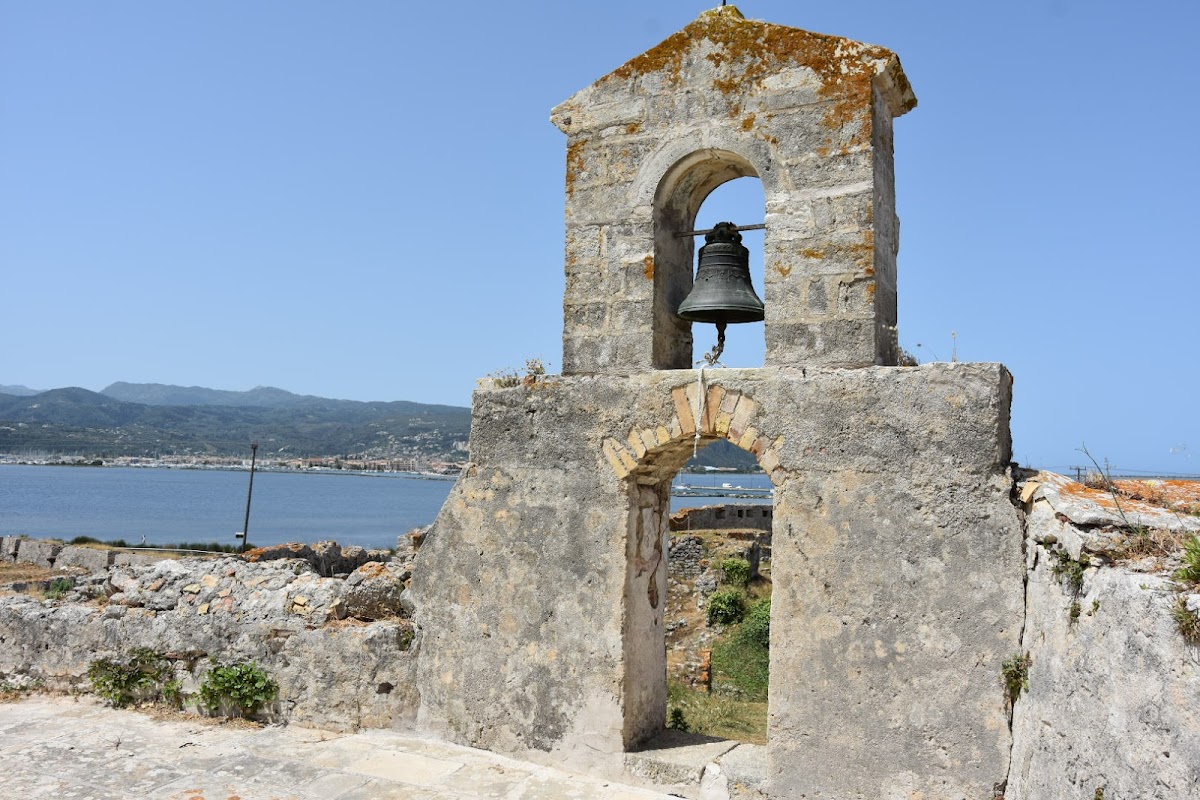
The fortress occupies a long, narrow sandspit projecting toward the mainland coast of Epirus. Its position controlled the approaches to Lefkada from the mainland. Access to the island was provided by sea and, historically, by a footpath running over the aqueduct.
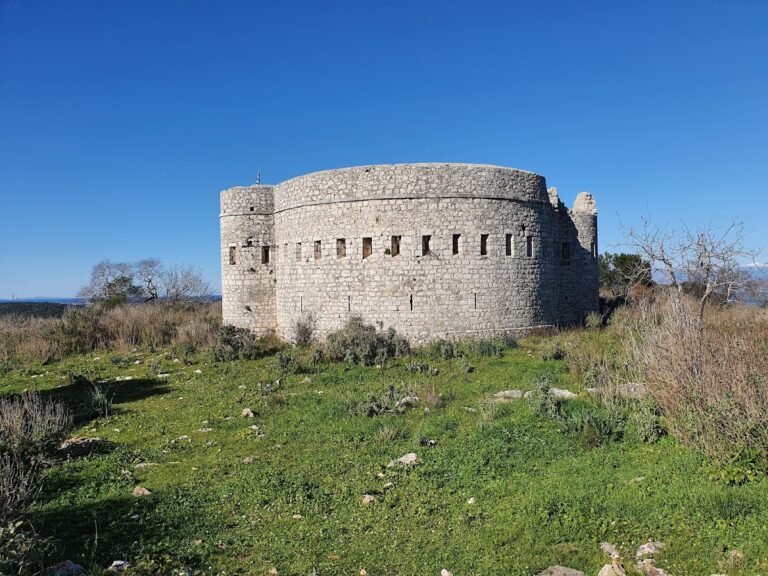
The earliest fortification probably stood in the northeastern corner of the present castle. It later grew into a walled town, which had become the island’s capital by the early fifteenth century. The Ottoman rebuilding of 1572 to 1574 produced an irregular hexagonal fortress measuring approximately 220 by 150 metres at its widest points. Hewn stone, or ashlar, was used in its construction.
Citadel and defensive works
Medieval citadel
The earlier medieval fortress was retained as a citadel in the northeastern corner of the Ottoman fortress. It formed the oldest core of the site and was incorporated into the larger defensive complex created in the sixteenth century. By 1713, the remains of this medieval citadel had been removed during Venetian modernization.
Ottoman fortress
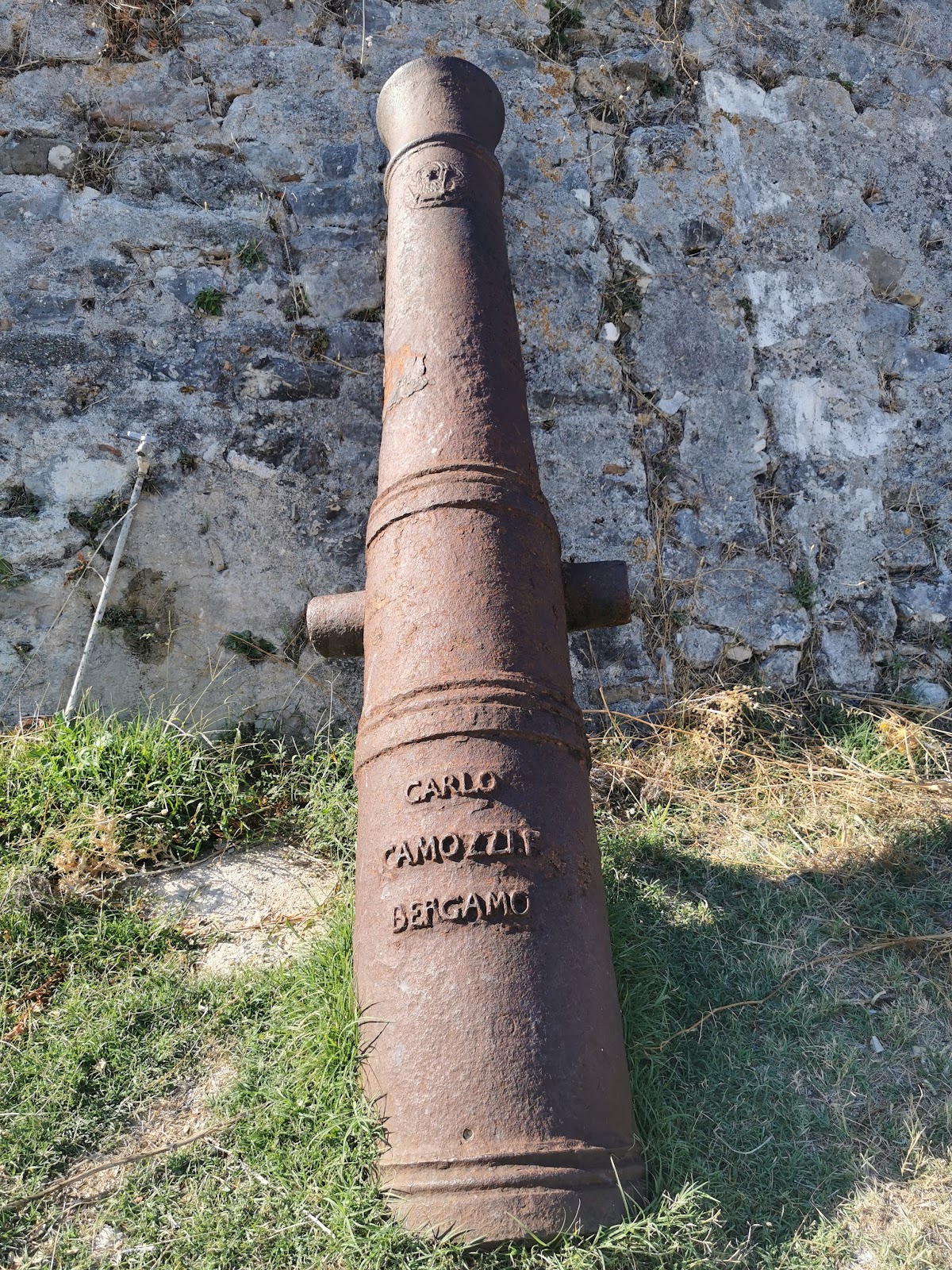
The enlarged Ottoman fortress contained nine large, round cannon bastions. The eastern ramparts, which faced the Ottoman-held mainland, were thickened and strengthened with two additional bastions, a ravelin, a forward defensive work, and a couvreface, an advanced structure shielding the main defenses. Further outworks were built along the fortress flanks.
The Venetian glacis, an open sloping defensive area outside a fortification, was formed from the ground created by demolishing the former walled town and the two suburbs immediately outside the fortress. The fortress was partly demolished during the Venetian abandonment of 1715 and 1716 and later restored. Its facilities were modernized further under British rule, while most buildings within the walls were demolished in 1938.
Water supply and settlement
Aqueduct
The aqueduct built in 1564 extended for three kilometres from the interior of the island to the castle town. It supplied both the walled settlement and the larger open settlement outside the fortress. A footpath ran along its top, making it part of the historic approach to the island as well as part of the castle’s water-supply system.
Houses inside and outside the walls
The Ottoman settlement within the fortress contained approximately 200 stone houses. The surrounding suburbs were built differently, with their buildings deliberately constructed of wood. These settlements formed part of the broader urban complex that developed around the castle before the Venetian evacuation and demolition of the walled town and adjoining suburbs.