Inowłódz Castle: A Gothic Royal Fortress in Poland

Site at a Glance
- Rating
- 4.4
- Popularity
- Medium
- Country
- Poland
- Primary era
- Medieval
- External website
- Open
- Eras represented
- Medieval, Early Modern
- Civilizations
- Kingdom of Poland, Polish–Lithuanian Commonwealth
- Site type
- Military
- Remains
- Castle
On this page8 sections
History
Inowłódz Castle is a Gothic royal castle in Poland, built at Inowłódz during approximately 1356–1366 under King Casimir III of Poland, also known as Casimir the Great. It guarded a customs chamber at a ford across the Pilica River on the trade route linking Lviv, Sandomierz, and Toruń. Alongside Łęczyca Castle, it was one of two royal castles in the Łęczyca region.
Royal foundation and administration
The castle is first mentioned in the fourteenth-century Chronicle of Janko of Czarnków. Written evidence and archaeological research place its construction in the reign of Casimir III, whose rule was associated with extensive royal building and fortification projects. The site’s position at a river crossing gave it both a defensive purpose and an administrative role, since the customs chamber collected duties on goods passing through the transit point.
Piotr Tłuk of Stryków, a member of the Jastrzębiec family, was the first recorded castellan of Inowłódz. A castellan was a royal official responsible for administering a castle and its surrounding district. Tłuk was a trusted official of King Władysław Jagiełło, who ruled Poland from 1386 and was also grand duke of Lithuania. By the end of the fourteenth century, the castle belonged to Jan and Abraham of the Nowodworski family, associated with the Nałęcz coat of arms. In 1393, Jagiełło bought it back and returned it to royal ownership because of its important location.
The Drzewicki period
In 1515, Adam Drzewicki received royal permission to purchase the Inowłódz starosty from Leżeński, the castellan of Małogoszcz. A starost was a royal official commonly responsible for managing a territorial estate or district. From that time, Inowłódz became the property of the wealthy Drzewicki family, whose best-known representative was Maciej Drzewicki.
The castle experienced a major rebuilding between 1521 and 1526, probably in connection with Adam Drzewicki, the brother of Bishop Maciej Drzewicki. While the family residence at Drzewica was being enlarged, Adam moved his family to Inowłódz. This phase brought the castle its most substantial rebuilding and strengthened the complex. The town and castle were later destroyed by fire, and the site passed through four rebuilding phases: around the turn of the fourteenth and fifteenth centuries, during the first quarter of the sixteenth century, in the second half of the sixteenth century, and in the mid-seventeenth century.
After Adam Drzewicki and Bishop Maciej Drzewicki died, the Inowłódz estates passed to Adam’s sons. Maciej Drzewicki (1503–1575) served as a royal secretary and custodian of Łęczyca, while Adam Drzewicki, who died in 1569, was Inowłódz starost from 1561.
War, destruction, and ruin
In the mid-seventeenth century, ownership passed to the Lipski family, associated with the Łada coat of arms. From 1648, the Inowłódz starost was the royal courtier Jan Olbracht Lipski of Lipie, who began another rebuilding campaign.
The work was interrupted by the war with Sweden. On 9 September 1655, Polish-Lithuanian Commonwealth forces clashed with Swedish troops at Inowłódz. An uprising against the Swedish forces also broke out in the Inowłódz and Piotrków region that year. During the Swedish Deluge, the Swedish invasion and occupation of much of the Polish-Lithuanian Commonwealth between 1655 and 1660, the castle changed hands several times.
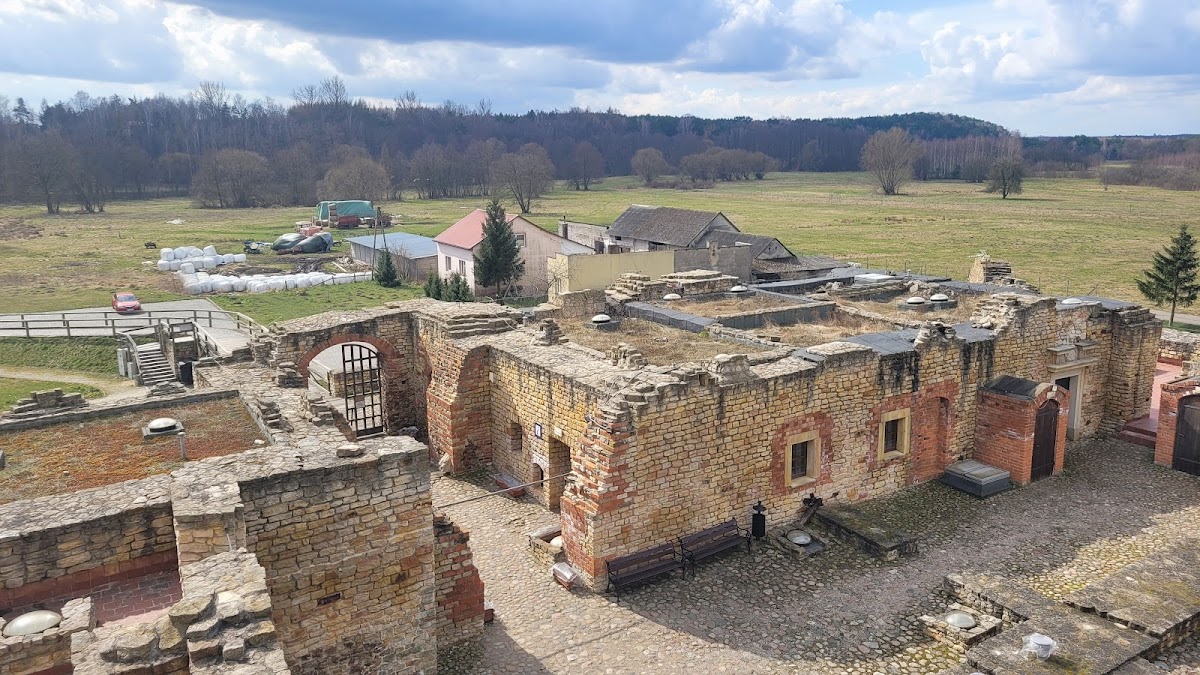
Military operations in 1655–1657 destroyed the castle. It ceased to serve defensive functions and gradually fell into ruin. For more than 300 years after the Swedish Deluge, it was not restored. During the nineteenth century, local inhabitants dismantled parts of its walls and buildings for building stone. In 1880, the Łódź manufacturer Antoni Urbanowski also used stone from the ruins to reinforce the banks of the Pilica for a planned project.
Investigation and reconstruction
The first scientific investigations of the remains began in 1949, after the end of the Second World War. During the period of the Polish People’s Republic, plans were prepared to secure the remains and preserve them as a permanent ruin, meaning a stabilized historic ruin retained without full reconstruction. Lack of funds prevented those plans from being implemented.
From 2007, the ruins were included in plans for reconstruction and rebuilding with financial support from the European Union. The project reconstructed the castle rather than preserving it solely as an unrestored ruin. The rebuilt complex was intended to accommodate local institutions, including a cultural centre, library, tourist-information point, and the Museum of the Inowłódz Region. Inowłódz Castle is a protected immovable monument in Poland, entered in the heritage register under number 767 on 27 December 1967.
Remains
Layout and defenses
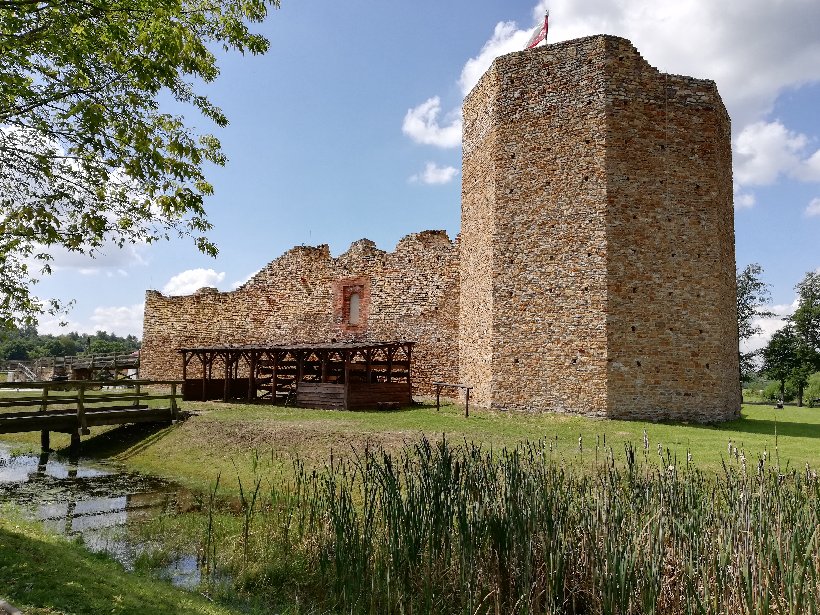
The castle was built in the Gothic style on a rectangular plan. It originally covered approximately 1,500 square metres, increasing to about 1,690 square metres after its first rebuilding. Its total usable floor area was 1,250 square metres. Two octagonal corner towers, each approximately 10 metres in diameter, formed part of the defensive arrangement. A curtain wall, the enclosing defensive wall between towers and interior buildings, surrounded the castle and was approximately 2.4 metres thick.
Water defenses and reconstructed buildings
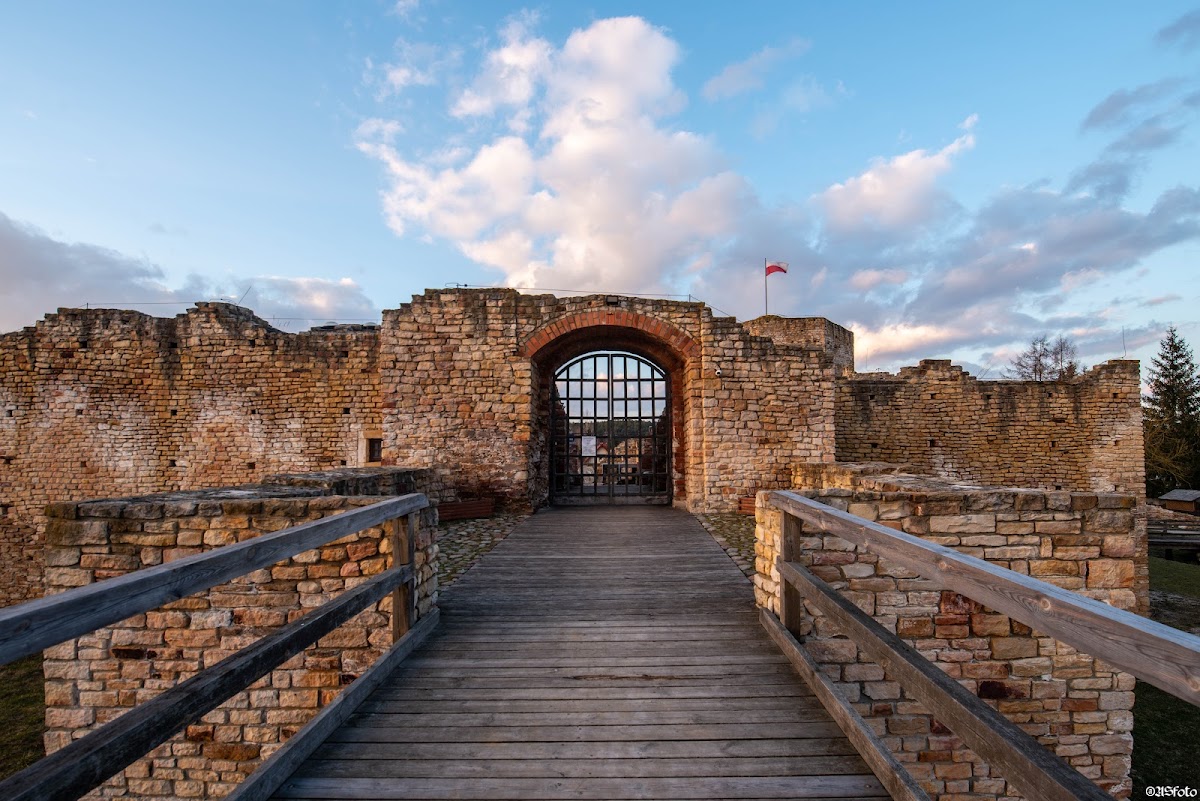
The fortification was accompanied by a moat supplied with water from the Pilica River and crossed by a wooden bridge. Nineteenth-century dismantling removed parts of the walls and buildings, while later archaeological research examined the surviving remains. The reconstructed complex includes the castle gate, a meeting hall, and a tower, incorporating the principal elements presented by the post-2007 rebuilding project.